Vercel AI SDK Releases @ai-sdk/xai 5.0.8: Adds Missing Video and Responses API Provider Options

Vercel AI SDK patches @ai-sdk/xai to 5.0.8, filling in missing video and Responses API provider options.
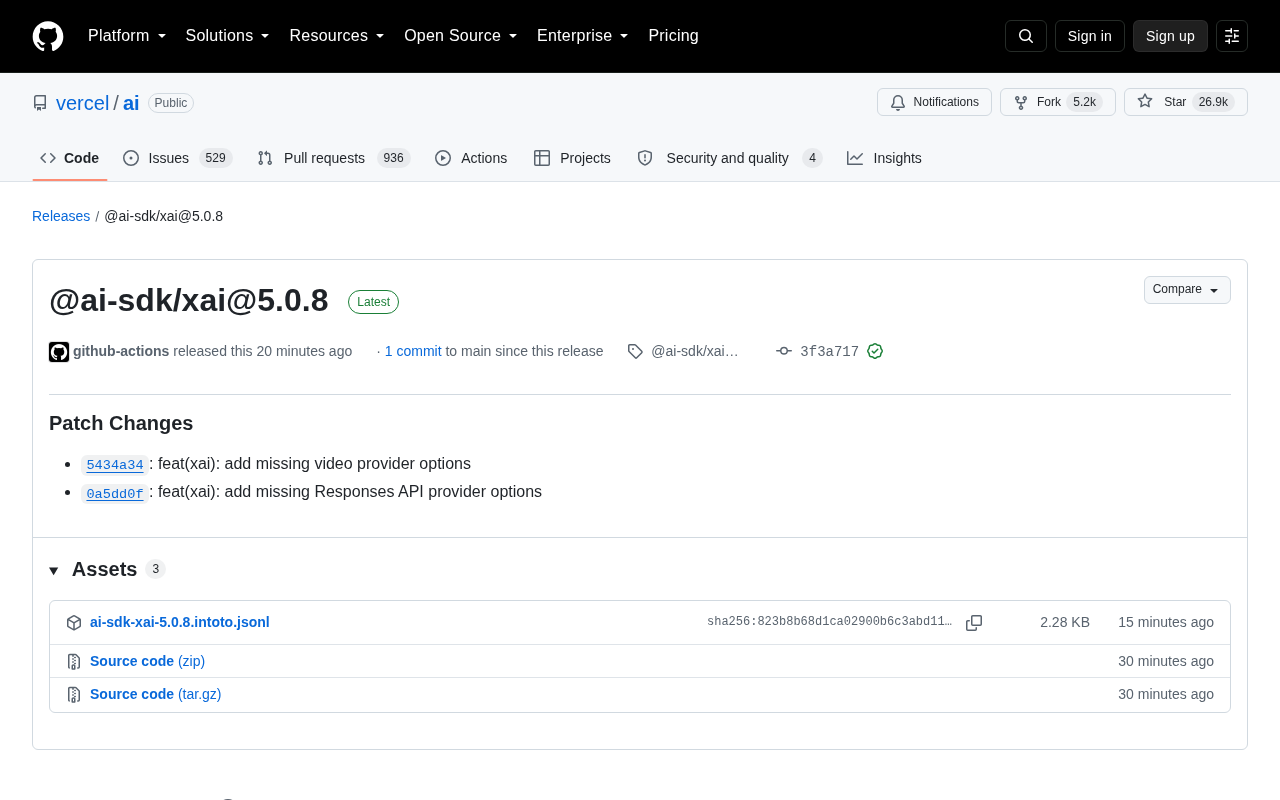
`@ai-sdk/xai@5.0.8` is a patch update that adds two previously missing configuration options to the xAI (Grok series) Provider: video-related provider options and Responses API provider options. Though released as a patch, both changes are feature enhancements, reflecting AI SDK's philosophy of continuously aligning with upstream model capabilities through frequent, low-risk releases. Upgrading is low-risk, but developers using xAI video or Responses API features should review the new options and verify parameter semantics against xAI's official documentation.
Vercel's AI SDK has received another minor iteration. @ai-sdk/xai@5.0.8 was recently released as a patch-level update, addressing two gaps in the xAI provider's configuration options. While marked as a Patch release, these additions could be exactly the missing pieces developers building applications with xAI (Grok series models) have been waiting for.
What's in This Update
According to the GitHub Release page, @ai-sdk/xai@5.0.8 includes two Patch Changes:
- Add missing video provider options (
feat(xai): add missing video provider options) - Add missing Responses API provider options (
feat(xai): add missing Responses API provider options)
Both changes carry a feat prefix, indicating they are feature enhancements rather than pure bug fixes. Shipping new features as patch versions is consistent with AI SDK's development cadence — using frequent, low-risk minor releases to continuously align with upstream model capabilities.
Why These Two Additions Matter
Video Options: Keeping Pace with Multimodal Capabilities
xAI's Grok series models are steadily expanding their multimodal processing capabilities. Previously, the AI SDK's xAI Provider had gaps in video-related provider options, meaning developers couldn't pass certain video processing parameters through the SDK's standard interface. With this fix, developers calling xAI's video-related capabilities through AI SDK now have more complete parameter control.
For teams building multimodal applications, the completeness of provider options directly determines whether you can fully leverage a model's capabilities. Missing configuration options often force developers to bypass the SDK's abstraction layer and call the underlying API directly — sacrificing the portability benefits that AI SDK's unified interface provides.
Responses API Options: Aligning with a Next-Generation Interface Paradigm
The Responses API represents the next generation of model interaction interfaces. Compared to traditional Chat Completions, it offers stronger expressiveness for state management, tool calling, and structured output. By filling in the missing Responses API provider options for xAI, developers can now exercise finer-grained control over how these requests behave.
This also reflects AI SDK's positioning as a unified abstraction layer: it needs to continuously track the evolution of each model provider's API and expose vendor-specific configuration options to upstream applications in a type-safe manner.
The Responses API was originally introduced by OpenAI in early 2025 as an evolutionary replacement for the Chat Completions API. The key distinction is that Chat Completions is a stateless, single-turn request-response model, while the Responses API has built-in conversation state management (enabling multi-turn continuity via
previous_response_id) with more systematic support for tool calling (Function Calling) and structured outputs (Structured Outputs). Specifically, the Responses API treats "tool execution" as a first-class citizen within the response lifecycle, supporting multi-step reasoning and tool call orchestration within a single API call — without requiring the client to manually manage intermediate state. xAI's adoption of this interface paradigm means developers using Grok series models can benefit from this more expressive interaction mechanism. AI SDK filling in the corresponding provider options ensures these fine-grained controls can be passed through the SDK's type-safe interface, without requiring developers to bypass the abstraction layer and manually construct raw request bodies.
The Philosophy Behind AI SDK's Iteration
Vercel's ai repository has accumulated over 26,000 stars and 5,200 forks, making it one of the most mainstream AI application development frameworks in the TypeScript/JavaScript ecosystem. It uses a monorepo structure, maintaining separate provider packages for OpenAI, Anthropic, Google, xAI, and other model providers — each with its own independent release cycle.
The benefits of this split are clear: updates to a single provider don't ripple into the entire SDK's major version, and provider packages can quickly catch up whenever a vendor's capabilities change. Patch releases like @ai-sdk/xai@5.0.8 are everyday evidence of this mechanism working efficiently.
Monorepo combined with Independent Versioning is a common governance model for large multi-package projects. Vercel AI SDK uses Turborepo to manage the build pipeline and Changesets to drive version management and changelog generation. Under this setup, each provider package (such as
@ai-sdk/openaiand@ai-sdk/xai) has its own version number and release cadence — a major version bump in the coreaipackage doesn't force all providers to update in lockstep. For consumer developers, this means upgrading a single provider on demand without bearing the risk of a full framework upgrade. For framework maintainers, it means pushing patches for a new model vendor's API within hours of its release, minimizing the window for capability drift. Semantic Versioning (SemVer) plays a contract role here: Patch versions promise backward compatibility, Feature versions allow additive non-breaking changes, and only Major versions permit breaking changes — giving developers a clear framework for assessing upgrade risk.
What Developers Should Do
For developers already using the xAI Provider in their projects, upgrading to 5.0.8 is a low-risk operation — patch versions follow semantic versioning and should not introduce breaking changes. Two things worth checking:
- If your application involves xAI video or Responses API calls, review the release notes after upgrading to see if there are newly available configuration options you can take advantage of.
- Cross-reference the newly exposed options against xAI's official documentation to confirm the semantics of each parameter and ensure they're being passed as intended.
Patches like this may seem minor, but they're exactly what keeps your application in sync with model capabilities. In a world where models iterate at breakneck speed, staying current with SDK updates often matters more than it might appear.
Related articles

WorkBuddy Full Tutorial: Build an AI Office Automation Agent from Scratch
A complete WorkBuddy tutorial: installation, three working modes, multimodal picture book video practice, expert team agent building, and workflow configuration for low-cost AI office automation.

WorkBuddy Agent Complete Guide: From Beginner to Automation in 7 Days
Based on Bilibili's 256-episode WorkBuddy masterclass, this systematically breaks down Tencent's AI office workbench core capabilities: Agent principles, Skill encapsulation, cross-platform connectors, scheduled automation, knowledge bases, and zero-code development, with learning path recommendations.

8 AI Accounts, 7 Failed: An Honest Review of Using AI to Get Work Done
Only 1 of 8 AI-run Bilibili accounts succeeded. We break down the real difference between "performing AI" and "using AI to get work done."