Vercel AI SDK Releases harness-fx 1.0.46 Patch Update

Vercel AI SDK releases harness-fx@1.0.46 patch, syncing dependencies and upgrading two related packages in tandem.
Vercel AI SDK has released `@ai-sdk/harness-fx@1.0.46`, a patch update focused on syncing upstream dependencies while coordinating upgrades to `@ai-sdk/harness-acp@1.0.71` and `@ai-sdk/harness@1.0.133`. This multi-package release pattern stems from the project's monorepo architecture, where downstream sub-packages version-bump together when underlying dependencies change. The release was automated via GitHub Actions and verified with GPG signing. As a Patch-level update, it contains no breaking changes and is safe to upgrade.
Vercel's AI SDK ecosystem has recently released a patch update for @ai-sdk/harness-fx@1.0.46. This is a minor version iteration focused primarily on dependency synchronization. While the scope of changes is modest, it reflects the project's high-frequency, stable maintenance cadence.
Update Overview
According to the Release notes on GitHub, version 1.0.46 is classified as a Patch Change. The core update involves syncing several upstream dependencies, with relevant commits including b2049fa, 11f0e71, 2b9195b, 446725d, and others.
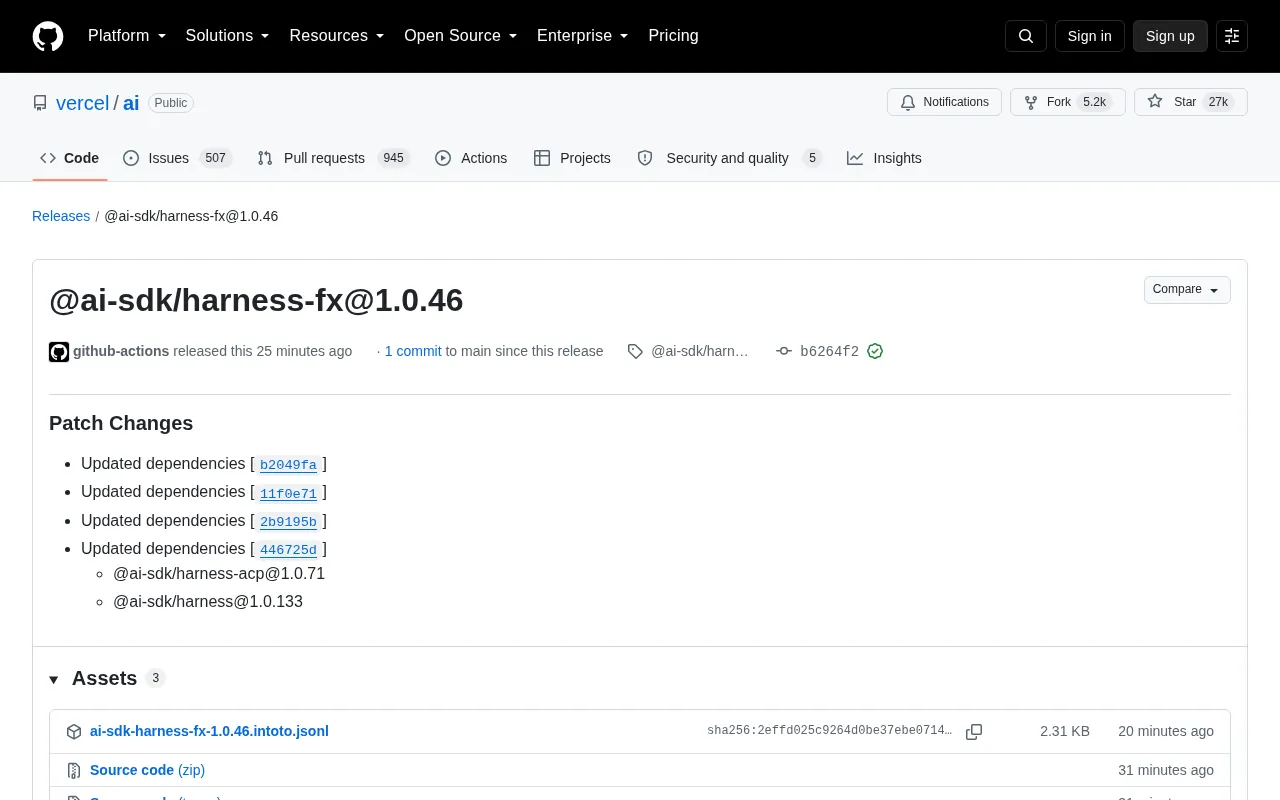
Alongside this release, related packages within the ecosystem were also upgraded in tandem, including @ai-sdk/harness-acp@1.0.71 and @ai-sdk/harness@1.0.133. This multi-package coordinated release pattern is common in monorepo (single repository) projects — when an underlying dependency changes, all affected sub-packages increment their version numbers and publish together to ensure compatibility across the entire toolchain.
This version was published at 09:46 via GitHub Actions automation and verified using GitHub's verified signature (GPG key ID: B5690EEEBB952194), ensuring the trustworthiness of the release artifact.
A monorepo is an architectural pattern where multiple related packages or projects are managed within a single code repository, as opposed to the Polyrepo model where each package maintains its own repository. The Vercel AI SDK uses a monorepo to manage dozens of
@ai-sdk/*sub-packages, typically leveraging tools like Turborepo and pnpm workspaces for automatic dependency graph tracking. When an underlying package version changes, the build system automatically identifies all packages that directly or indirectly depend on it and triggers corresponding version bumps and publish workflows. The key advantage of this approach is that the entire toolchain remains in a compatible state at any given time, avoiding runtime errors caused by version mismatches.
About Vercel AI SDK
Vercel AI is one of the most active open-source projects in the frontend and full-stack developer community, having accumulated approximately 27,000 Stars and 5,200 Forks on GitHub. It primarily provides developers with a toolkit for building AI-powered applications, covering common scenarios such as model invocation and streaming response handling.
The harness series of packages involved in this update are, based on naming conventions, related to testing or runtime framework components ("harness" typically refers to a test/runtime framework). Continuous maintenance of these infrastructure packages is critical to the stable operation of downstream projects that depend on the AI SDK.
In software engineering, "harness" typically refers to a "Test Harness" — an infrastructure component that provides a controlled environment for running tests or executing code. In the context of the Vercel AI SDK, the
harnessseries (harness,harness-fx,harness-acp) likely handles unified management of model invocation lifecycles, processing of side effects (fx, i.e., effects), and standardization of AI capability protocols (acp, i.e., AI Capability Protocol). These foundational packages sit at the bottom of the entire SDK's dependency chain — when they change, all upstream feature packages must update accordingly, making coordinated multi-package releases an inevitable maintenance pattern.
The Significance of Patch Updates
For developers, Patch-level updates generally indicate non-breaking changes, primarily used for bug fixes or dependency synchronization. This means projects using the package can typically upgrade safely without major adjustments to existing code.
High-frequency dependency synchronization also sends a positive signal: the project maintainers are closely tracking changes in the upstream ecosystem and promptly propagating underlying fixes throughout the entire toolchain. For teams using Vercel AI SDK in production environments, keeping dependencies reasonably up to date helps ensure access to the latest stability improvements and security fixes.
It's worth noting that since the official Release Notes only list commit hashes for dependency updates without detailed change descriptions, the specific technical details of each dependency change require reviewing the corresponding commits. Developers following this project are encouraged to visit the GitHub repository's Releases page directly to track the complete change history.
Related articles

Qwen4 Architecture Preview Open-Sourced: 125B Parameters, 512 Experts, Designed for VRAM-Constrained Hardware
Qwen4 isn't released yet, but its architecture is previewed via open-source Qwen3.8 Flash Next: 125B params, 6B activated per token, 512 experts, 262K context, built for VRAM-limited hardware. This article covers official confirmations, key config.json metrics, and local deployment tests on 24G memory.

Run 8K Images on 6GB VRAM! Hands-On Test of Fudan's Open-Source MOSS-Image Model
Fudan OpenMouse team and Shanghai MOSS Intelligence open-source MOSS-Image, a 500M-parameter DT architecture text-to-image model that runs locally on 6GB VRAM with precise text rendering, structured layout control, and 4K Token prompt support—ideal for e-commerce posters and local deployment by individual creators.

Overseas Blogger Tests Local Deployment of 100B-Parameter MoE Model: Key Lessons on Quantization and Tool Calling
Overseas blogger tests local deployment of Alibaba's Qwen 3.8 Flash Next 100B MoE model on a Strix Halo mini PC and CUDA workstation, revealing how quantization precision affects tool-calling success and the real-world performance of the Strata and GUFO inference engines.