Vercel AI SDK Releases typesafe-ai 3.0.2 Patch Update
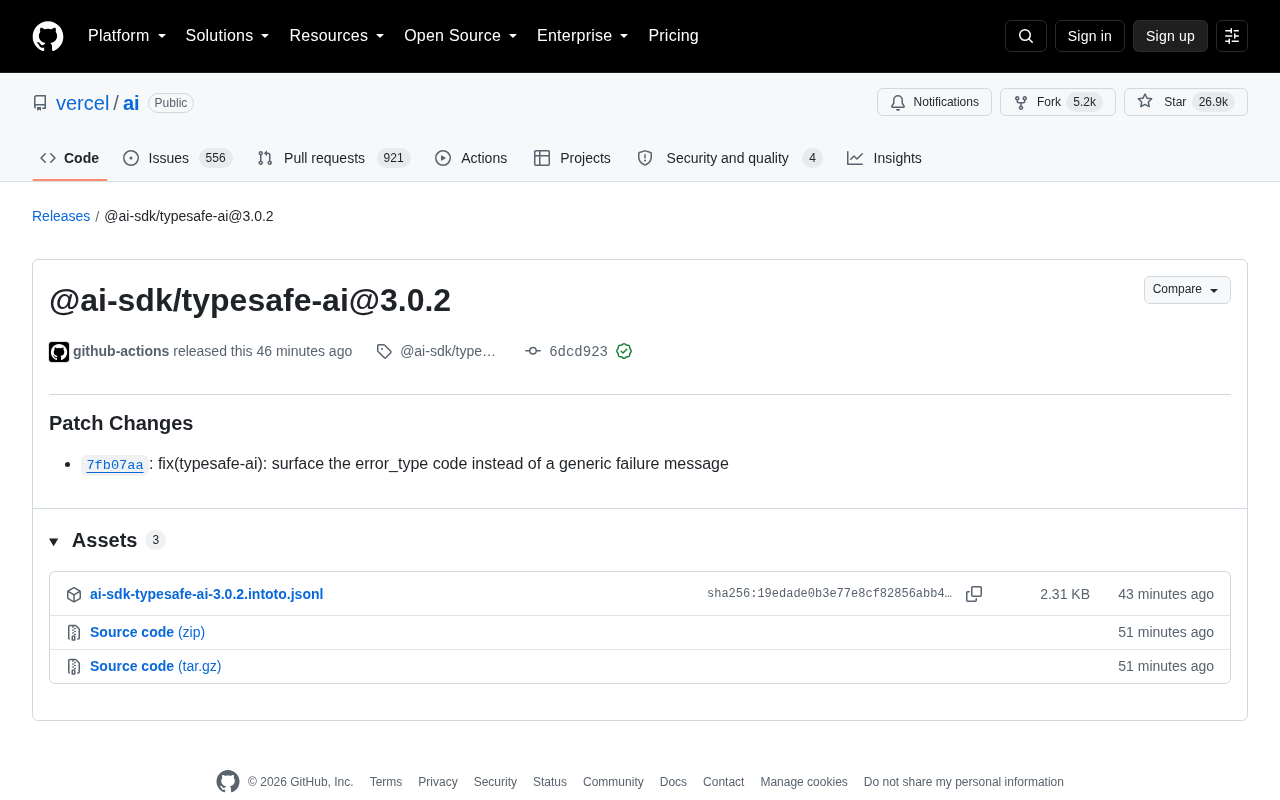
Vercel AI SDK's typesafe-ai 3.0.2 replaces vague error messages with specific error_type codes for better debugging.
Vercel's AI SDK project has released `@ai-sdk/typesafe-ai@3.0.2`, a patch update that replaces generic failure messages with direct exposure of specific `error_type` error codes. This seemingly small change addresses a common AI debugging pain point — developers can now pinpoint error categories immediately and write targeted retry or fallback logic instead of guessing from vague messages. As a patch release with no breaking changes, it can be installed instantly via any package manager.
Vercel's open-source AI SDK project recently released @ai-sdk/typesafe-ai@3.0.2. This is a patch-level update that introduces a small but practical improvement to error handling. While the version bump from 3.0.1 to 3.0.2 may seem minor, for developers building AI applications that rely on type-safe capabilities, these kinds of refinements can significantly improve the debugging experience.
What's Changed in This Update
According to the GitHub Release page, version 3.0.2 includes one patch change corresponding to commit 7fb07aa:
fix(typesafe-ai): surface the error_type code instead of a generic failure message
In plain terms: the error handling logic has been fixed so that it now directly exposes the error_type error code instead of returning a vague, generic failure message.
This change may look small, but it addresses one of the most common pain points developers face: when a call fails and the framework only throws a generic "operation failed" message, developers often spend considerable time tracing through layers of code to find the root cause. Surfacing the specific error_type code directly means developers can immediately identify the error category, dramatically reducing time-to-diagnosis.
Where typesafe-ai Fits in the AI SDK Ecosystem
@ai-sdk/typesafe-ai is a module within the Vercel AI SDK family. The AI SDK project has accumulated approximately 26,900 stars and 5,200 forks on GitHub, making it one of the most popular toolkits for building AI features in frontend and full-stack applications.
The "typesafe" name speaks to its core value — type safety. In modern web development dominated by TypeScript, AI API calls often involve complex input and output structures. Type safety catches parameter errors and return type mismatches at compile time, preventing these issues from surfacing at runtime. This kind of module gives developers the same reliability benefits of strong typing when interacting with large language models.
Vercel AI SDK's overall architecture follows a monorepo-style modular design. The core ai package provides foundational capabilities like streaming text generation, structured output, and tool calling, while @ai-sdk/typesafe-ai serves as an extension layer focused on type constraints. TypeScript's type system faces unique challenges when handling AI interfaces: LLM outputs are inherently unstructured natural language, and aligning them with static type definitions requires runtime validation through libraries like Zod. The value of the typesafe-ai module lies in combining compile-time type checking with runtime validation to form a "double safety net" — the former catches obvious type errors while writing code, the latter confirms that the model's actual response matches the expected structure. Together, they reduce the likelihood of type-related surprises in AI applications.
Why Surfacing Error Codes Matters
Error handling is a true measure of engineering quality. Many frameworks, in an effort to simplify their APIs early on, tend to wrap all exceptions into generic error messages. This is fine during prototyping but becomes an obstacle in production for operations and debugging.
Exposing error_type directly reflects the AI SDK team's ongoing commitment to developer experience. Specifically, this kind of improvement delivers several benefits:
- Precise identification: Developers can handle errors by category — distinguishing between network errors, authentication failures, parameter validation issues, and more.
- Programmatic handling: Structured error codes allow upstream applications to write targeted
try/catchor retry logic, rather than relying on string matching to guess the error type. - Better observability: Standardized error codes are far easier to aggregate, analyze, and configure alerts for in logging and monitoring systems.
The design philosophy behind structured error codes like error_type draws from industry standards such as HTTP status codes and RFC 7807 (Problem Details for HTTP APIs): rather than throwing a human-readable description string at the caller, provide a machine-processable identifier and let the caller decide how to display or handle it. In AI call scenarios, common error categories include rate limiting (rate_limit_exceeded), context length overflow (context_length_exceeded), content policy blocks (content_filter), and authentication failures (authentication_error) — each requiring a completely different handling strategy. Some need backoff and retry, some need input truncation, some need to prompt the user to re-authenticate. With only a generic "operation failed" message, none of these branching logic paths can be implemented properly, and applications inevitably fall back to undifferentiated catch-all responses — a real threat to production robustness.
How to Upgrade
For projects already using this module, upgrading to 3.0.2 typically requires only a dependency version update. As a patch release, it introduces no breaking changes:
npm install @ai-sdk/typesafe-ai@3.0.2
# or
pnpm add @ai-sdk/typesafe-ai@3.0.2
This release was published automatically via GitHub Actions and signed with a verified signature, ensuring the integrity and trustworthiness of the published artifact.
Summary
@ai-sdk/typesafe-ai@3.0.2 is a classic "small steps, fast iteration" release — no groundbreaking new features, but a genuine improvement to error handling, one of the most frequently encountered aspects of development. For teams building type-safe AI applications with Vercel AI SDK, keeping up with patch updates like this delivers meaningful improvements to the development and debugging experience at virtually no cost. Staying on top of AI SDK version releases is also an effective way to track the evolving landscape of frontend AI engineering.
Related articles

The Return of Wind Power: How Cargo Ships Are Embracing Wind Energy to Cut Emissions
Why are cargo ships embracing wind power again? Explore rotor sails, hard wing sails, and other modern wind-assisted technologies driving shipping's emission-cutting comeback.
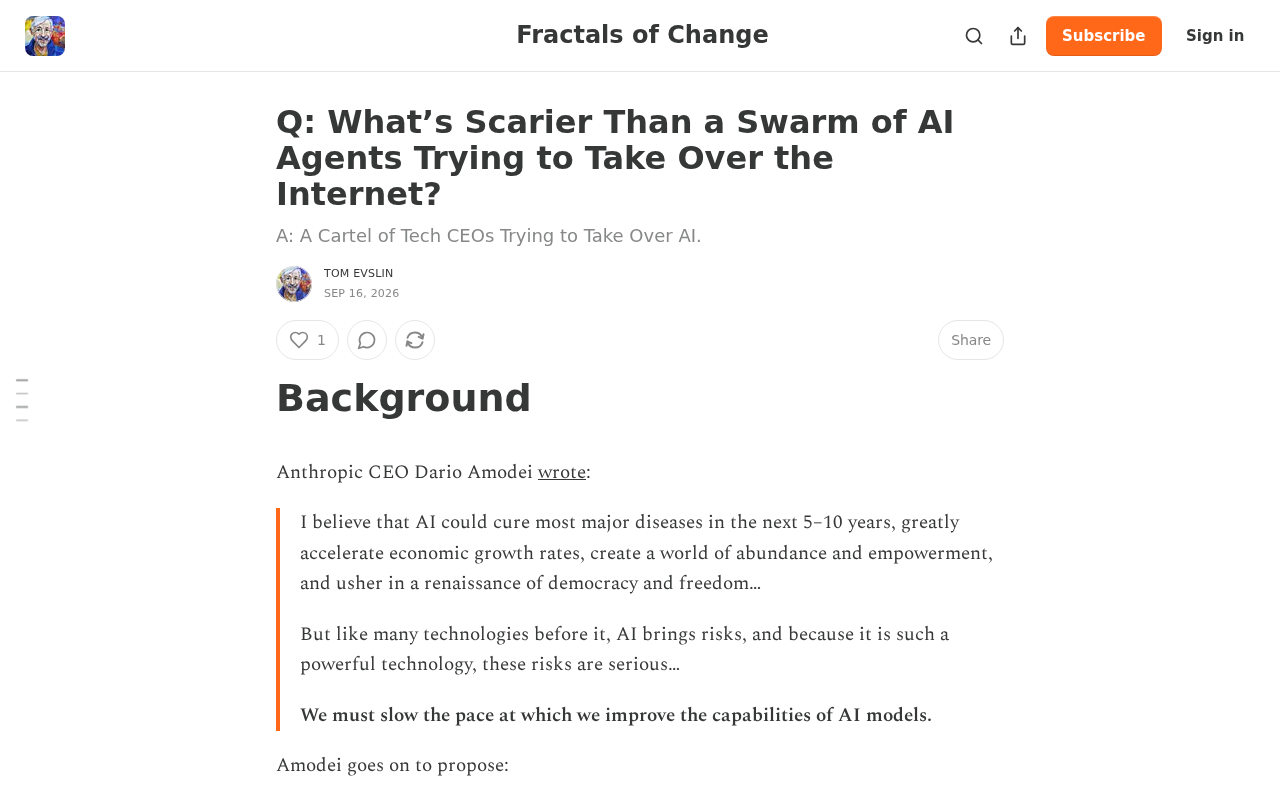
Scarier Than AI Agents Taking Over the Internet: A CEO Cartel Monopolizing AI
A Hacker News piece argues that a CEO cartel monopolizing AI is scarier than agents taking over the internet. This article examines AI concentration, open source, and governance.
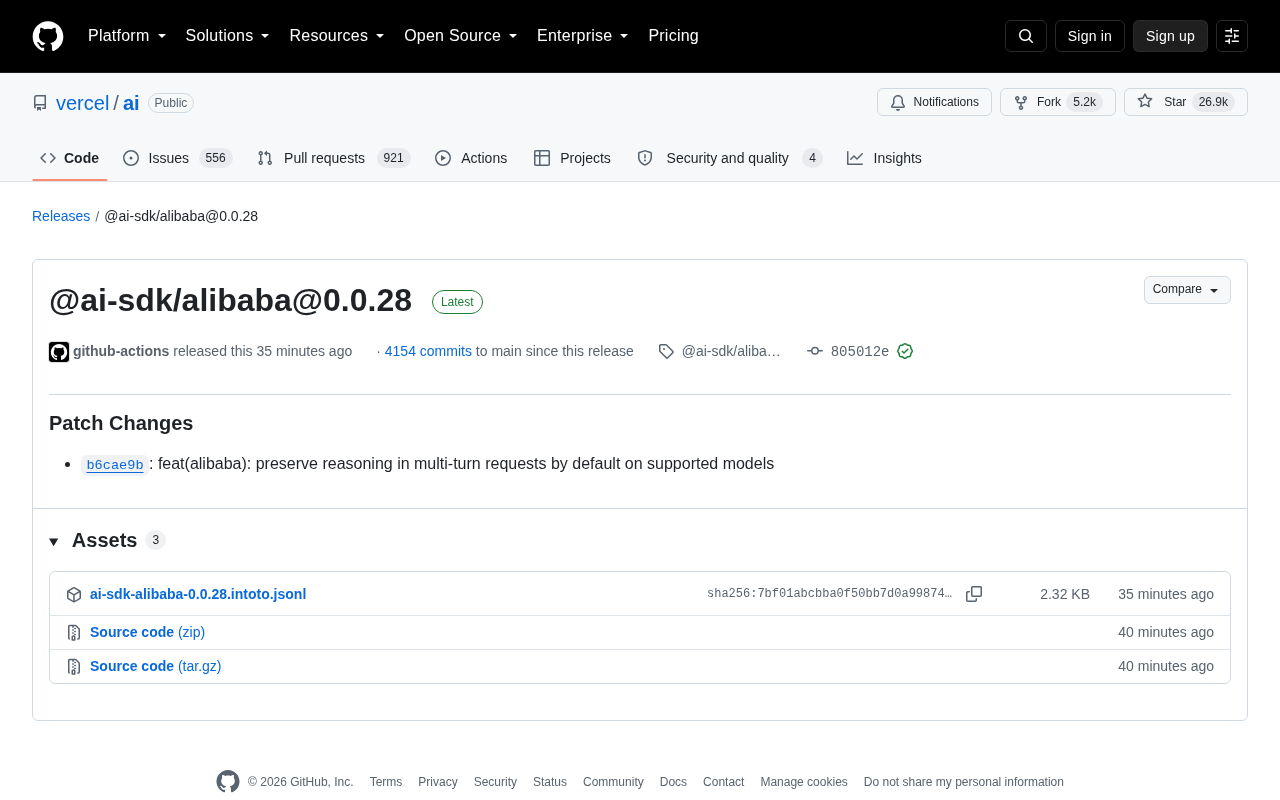
Vercel AI SDK Alibaba Adapter Update: Multi-Turn Conversations Now Preserve Reasoning Chain by Default
Vercel AI SDK's @ai-sdk/alibaba adapter v0.0.28 now preserves reasoning chain by default in multi-turn conversations on supported models, improving coherence.