Vercel AI SDK Releases workflow-harness 1.0.116 Patch Update
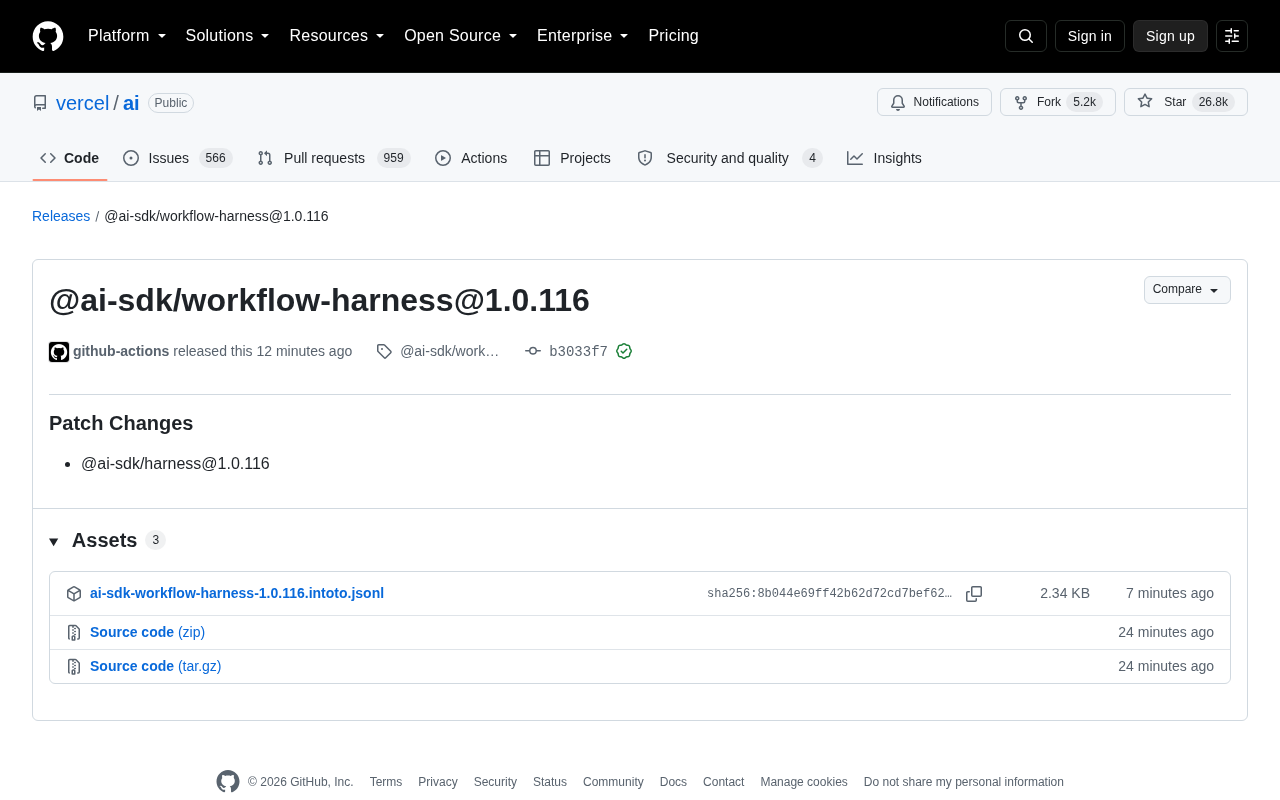
Vercel AI SDK releases workflow-harness 1.0.116 patch, syncing the internal harness dependency to the same version.
Vercel's AI SDK repository has released `@ai-sdk/workflow-harness@1.0.116`, a routine patch update whose sole change is syncing the internal `@ai-sdk/harness` dependency to the same version. The release was automated via GitHub Actions with GPG signature verification for supply chain trust. Under SemVer, this patch carries no breaking changes, making it a low-risk upgrade. With ~26,800 GitHub stars, the SDK's frequent patch cadence signals strong, active maintenance.
Vercel's official AI SDK repository recently published @ai-sdk/workflow-harness@1.0.116. This is a patch-level minor release that primarily syncs the internal dependency @ai-sdk/harness@1.0.116. For developers building AI workflows on top of the Vercel AI SDK, this kind of continuous iteration reflects the project's steady maintenance cadence.
Release Overview
This release was pushed on September 18 via GitHub Actions automation. The commit carries a verified GPG signature (key ID: B5690EEEBB952194), ensuring the trustworthiness of the release source. According to the Release Notes, this update is classified as a Patch Change, and the core change is upgrading the dependency @ai-sdk/harness to 1.0.116 in lockstep.
Patch releases typically do not involve breaking changes or major new features — they are more focused on bug fixes, internal optimizations, or dependency version alignment. Developers can generally upgrade without modifying existing code, making these updates low-risk.
Automated release pipelines (like this one triggered by GitHub Actions) are a key engineering practice in modern open-source projects. Combined with version management tools like Changesets, developers can attach change description files when submitting PRs, and the CI system automatically aggregates the Changelog, bumps version numbers, and publishes to npm after merging. GPG signature verification adds a layer of supply chain security on top of this — even if an attacker obtains npm publish credentials, they cannot forge a GitHub-verified commit without the corresponding private key, reducing the risk of supply chain attacks. For AI application teams that depend on many third-party packages, checking release signatures is one of the foundational steps in supply chain security review.
About Vercel AI SDK and harness
Vercel's ai repository is a popular open-source toolkit for building AI applications, with approximately 26,800 stars and 5.2k forks on GitHub, reflecting a highly active community. The SDK provides a unified interface for calling various large language models and wraps common capabilities such as streaming responses, tool calling, and structured output.
workflow-harness and harness are internal supporting modules within the SDK. Judging from the naming, harness-type components are typically used to provide runtime environments, testing scaffolding, or execution orchestration for workflows. The fact that both packages have their version numbers strictly aligned (both at 1.0.116) indicates they stay in sync during the release process and are a tightly coupled pair of internal packages.
Under the Semantic Versioning (SemVer) specification, version numbers consist of three parts: MAJOR.MINOR.PATCH. An increment in the PATCH position (e.g., 1.0.115 → 1.0.116) indicates a backward-compatible bug fix; MINOR indicates new functionality without breaking existing interfaces; MAJOR signals breaking changes. Both workflow-harness and harness remaining on the 1.0.116 PATCH track means that since their 1.0.0 release, no breaking changes have been introduced, and the overall API interface remains stable. This is a healthy evolutionary pattern for infrastructure-level packages, and downstream developers can feel relatively confident following patch upgrades.
What This Means for Developers
For teams currently using the Vercel AI SDK, a dense and regular patch release cadence is a positive signal — it means the project is under continuously active maintenance. While individual small releases may have limited changes, they cumulatively contribute to the SDK's stability and reliability.
Recommendations for developers:
- If you have pinned versions via npm/pnpm, consider upgrading based on your project's test coverage situation;
- Patch versions are generally backward compatible, but it's still advisable to run a regression test suite in CI before pushing to production;
- Keep an eye on the full Changelog in the repository to track the cumulative changes in the harness family of packages.
It's worth noting that the public information provided in this release is fairly limited — only the dependency sync is noted as a change. To understand what specific issues were fixed, you'll need to dig into the corresponding commits and PR records.
Summary
@ai-sdk/workflow-harness@1.0.116 is a routine patch release whose core change is syncing @ai-sdk/harness@1.0.116. While the release itself carries limited new information, it indirectly confirms the Vercel AI SDK ecosystem's high-frequency iteration rhythm and its well-engineered automated release pipeline. For AI application developers, staying on top of these kinds of updates helps you pick up fixes and optimizations in a timely manner.
Related articles
Three Stages of AI LLM Testing: A Practical Guide from Core Concepts to API Calls
A learning path for testers covering LLM fundamentals, prompt engineering, OpenAI SDK calls, API Key vs Token differences, streaming output, RAG, and Agent systems.
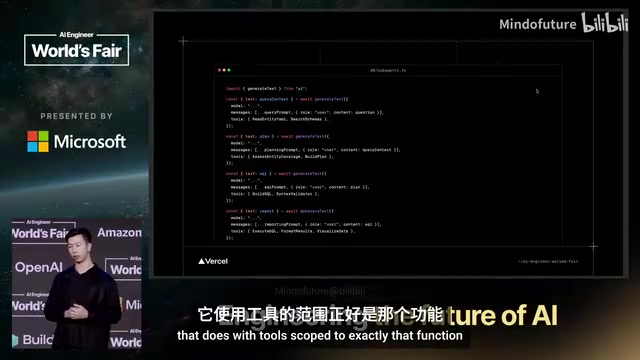
Vercel's Chief of Software Looks Back: The Evolution of Agent Building — From Multi-Agent Chains to File System Agents
Vercel's Chief of Software Andrew recaps the agent-building journey at AI Engineer: from giant prompts to multi-agent chains, monolithic memory, file system agents, and the open-source EVE framework.
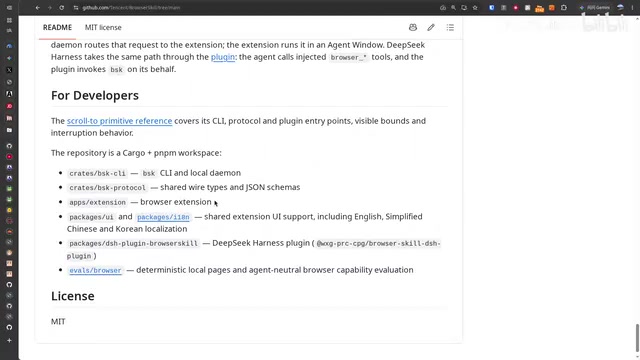
Tencent's Open-Source BSK in Action: Letting AI Take Over Your Already-Logged-In Browser
Tencent's open-source BSK (Browser Skill Kit) lets AI take over your real, logged-in Chrome via WebSocket. We break down the architecture, setup, and three key pitfalls from real-world testing.