Vercel AI SDK Releases workflow-harness 1.0.135 Patch Update

Vercel AI SDK workflow-harness 1.0.135 patch syncs internal dependency with no breaking changes.
Vercel AI SDK's `@ai-sdk/workflow-harness` has released version 1.0.135, a dependency-sync patch that upgrades the internal `@ai-sdk/harness` package to the same version. The release was automated via GitHub Actions with GPG signature verification. Since it contains no new features or breaking changes, the upgrade risk is minimal. Teams using Vercel AI SDK are advised to pair sensible version pinning with CI automation to stay current while reducing maintenance overhead from frequent releases.
Vercel's popular AI development toolkit vercel/ai has released @ai-sdk/workflow-harness@1.0.135. This is a patch-level update focused on syncing internal dependencies. While the version bump is minor, it's still worth tracking for developers who rely on this toolchain to build AI workflows.
Update Overview
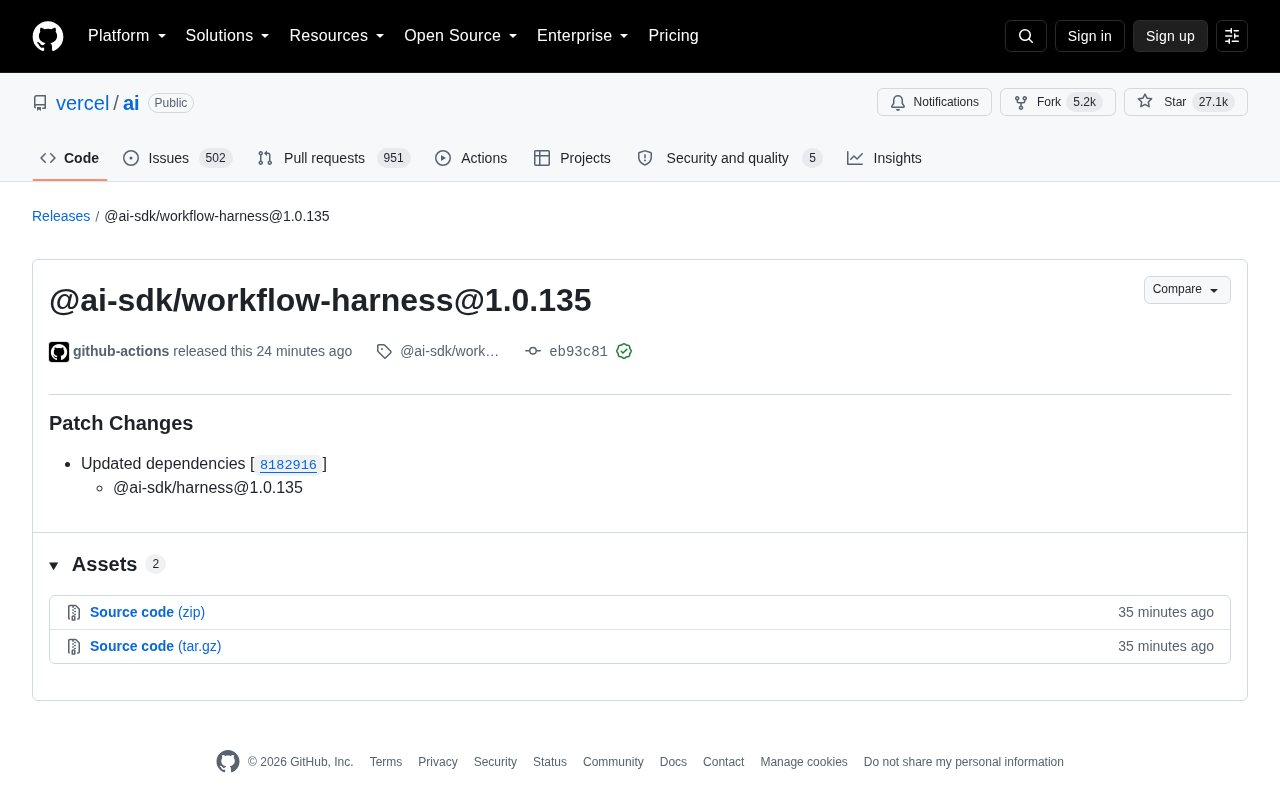
According to the GitHub Releases page, @ai-sdk/workflow-harness@1.0.135 falls under Patch Changes, with the core change being an internal dependency update:
- Dependency
@ai-sdk/harness@1.0.135upgraded in sync - Corresponding commit hash:
8182916 - Published on September 30 via GitHub Actions automated pipeline
- The commit carries GitHub's verified GPG signature (key ID: B5690EEEBB952194), ensuring the release source is trustworthy
Patch releases typically don't introduce breaking changes — they're primarily used for bug fixes, dependency syncing, or minor optimizations. Based on the release notes, this update includes no new features or API changes, making it safe to upgrade without concern.
What Is workflow-harness?
@ai-sdk/workflow-harness is one of the modular components within the Vercel AI SDK ecosystem. The Vercel AI SDK is a widely adopted framework for building AI-powered applications — the vercel/ai repository has accumulated over 27.1k stars and 5.2k forks on GitHub, a testament to its influence in frontend and full-stack AI development.
Harness-type tools are generally used for testing, orchestration, or abstracting underlying capabilities. Based on its name, workflow-harness is primarily designed for building and validating AI workflows. It maintains version parity with its base dependency @ai-sdk/harness, meaning the two are tightly coupled — every iteration of the underlying harness triggers a corresponding release of workflow-harness.
Vercel AI SDK uses a monorepo architecture, splitting different capabilities into independent scoped packages (such as @ai-sdk/openai, @ai-sdk/anthropic, @ai-sdk/core, etc.), with well-defined dependency hierarchies between them. @ai-sdk/harness serves as the foundational package, providing test fixtures and abstract interfaces for capability encapsulation. @ai-sdk/workflow-harness builds on top of it, focusing on the orchestration and validation logic for multi-step AI workflows. This layered design allows changes in lower-level packages to propagate upward via version syncing, ensuring both independent maintainability and a consistent functional baseline across layers.
Practical Impact for Developers
For teams actively using Vercel AI SDK, here are some strategies for handling this kind of frequent patch release:
Should You Upgrade Immediately?
Patch versions are primarily about fixes and dependency syncing — the risk is low. If your project is running stably and you haven't encountered any related issues, you can batch this upgrade into your next regular maintenance window. However, if your project has strict requirements around dependency consistency, it's recommended to stay aligned with the latest harness version to avoid potential issues from version mismatches.
Version Management Recommendations
Given Vercel AI SDK's automated release pipeline and rapid iteration cadence, developers should consider:
- Using a sensible version pinning strategy in
package.json(e.g.,^or exact pinning) to balance stability with timely updates based on your team's needs - Watching release notes for any Breaking Changes markers — patch versions are generally safe
- Adding automated dependency upgrade testing in your CI pipeline to reduce upgrade risk
Under the Semantic Versioning (SemVer) specification, version numbers follow the MAJOR.MINOR.PATCH format: MAJOR changes indicate incompatible API breaks, MINOR indicates backward-compatible new features, and PATCH indicates backward-compatible bug fixes or internal adjustments. The common ^1.0.135 notation in package.json allows automatic upgrades within the same MAJOR version (both MINOR and PATCH), while ~1.0.135 only permits automatic PATCH upgrades. For a rapidly iterating AI SDK, it's advisable to lock exact installed versions using package-lock.json or pnpm-lock.yaml, then use automation tools like Dependabot or Renovate to submit scheduled upgrade PRs — striking a balance between flexibility and stability.
Summary
@ai-sdk/workflow-harness@1.0.135 is a typical dependency-sync patch update with no new features or breaking changes — its sole purpose is to iterate alongside @ai-sdk/harness. The impact on end users is minimal, but it reflects Vercel AI SDK's active maintenance cadence and well-structured release process. Keeping an eye on these version updates helps teams maintain a healthy and secure technology stack.
Related articles

Huberman's Rational Supplement Guide: A Five-Layer Health Framework and Scientific Decision-Making
Stanford neurobiology professor Huberman proposes a rational supplement framework: behavior and nutrition are the foundation, basic combination supplements serve as insurance, and sleep/hormonal/cognitive directions should stick to single-ingredient experiments. Omega-3 is the top single-ingredient choice, and melatonin is not recommended.

The Unsung Painter Behind Gilded Age Manhattan Interior Design
HN discussion highlights the painter behind Gilded Age Manhattan interiors: he created murals and decorative paintings but was long overlooked as his work was seen as architectural appendage.

Can AI Agents Be Socially Engineered? Understanding Prompt Injection and Tool Permission Risks
Through Invariant Lab's GitHub Issue injection and Brave's AI browser attack, this article analyzes how Prompt Injection induces AI Agents to perform unauthorized actions, and offers protection advice across three layers: least privilege, tool validation, and operation auditing.