Vercel AI SDK Svelte 5.0.127 Released: Dependency Update Patch

Vercel AI SDK Svelte adapter 5.0.127 patch syncs with ai@7.0.127, no breaking changes.
`@ai-sdk/svelte@5.0.127` is a routine maintenance patch from the Vercel AI SDK team, syncing the Svelte adapter with `ai@7.0.127` and incorporating upstream dependency improvements. As a monorepo project, coordinated releases like this are standard practice and don't indicate API or feature changes in the Svelte adapter itself. Released via GitHub Actions with GPG signature verification, this low-risk patch is safe to adopt, provided `@ai-sdk/svelte` and the `ai` core package versions are kept aligned.
The Vercel AI SDK team has released @ai-sdk/svelte@5.0.127. This is a patch-level update focused primarily on internal dependency upgrades, introducing no breaking changes. For developers integrating large language model capabilities into Svelte projects, minor updates like this typically mean a painless upgrade path.
Release Overview
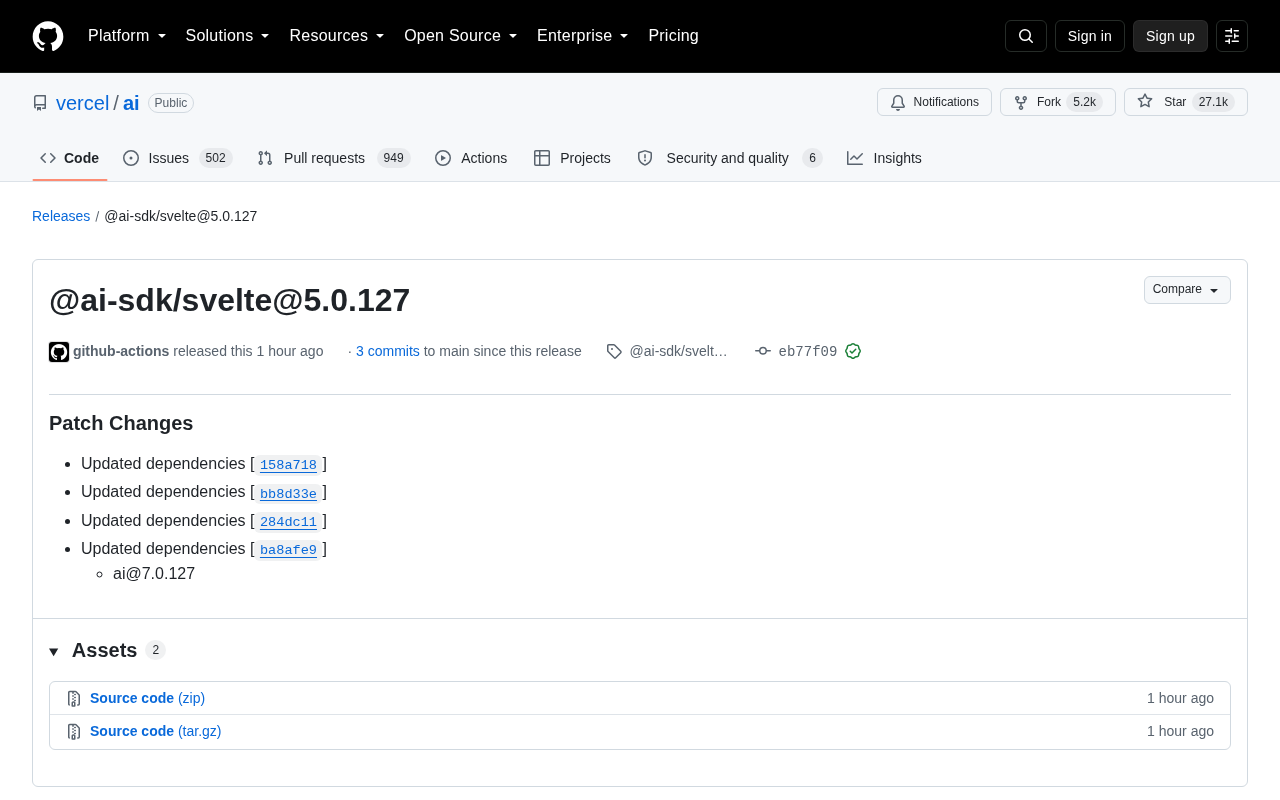
This version was published on October 1st via a GitHub Actions automated pipeline, with commit hash eb77f09, and verified through GitHub's GPG signature (Key ID: B5690EEEBB952194) to confirm the authenticity of the release source. The vercel/ai repository has accumulated over 27,000 stars and 5,200 forks, making it one of the more active open-source tools in the AI application development ecosystem.
What Changed: Dependency Upgrades
According to the release notes, @ai-sdk/svelte@5.0.127 falls under Patch Changes, with the core changes being updates to a series of upstream dependencies:
- Updated dependencies [
158a718] - Updated dependencies [
bb8d33e] - Updated dependencies [
284dc11] - Updated dependencies [
ba8afe9]
In sync with this, the core ai package has also been upgraded to 7.0.127. This means the Svelte adapter's update is essentially a coordinated release following the core SDK's versioning cadence. Since the Vercel AI SDK uses a monorepo structure, the core package and framework adapters (React, Vue, Svelte, etc.) tend to stay version-aligned — which explains why both the Svelte package and the ai core package share the .127 patch number.
The Vercel AI SDK uses a monorepo architecture, managing the core ai package and framework adapters (@ai-sdk/react, @ai-sdk/vue, @ai-sdk/svelte, etc.) through pnpm workspaces. In this setup, framework adapters typically only contain framework-specific binding logic (such as Svelte store wrappers and reactive state management), while the actual AI call capabilities, streaming, and Provider abstractions are all provided by the core ai package. As a result, when the core package ships fixes or improvements, adapters publish new versions in the form of "dependency updates" — even if the adapter code itself hasn't changed. This is why the changelog for this release only lists commit hashes without specific descriptions: the actual changes happened in upstream dependencies, and you'd need to trace each commit hash for the full picture.
What This Means for Svelte Developers
@ai-sdk/svelte is the official Vercel AI SDK binding for the Svelte framework, enabling developers to easily integrate chat, streaming text generation, and other AI features into Svelte and SvelteKit applications. Patch versions typically don't change existing API call patterns, so the upgrade risk is minimal.
For teams currently using this SDK, here's a recommended upgrade approach:
Upgrade Validation Steps
- Update
@ai-sdk/svelteto5.0.127in yourpackage.json, and ensure theaicore package is also upgraded to7.0.127to avoid version mismatches. - Since this is purely a dependency update, focus on whether upstream dependencies have fixed any bugs or security issues that previously affected your use case.
- Run your existing test suite to confirm that streaming responses, message state management, and other functional behaviors remain unchanged.
It's worth noting that the official release notes don't include specific descriptions for each dependency update. Developers who need more detail will need to look up the change records associated with each commit hash.
The core value of @ai-sdk/svelte lies in seamlessly combining the AI SDK's async streaming capabilities with Svelte's reactive system. It provides ready-to-use utility functions like useChat and useCompletion, which internally manage message lists, loading states, and error states via Svelte's store mechanism — so developers don't need to manually handle SSE (Server-Sent Events) or ReadableStream parsing. In SvelteKit projects, the adapter also works with SvelteKit's +server.ts routes to return streaming responses directly, enabling end-to-end typewriter-style output. Understanding this layered abstraction helps developers accurately determine whether an issue originates in the adapter layer or the core package, making debugging more efficient.
Summary
@ai-sdk/svelte@5.0.127 is a typical maintenance patch release, with its primary value being synchronization with ai@7.0.127 and the incorporation of upstream dependency improvements. It reflects Vercel AI SDK's continuously fast iteration pace — high-frequency minor releases help deliver underlying fixes in a timely manner. For production projects that prioritize stability, this type of patch release is exactly the kind of update worth keeping up with.
Related articles

Random Pruning of the DPO Computation Graph: 1.4x Training Speedup and Lower Peak Memory
DPO training too slow and memory-hungry? This paper proposes a random pruning framework for the DPO computation graph, sampling independently across position, sequence, and branch dimensions; branch pruning achieves a 1.426x step-time speedup and cuts training time by about 30%, with in-depth attribution of memory and time gains.

Why Does JEPA Underperform MLM in Longitudinal EHR Representation Learning?
New study compares JEPA and MLM for longitudinal EHR representation learning on MIMIC-IV: three JEPA variants train stably without collapse but underperform MLM; target size, not heterogeneity, drives prediction error.

Transfer Learning + Visible Light Communication: A New Approach to Energy-Efficient Indoor Positioning
A study proposes a transfer learning-based visible light communication indoor positioning method, achieving 47% accuracy improvement on the BOSCH factory dataset, 67.5% model efficiency under high noise, and introducing the ME composite metric for energy-efficient positioning in energy-constrained industrial IoT scenarios.