Vercel AI SDK Update: @ai-sdk/vue 4.0.181 Released

Vercel AI SDK's Vue adapter package releases 4.0.181 patch, only syncing dependency to ai@7.0.181.
This article reports the release of @ai-sdk/vue 4.0.181. It is a patch-level update whose only change is syncing the dependency to core package ai@7.0.181, with no new APIs or breaking changes in the Vue adapter layer itself. The release was automatically triggered by github-actions, with 7 commits accumulated since the previous version. The article notes that Vue developers using composables like useChat and useCompletion are advised to follow the upgrade, and after upgrading should check that streaming response parsing and tool call state callbacks work properly, and ensure the ai package version explicitly depended on by the project is aligned. The article also analyzes AI SDK's monorepo high-frequency, small-step release strategy, recommending production projects lock versions and validate in batches before upgrading.
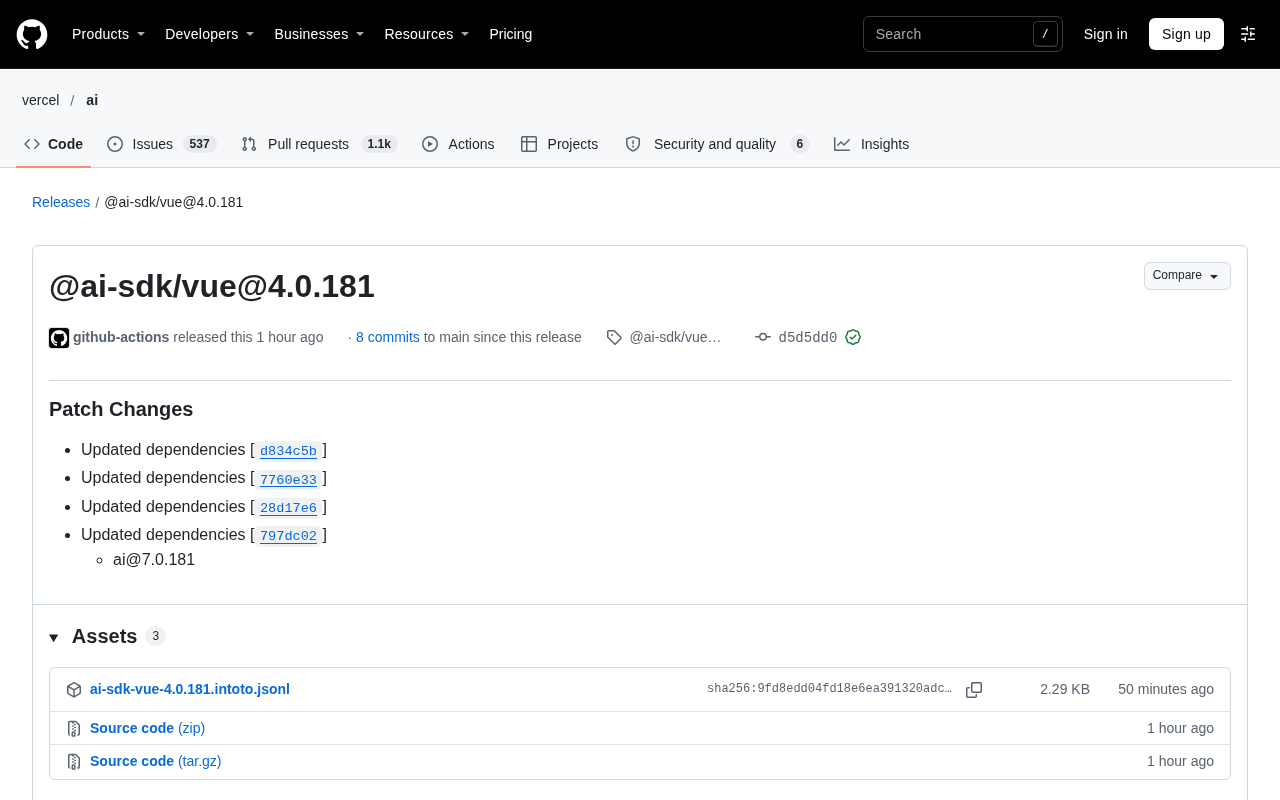
Vercel's AI SDK Vue adapter package @ai-sdk/vue has released version 4.0.181. This is a patch-level update, with the core change being a synchronized dependency upgrade pointing to ai@7.0.181. For developers building AI chat interfaces with Vue, this means fixes and adjustments in the underlying core library will propagate to the frontend layer through this release.
What Changed in This Update
According to the GitHub Releases page, the change type for @ai-sdk/vue@4.0.181 is marked as Patch Changes, with the specific content being "Updated dependencies," listing four commit references (d834c5b, 7760e33, 28d17e6, 797dc02), ultimately aligning the ai package to version 7.0.181.
In other words, the Vue package itself introduces no new APIs or breaking changes — the changes come from the core package it depends on. This release pattern is common in the AI SDK monorepo: core capabilities iterate in the ai package, while framework adapter layers (Vue, React, Svelte, etc.) maintain behavioral consistency by synchronizing dependency versions.
The version number skipped 4.0.180 and jumped directly to 4.0.181, indicating this is a routine release automatically triggered by the continuous integration pipeline, pushed by the github-actions bot at 21:10 on the 23rd, with 7 commits accumulated since the previous version.
What This Means for Vue Developers
If you use composables like useChat and useCompletion in your Vue project to interface with LLM streaming output, this upgrade falls into the category of recommended but not urgent. Patch versions typically contain bug fixes and internal refactoring, with API signatures remaining stable.
In practice, simply upgrade the dependency:
npm install @ai-sdk/vue@4.0.181
After upgrading, it's recommended to check two things: first, whether streaming response parsing is consistent with before; second, whether there are any anomalies in tool calling-related state callbacks. Since the core ai package is also upgraded to 7.0.181, if your project also directly depends on ai, make sure the versions of both packages match to avoid type definition conflicts.
useChat and useCompletion are composables provided by AI SDK for Vue, built on Vue 3's reactivity system. useChat manages a multi-turn conversation: maintaining the message list, sending requests, receiving streaming responses chunk by chunk and triggering view updates, while exposing reactive state such as messages, input, handleSubmit, and isLoading. useCompletion targets single-turn text completion scenarios with a lighter interface. Both encapsulate SSE (Server-Sent Events) stream parsing and incremental rendering logic, so any fixes to the stream parser or message state machine in the core ai package will directly change the runtime behavior of these composables, while function signatures remain unchanged.
Tool calling refers to the model, when generating a response, not directly outputting final text but returning a structured "call request," which the frontend or server executes the corresponding function for, then passes the result back to the model to continue generation. In AI SDK, this involves tool definitions (name, parameter schema), call states (pending, executing, completed, error), and serialization of result messages. Since tool calling spans multiple streaming steps, state callbacks depend heavily on the core package's message merging logic. When the core package adjusts this implementation in a patch, the frontend may experience tool call cards not updating or state misalignment, so this pipeline should be specifically verified after upgrading.
Behind the Version Numbers: AI SDK's Release Cadence
This release reveals Vercel AI SDK's maintenance strategy — high frequency, small steps. The ai package has reached version 7.x, while the Vue adapter layer is at 4.x, with the two version lines evolving independently, and the adapter layer maintaining compatibility with the core through dependency locking.
The benefit of this strategy is that fixes reach users quickly; the cost is that version numbers grow rapidly. For production projects, a safer approach is to lock specific versions in the lockfile and validate upgrades in batches, rather than immediately following every patch.
This release does not include changelog details; the specific content of the four dependency commits needs to be traced in the core package's commit history. If runtime issues are discovered later, rolling back to the previous patch version is the lowest-cost solution.
Monorepo is the code organization approach adopted by AI SDK: the core package ai and framework adapter packages (@ai-sdk/vue, @ai-sdk/react, etc.) are managed in the same Git repository, sharing build configurations, testing tools, and release pipelines. This structure allows core capability iterations to propagate to all adapter layers at once, but also brings version coordination challenges — packages need to be released simultaneously and dependency versions need precise alignment, so a common practice is to maintain independent version sequences for each package, with release tools automatically synchronizing version numbers. Vercel AI SDK maintains the correspondence between ai and each adapter package in exactly this way, at the cost of triggering a full-package release with every core commit.
FAQ
Is this update a breaking change? No. It's a patch-level update, and the change content is only dependency synchronization.
Do I need to upgrade the ai package at the same time?
@ai-sdk/vue@4.0.181 already declares a dependency on ai@7.0.181, which the package manager will handle automatically. If your project explicitly depends on ai, it's recommended to align to the same version.
Where can I view the complete changes? The compare view on the GitHub Releases page shows all 7 commits since the previous version.
Related articles

ChatGPT Plus Subscription Pitfall Guide: Go/Plus/Pro Tier Comparison and Quick Activation
A complete ChatGPT Plus subscription guide based on a Bilibili tutorial: from registering an account, comparing Go/Plus/Pro tiers, to the practical steps for quickly completing your subscription.

GPT-6.2 Sol/Astra Released! A Step-by-Step ChatGPT Plus Subscription Guide and Tier Comparison
GPT-6.2 Sol/Astra is out—here's a ChatGPT Plus subscription guide: register an account, compare Go/Plus/Pro tiers, and subscribe in a minute.

Comparing Three Channels for Subscribing to GPT Plus in China: Is Website Top-Up the Easiest?
How to subscribe to GPT Plus in China? This article compares website top-up, credit card, and mobile top-up channels—process, cost, and risk—with steps and tips to help you choose wisely.