Vercel AI SDK Update: harness-opencode Patch Fix Analysis

Vercel AI SDK patch replaces sandbox credential helper from `create` to `resolve` across all bridge adapters.
Vercel AI SDK released `@ai-sdk/[email protected]`, a patch that replaces `createSandboxCredentialEnvironment()` with the more semantically precise `resolveSandboxCredentialEnvironment()` across all bridge-backed adapters. The shift from "create" to "resolve" reflects a design change toward context-based derivation of credential configs, reducing side effects and improving predictability. The release also upgrades `@ai-sdk/harness` to 1.0.133. Developers using the old function should plan migration; while the patch carries low upgrade risk, security-sensitive logic warrants testing before production deployment.
Vercel's AI SDK project has released @ai-sdk/[email protected], a patch-level update focused on adjustments to sandbox credential environment handling logic. For developers building AI applications on this SDK, patches like this may seem minor, but they directly affect runtime stability and security.
This article is based on information from the official GitHub Release page and outlines the actual changes in this update and their potential significance. Note that the source material only includes the Release changelog, so the analysis below is scoped accordingly.
Update Overview
According to the Vercel AI repository's Release notes, @ai-sdk/[email protected] is a Patch-level update with one core fix:
fix(harness): expose
resolveSandboxCredentialEnvironment()helper in favor ofcreateSandboxCredentialEnvironment()and use it across bridge backed adapters
In short, this update introduces a new helper function resolveSandboxCredentialEnvironment() to replace the existing createSandboxCredentialEnvironment(), and adopts the new method uniformly across all bridge-backed adapters.
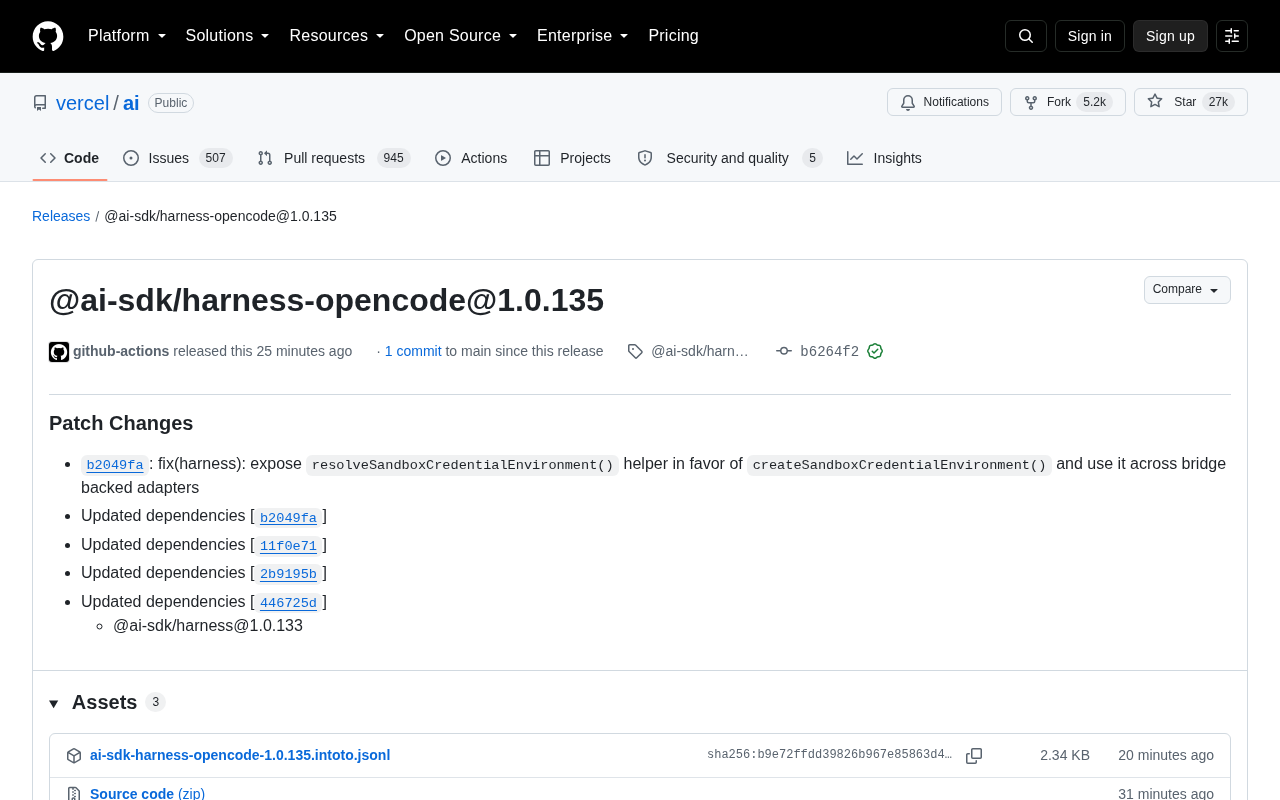
In addition, this version includes dependency updates (corresponding to commits 11f0e71, 2b9195b, 446725d, etc.) and upgrades the underlying @ai-sdk/harness to 1.0.133. The entire commit carries GitHub's verified signature, ensuring the trustworthiness of the release source.
Semantic Difference Between resolve and create
The most noteworthy aspect of this change is the shift in function naming from create to resolve. While it's just a function name change on the surface, it often reflects a shift in design philosophy.
create typically implies constructing a brand-new credential environment object, while resolve emphasizes "resolving and obtaining" — deriving the appropriate credential environment based on the current context, potentially reusing existing configuration or generating it on demand. This semantic shift is typically intended to make credential handling more deterministic and predictable, reducing side effects caused by redundant object creation.
For scenarios involving sandbox execution environments, the correctness of credential management is especially critical. When AI applications run code or call external tools, execution often happens inside an isolated sandbox, and how credential environments are resolved directly determines whether permission boundaries are clear and whether keys are injected correctly.
Practical Impact for Developers
If your project uses @ai-sdk/harness-opencode — especially when interacting with sandbox environments through bridge adapters — it's recommended to update promptly.
Based on the changelog, createSandboxCredentialEnvironment() is being superseded by resolveSandboxCredentialEnvironment() (the phrase "in favor of" indicates the former is being de-emphasized and may be gradually deprecated). If your code calls the old function directly, be aware of potential compatibility changes in future versions — migrating to the new helper proactively is the safer approach.
As a Patch version, this should theoretically comply with Semantic Versioning (SemVer) and not introduce breaking changes, so upgrading should be relatively safe. However, since this involves security-sensitive credential logic, it's still advisable to validate in a test environment before deploying to production.
Semantic Versioning (SemVer) is a widely adopted convention in software dependency management, using the format MAJOR.MINOR.PATCH. Patch-level updates are theoretically limited to backward-compatible bug fixes and should not alter the behavior or signature of public APIs. However, there's a gray area between theory and practice: when a fix involves a function that was originally poorly designed (like the now-deprecated createSandboxCredentialEnvironment()), code that directly calls the old interface may still face removal risk in a future Minor version — even if the version number follows the spec. Therefore, for security-sensitive paths such as credentials and permissions, upgrade risk cannot be assessed by version level alone; the specific changes in the changelog must be reviewed manually.
About Vercel AI SDK
Vercel AI SDK is one of the more popular open-source toolkits for building AI applications, with around 27,000 stars and 5,200 forks on GitHub and a notably active community. It provides a unified interface for integrating with different model providers and encapsulates common capabilities like streaming responses, tool calling, and sandbox execution.
Sub-packages like harness and harness-opencode are typically aimed at lower-level execution orchestration scenarios, such as running AI-generated code in controlled environments. This explains why sandbox credential management is a recurring area of focus — secure isolation is a prerequisite for these capabilities to work in practice.
The frequency of patch releases (version number already at 1.0.135) also reflects that the project is still in a rapid iteration phase, with features and interfaces continuously being refined. For developers relying on fast-evolving libraries like this, pinning versions and monitoring changelogs are essential engineering practices.
Bridge adapters are a key abstraction layer in the AI SDK architecture, responsible for connecting the SDK's unified interface to specific underlying execution environments. In the context of harness-opencode, bridge adapters act as a "translation layer" between AI model calls and the actual code execution sandbox — handling request format conversion, context passing, and injection of runtime credentials. Because bridge adapters operate across multiple execution boundaries, credential environment handling must be highly consistent; otherwise, different adapters may behave differently when injecting keys, leading to hard-to-debug security vulnerabilities or privilege leakage. This update's move to uniformly replace scattered legacy calls across bridge adapters with resolveSandboxCredentialEnvironment() is precisely aimed at eliminating this potential inconsistency.
Summary
The @ai-sdk/[email protected] update is small in scope, but it's a microcosm of the SDK's ongoing refinement in security and engineering quality. The function rename from create to resolve, along with its unified adoption across bridge adapters, points toward a cleaner and more controllable credential management design. For teams that depend on this functionality, staying current with version updates and gradually migrating to the new helper is the prudent path forward.
Related articles

Deconstructing ReAct: A Hands-On Guide to Building AI Agents from Scratch
A deep dive into the ReAct (Reason and Act) pattern behind AI Agents, demonstrated through a weather query case: how LLMs call tools, the inner mechanics of the ReAct loop, multi-tool routing and state management, along with infinite-loop pitfalls and development best practices.

LangChain4j from Beginner to Practice: An Advanced Course in LLMs for Java Programmers
Bilibili LangChain4j tutorial analysis: How Java programmers can add AI highlights to their resumes by mastering LLM frameworks, vector databases, and RAG technology to meet enterprise AI enablement layer development needs.

Java Developer's Path to AI Full-Stack: From Traditional Tech Stack to LLM Development in Practice
A Bilibili course explains how Java developers can advance from traditional microservices to AI full-stack engineering, covering LLM development skills, resume strategies, and job market trends.