Vercel AI SDK Update: workflow-harness Sandbox API Refactoring Explained

Vercel AI SDK workflow-harness 1.0.126 upgrades to ES2022 and refactors the sandbox API boundary.
Vercel AI SDK's `@ai-sdk/workflow-harness` has released patch version 1.0.126, synchronized with the main `@ai-sdk/harness` package. The update includes two core changes: upgrading the compilation target to ES2022 for leaner, modern output with less transpilation overhead, and refactoring the sandbox API to achieve a cleaner separation of concerns — extracting sandbox configuration and lifecycle management from harness orchestration logic while streamlining template and snapshot handling. Developers should validate existing sandbox configuration code in a test environment before deploying, and confirm their runtime supports ES2022.
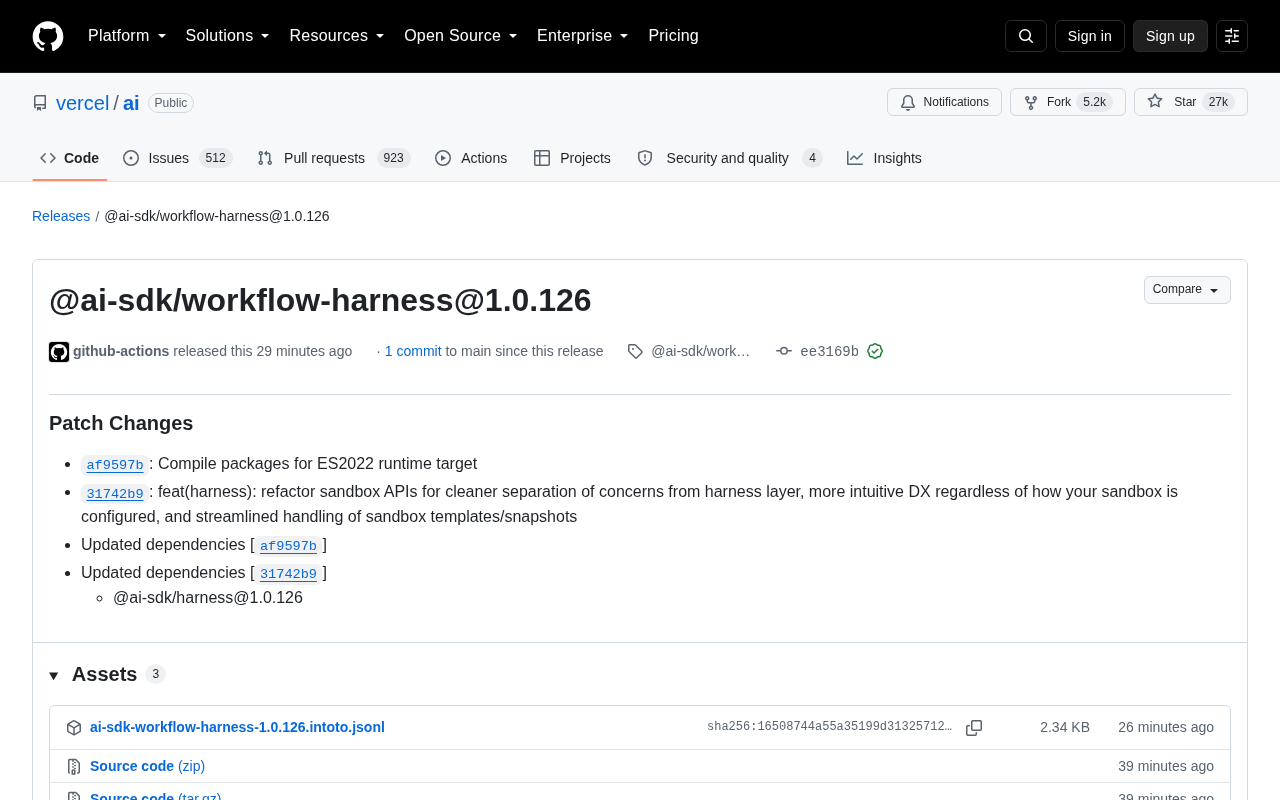
Vercel's widely followed AI SDK project (27k stars and 5.2k forks on GitHub) has released @ai-sdk/workflow-harness@1.0.126. This update lands as a patch release, centered on a refactored sandbox API and an updated runtime compilation target. While the version bump is minor, developers building AI workflows on this toolchain will find meaningful improvements to the developer experience (DX).
Two Core Changes in This Update
Based on the official Patch Changes notes, version 1.0.126 includes two primary modifications:
Compilation target upgraded to ES2022. Commit af9597b explicitly states that the package is now compiled targeting the ES2022 runtime. This means the output can directly leverage ES2022 language features (such as top-level await, class fields, Error.cause, etc.), reducing unnecessary transpilation. Projects running on modern Node.js or browser runtimes benefit from leaner output and better performance. For projects already on newer runtimes, this is a largely painless win.
Sandbox API refactoring. Commit 31742b9, tagged as feat(harness), is the headline change in this release. The official description aims for a cleaner separation of concerns between the sandbox layer and the harness layer, delivering a more intuitive developer experience regardless of sandbox configuration, while also streamlining the handling of sandbox templates and snapshots.
Why Separating Sandbox and Harness Responsibilities Matters
In an AI workflow execution framework, the harness layer is responsible for orchestrating task flows, scheduling model calls, and tool execution, while the sandbox layer provides an isolated, secure environment for code and tool execution. When the API boundary between these two layers is blurry, developers often end up writing boilerplate code unrelated to business logic just to configure sandbox templates and manage runtime snapshots.
This refactoring's emphasis on a "cleaner separation of concerns" essentially extracts sandbox configuration and lifecycle management from the core logic of the harness. The direct benefit: no matter which sandbox configuration you use, the higher-level workflow orchestration code remains consistent in how it's called, reducing cognitive overhead. For teams that need to switch between different environments (local, cloud sandbox, snapshot restore), the clarity of such abstractions often determines long-term maintainability.
Separation of Concerns is a classic software engineering principle that divides a system into independent modules, each responsible for its own domain. In execution framework libraries, this principle is especially critical: the harness layer needs to focus on what to do (orchestrate tasks, schedule calls), while the sandbox layer focuses on where to do it (provide an isolated, secure execution context). When the APIs of these two layers are tightly coupled, business orchestration code is forced to be aware of internal sandbox details — such as manually handling sandbox initialization order or hardcoding snapshot IDs inside workflow code. The essence of this refactoring is to introduce a stable interface contract between the two layers, making the sandbox implementation details transparent to upper-layer code — similar to how an operating system abstracts hardware differences through system calls.
Streamlined Template and Snapshot Handling
The release notes specifically mention "streamlined handling of sandbox templates/snapshots." Sandbox templates are typically used to predefine a reusable execution environment (e.g., pre-installed dependencies, configured runtimes), while snapshots are used to save and restore the state of a sandbox at a given point in time.
In AI agent and automated workflow scenarios, both capabilities are critical: templates ensure consistency in the starting point for tool execution, while snapshots support interruption recovery and debugging rollback for long-running tasks. Streamlining these processes means developers can more quickly build reproducible execution environments and spend less time troubleshooting environment setup.
Sandbox snapshots originate from the virtualization world: serializing the complete memory and filesystem state at a given moment for later restoration, bypassing re-initialization. In AI agent execution scenarios, a long-running task may involve dozens of tool calls. If interrupted midway due to network timeout or quota limits, being able to hot-restart from the most recent snapshot — rather than re-running from scratch — is crucial for controlling cost and latency. Sandbox templates are analogous to Docker images: the runtime environment (dependency libraries, config files, runtime versions) is pre-packaged into a reusable base layer, and each new sandbox instance is derived from the template, ensuring environment consistency across execution instances. Together, they form the infrastructure for "reproducible and recoverable" AI workflow execution environments.
Version Alignment and Upgrade Recommendations
This release simultaneously updates the dependency package @ai-sdk/harness@1.0.126, keeping both packages in version sync. The release notes reference updated dependencies af9597b and 31742b9, indicating that both the main harness package and workflow-harness have absorbed the ES2022 compilation and sandbox refactoring changes.
For developers currently using this toolchain, there are two things to watch before upgrading: first, confirm that your runtime environment is compatible with the ES2022 target (modern Node.js versions are largely fine); second, since the sandbox API has been refactored, code related to sandbox configuration, templates, and snapshots may need to be adjusted to match the new API. Even though the version is still patch-level, any API shape changes warrant validation in a test environment before going to production.
Summary
@ai-sdk/workflow-harness@1.0.126 is not a feature-explosion update — it's a refinement focused on developer experience and engineering quality. The ES2022 compilation target produces more modern output, while the sandbox API refactoring clarifies the boundary between harness and sandbox. For developers building AI workflows and agent execution frameworks, this kind of continuous improvement to foundational abstractions is precisely what determines whether a framework can evolve stably over the long term.
Background Notes
ES2022 is the 2022 edition of the ECMAScript standard, introducing several practical features: public/private class fields and static blocks (class fields / static {}), top-level await (usable directly at the module top level without wrapping in an async function), Array.prototype.at(), and more. Upgrading the compilation target from lower versions (such as ES5/ES2017) to ES2022 means bundlers no longer need to transpile these features into polyfill form for older syntax, resulting in smaller output, cleaner call stacks, and a more direct correspondence between source code and output during debugging. Node.js 16 and above have fairly complete support for ES2022 features, so for most server-side AI workflow projects, this upgrade requires virtually no additional adaptation.
Related articles

Random Pruning of the DPO Computation Graph: 1.4x Training Speedup and Lower Peak Memory
DPO training too slow and memory-hungry? This paper proposes a random pruning framework for the DPO computation graph, sampling independently across position, sequence, and branch dimensions; branch pruning achieves a 1.426x step-time speedup and cuts training time by about 30%, with in-depth attribution of memory and time gains.

Why Does JEPA Underperform MLM in Longitudinal EHR Representation Learning?
New study compares JEPA and MLM for longitudinal EHR representation learning on MIMIC-IV: three JEPA variants train stably without collapse but underperform MLM; target size, not heterogeneity, drives prediction error.

Transfer Learning + Visible Light Communication: A New Approach to Energy-Efficient Indoor Positioning
A study proposes a transfer learning-based visible light communication indoor positioning method, achieving 47% accuracy improvement on the BOSCH factory dataset, 67.5% model efficiency under high noise, and introducing the ME composite metric for energy-efficient positioning in energy-constrained industrial IoT scenarios.