Vercel AI SDK Update: workflow-harness Version Release Breakdown

Vercel AI SDK's workflow-harness sub-package hits patch 132, showcasing mature automated release engineering.
Using the routine `@ai-sdk/workflow-harness@1.0.132` npm patch release as a starting point, this article explores the sub-package's role in multi-step AI workflow orchestration and testing, as well as the Changesets and GitHub Actions-based automated versioning pipeline behind it. The focus is on helping developers understand monorepo sub-package maintenance patterns and how to approach high-frequency patch releases: watch the changelog, lock dependencies in production, and coordinate upgrades with the core package.
What's Behind This Release
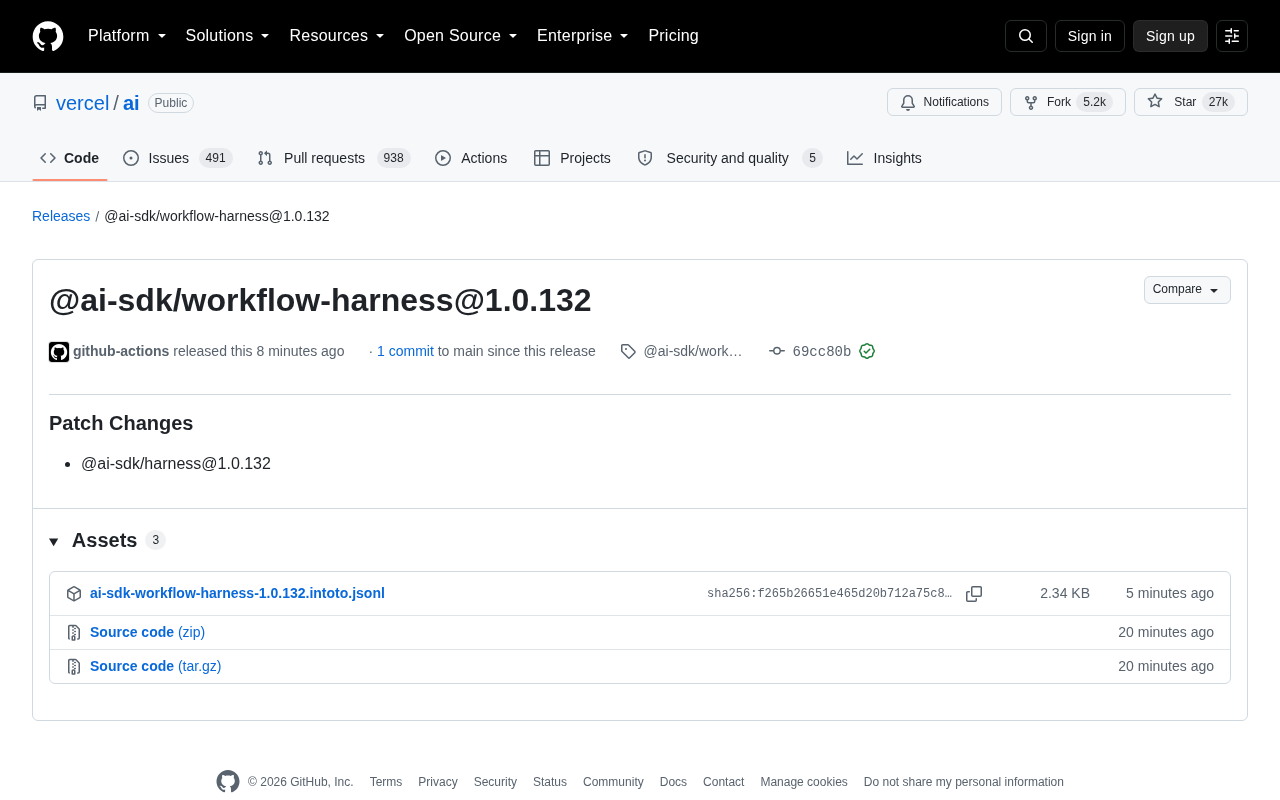
The source material for this article comes from a Release record in Vercel's official GitHub repository vercel/ai, tagged as @ai-sdk/workflow-harness@1.0.132. The release was automatically tagged by GitHub Actions, with commits verified via GitHub's GPG signature (key ID: B5690EEEBB952194), corresponding to PR #21666 (Version Packages).
To be upfront: this release is essentially a routine npm package version notification with no detailed changelog or feature description attached. This article therefore focuses less on new features and more on the context around the @ai-sdk/workflow-harness module itself — its role within the Vercel AI SDK ecosystem — to help developers understand the significance of this type of update.
What Is @ai-sdk/workflow-harness
Vercel AI SDK is one of the most widely used toolkits for frontend and full-stack developers building AI applications. Its GitHub repository has accumulated around 27k stars and 5.2k forks, reflecting a vibrant and active community. The SDK is structured as a monorepo containing multiple independently published sub-packages — @ai-sdk/workflow-harness being one of them.
From its name alone, workflow-harness appears to target AI workflow orchestration and testing scenarios. In software engineering, "harness" typically refers to a scaffold or framework used to drive and execute a piece of logic. In the context of the AI SDK, this module most likely supports building, running, and validating multi-step AI pipelines — for example, chaining multiple model calls, tool calls, and state transitions in an orchestrated flow.
What the Version Number Tells Us
The patch segment of 1.0.132 has already reached 132 iterations, indicating this module is under high-frequency maintenance. Small releases like this typically include bug fixes, dependency upgrades, or compatibility adjustments with the main SDK. They are the natural output of a continuous integration pipeline rather than a major feature milestone.
Vercel AI SDK's monorepo is built on Turborepo, managing the core ai package, model provider adapters (such as @ai-sdk/openai and @ai-sdk/anthropic), and utility sub-packages all within a single repository. Each sub-package is independently published to npm with its own versioning, though they generally need to maintain a compatible version range with each other. workflow-harness sits at the toolchain support layer — unlike API packages exposed directly to end users, it primarily serves developers who need debugging and validation capabilities when building complex AI workflows. This kind of "internal support package" is common in large SDK ecosystems yet often lacks standalone documentation, leaving developers to rely on source code and test cases to understand its actual capabilities.
The Value of Automated Release Pipelines
One detail in this release worth noting for developers is how it was published: automatically tagged by github-actions, paired with a Version Packages PR — a classic Changesets workflow pattern — enabling semantic versioning and automated releases.
For monorepo projects managing multiple sub-packages, manually tracking versions is error-prone. Vercel's approach — using Changesets to collect changes, automatically generating version numbers and release notes, and using GPG signatures to ensure commit integrity — represents the standard engineering practice for modern open-source projects. GitHub's verified signature further ensures that published artifacts haven't been tampered with, which is especially important for foundational libraries that thousands of downstream projects depend on.
Changesets is a version management tool designed specifically for monorepos. The workflow works roughly as follows: when submitting code, developers include a .changeset file describing the change level (major/minor/patch); the Changesets Bot automatically aggregates these files and opens a "Version Packages" PR, which upon merging automatically updates each sub-package's package.json version and generates a CHANGELOG.md; CI then triggers npm publishing. The core value of this mechanism is that it returns the judgment of "who changed what and how significant is it" to the contributors themselves, while fully automating the tedious version calculation and publishing operations. Compared to manual version management, Changesets significantly reduces the risk of version drift and missed releases in multi-package projects. It has been widely adopted by major open-source projects including Svelte and Chakra UI.
Practical Advice for Developers
If your project uses Vercel AI SDK to build agents or multi-step workflows, here are some recommended practices when encountering high-frequency patch releases like this:
- Focus on the changelog, not just the version number: Patch versions are generally safe to upgrade, but it's worth checking the corresponding PR or release notes to confirm whether any behavioral changes are included.
- Lock your dependency versions: Use a lockfile in production environments to pin versions and avoid unexpected changes from automatic upgrades.
- Coordinate upgrades with the main SDK: Sub-packages often need to stay in sync with the core
aipackage — pay attention to compatibility notes when upgrading.
Summary
The @ai-sdk/workflow-harness@1.0.132 release is itself a routine automated patch update with limited information. However, it reflects two characteristics of the Vercel AI SDK ecosystem: first, the module focused on AI workflow orchestration is being continuously refined; and second, there is a mature automated release and signature verification mechanism operating behind the scenes. For teams relying on this toolchain, understanding these engineering practices is ultimately more valuable than tracking individual version numbers.
Related articles

Meta Fined $25 Billion: New Mexico's Cambridge Analytica Case Sets Record
New Mexico issued a $25 billion penalty against Meta over the Cambridge Analytica data scandal, setting a record fine for a tech giant. This article covers the case background, fine calculation logic, and developer community divisions, analyzing the impact of state-level regulation on the tech industry.

PACE: A New 4-Bit Recurrent State Quantization Method That Makes Linear Attention Models More Memory-Efficient
PACE is a post-hoc 4-bit recurrent state quantization method that uses periodic rounding and channel-aligned encoding to match 8-bit performance on linear attention models while saving about one-third of memory.

Tesla Cybercab to Go on Sale by Year-End: No Steering Wheel, Under Regulatory Investigation
Tesla announces it will start selling the steering-wheel-free, two-seat Cybercab by year-end as federal regulators investigate its compliance with vehicle safety standards.