Meta Fined $25 Billion: New Mexico's Cambridge Analytica Case Sets Record

New Mexico fined Meta $25 billion under consumer protection law over the Cambridge Analytica scandal, sparking debate on state enforcement and privacy regulation.
The New Mexico Attorney General's Office issued a $25 billion penalty judgment against Meta in a lawsuit involving the Cambridge Analytica data scandal, setting a record for fines against tech giants. The amount was calculated based on affected users in the state and the statutory maximum per violation, but Meta is expected to appeal and the final amount may be reduced. Hacker News discussion is divided: some say the fine is still not enough of a deterrent, while others worry about compliance burdens from fragmented state enforcement. The case shows state attorneys general are becoming a key force in tech regulation, and data-driven companies will face stricter judicial scrutiny over informed consent and data usage disclosure.
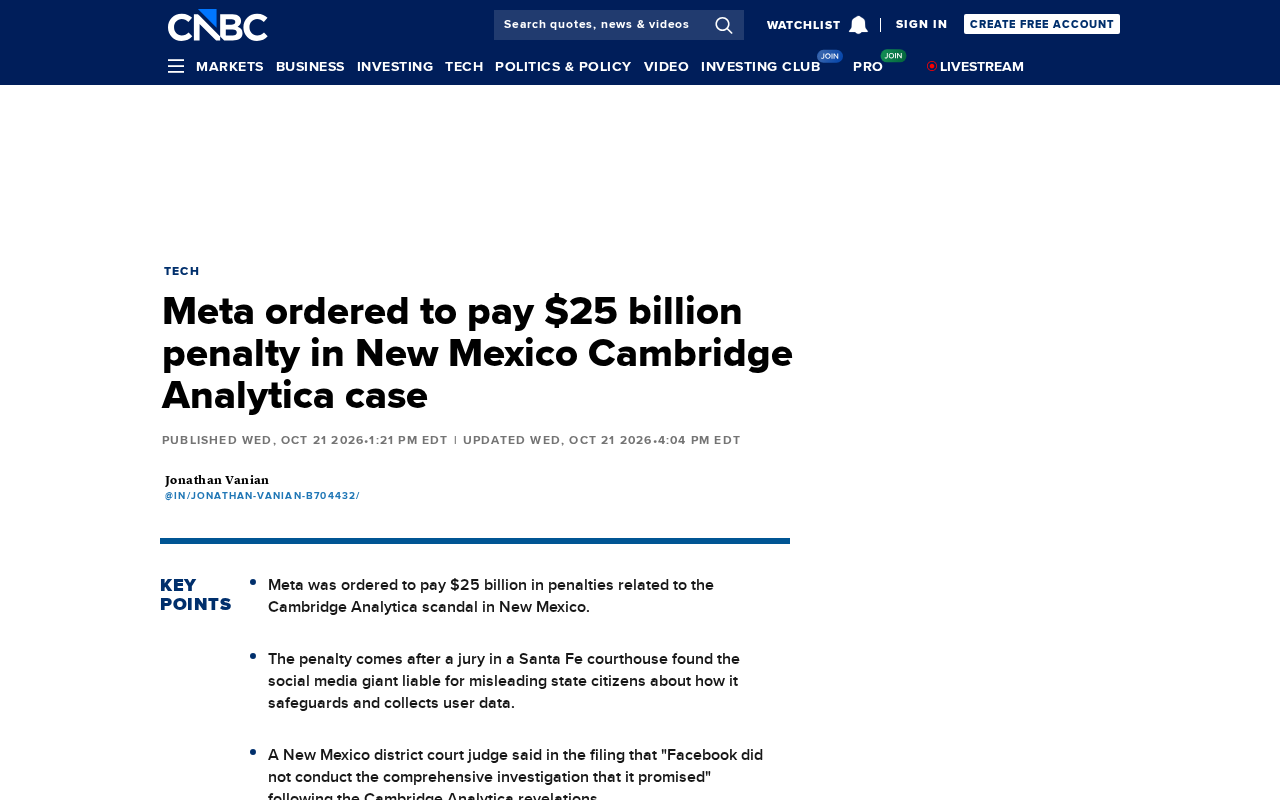
The New Mexico Attorney General's Office recently announced a penalty judgment of up to $25 billion against Meta (formerly Facebook) in a lawsuit involving the Cambridge Analytica data scandal. If ultimately enforced, this figure would set a record for fines against tech giants. The news sparked heated discussion on Hacker News, quickly garnering 330 points and 203 comments, as developers and privacy advocates engaged in intense debate over the legality and practical impact of the ruling.
Case Background: The Cambridge Analytica Scandal Continues
The Cambridge Analytica incident first came to light in 2018, when it was disclosed that the political consulting firm Cambridge Analytica had obtained personal data from tens of millions of Facebook users through a third-party app, using it for targeted political advertising. The scandal raised global questions about Facebook's data governance capabilities, and the U.S. Federal Trade Commission (FTC) subsequently imposed a $5 billion fine. New Mexico's lawsuit takes a different angle, invoking state-level consumer protection law to allege that Meta failed to effectively protect user data and misled users about data-sharing practices in its product descriptions.
According to a press release from the New Mexico Department of Justice, the state argued that Meta's conduct violated the Unfair Practices Act and sought civil penalties proportional to the number of affected users. The $25 billion figure was calculated based on the number of affected users within the state and the statutory maximum penalty per violation.
Cambridge Analytica was a British political consulting firm. A joint investigation by The Guardian and The New York Times in 2018 revealed that the company had collected personal data from approximately 87 million Facebook users—including information about users' friends' networks—through a personality test app called "thisisyourlife" without users' explicit consent. This data was used to build psychological profiles and serve targeted political advertising for the 2016 U.S. election and the UK Brexit referendum. After the scandal broke, Facebook acknowledged its failures in data governance, and Cambridge Analytica subsequently went bankrupt. The U.S. Federal Trade Commission (FTC) fined Facebook $5 billion in 2019 and required it to reform its privacy protections. The scandal became a turning point for global data privacy regulation, directly strengthening enforcement of the EU's General Data Protection Regulation (GDPR) and accelerating privacy legislation across U.S. states.
How Was the $25 Billion Figure Calculated?
Based on public information, this figure was not arbitrarily set. The New Mexico Attorney General's Office described it in its press release as a "historic victory against Big Tech" and emphasized that the fine was intended to deter similar future conduct. Legal experts note that state consumer protection laws typically allow penalties to be calculated per affected user per violation, and if the court finds that Meta's violations persisted for years, the cumulative amount could reach tens of billions of dollars.
However, the judgment still faces appeal. Meta will likely challenge it on grounds that the fine is excessive and violates the constitutional principle of proportionality. In the Hacker News comment section, some users pointed out that similar astronomical fines at the state court level are often reduced by higher courts, and the actual amount paid may end up far lower than the judgment figure.
State consumer protection laws (often called Unfair Deceptive Practices Acts or UDAP) generally authorize attorneys general to bring lawsuits against deceptive business practices and impose civil penalties per violation. The maximum penalty amount is typically specified by state law (for example, New Mexico's Unfair Practices Act sets a maximum fine of $5,000 per violation), but courts calculating total penalties may treat each independent violation for each affected user as a separate act, thereby accumulating enormous figures. This calculation method is similar to the FTC's mechanism of daily penalties per violation, designed to make fines proportional to the scale of the violation. However, the constitutional principle of proportionality (especially the Eighth Amendment's prohibition on excessive fines) is often invoked by defendants, and courts may reduce fines on the grounds that they are disproportionate to the severity of the conduct.
Multiple Perspectives: Divisions Among the Developer Community and Privacy Advocates
The discussion on Hacker News revealed two distinct positions. Some commenters argued that this is a deserved punishment for Meta's long-standing disregard for user privacy, and that $25 billion is still a "manageable operating cost" relative to Meta's annual revenue—真正有效的威慑需要更高的罚款或结构性拆分. Others worried that state attorneys general using broad consumer protection laws to pursue massive claims could amount to "opportunistic enforcement," with the ultimate costs passed on to users or small and medium-sized advertisers.
This division is also reflected in broader tech policy discussions. According to statements from some privacy advocacy groups on social media, they view this case as a model for individual states regulating tech giants independently, while industry lobbying groups warn that fragmented state-level litigation increases compliance burdens and that the actual connection between fine amounts and violations requires judicial review.
Impact on Meta and the Industry
In the short term, Meta's financial performance will not be immediately affected by this judgment, as the appeals process could last for years. But the signal the case sends cannot be ignored: U.S. state attorneys general are increasingly actively invoking local consumer protection laws to bring independent lawsuits against tech companies rather than waiting for federal action. This "state-level enforcement race" may become the new normal for tech regulation.
For AI and data-driven companies, this case once again highlights the importance of data source compliance and informed user consent. Although the Cambridge Analytica incident occurred years ago, its legal consequences continue to reverberate. Companies building user profiles and training recommendation algorithms may face cumulative penalties from multiple jurisdictions if they fail to clearly disclose data usage and obtain valid consent.
In the absence of comprehensive federal data privacy legislation in the U.S., it has become a trend for state attorneys general to bring lawsuits against tech companies under their states' consumer protection laws. California, Washington, Texas, and others have dedicated privacy enforcement divisions and frequently investigate the data processing practices of large platforms. This "state-level enforcement race" stems from the FTC's limited resources and slower action, while state attorneys general have independent enforcement authority and stronger political incentives. For companies, this means compliance strategies cannot consider only federal standards but must also address differing legal interpretations and penalty calculation methods across states, significantly increasing legal risk and compliance costs.
Conclusion
The $25 billion fine is a shocking number, but what truly deserves attention is the regulatory logic behind it: state-level enforcement is filling the gap left by federal regulation, and tech giants must pay for data governance failures from years ago. Regardless of the appeal outcome, this case will become an unavoidable precedent in discussions about platform responsibility and privacy protection.
One-line Summary
New Mexico fined Meta $25 billion under consumer protection law over the Cambridge Analytica data scandal, sparking widespread debate about state-level enforcement and privacy regulation.
Paragraph Summary
The New Mexico Attorney General's Office issued a $25 billion penalty judgment against Meta in a lawsuit involving the Cambridge Analytica data scandal, setting a record for fines against tech giants. The amount was calculated based on the number of affected users in the state and the statutory maximum penalty per violation, but Meta is expected to appeal and the final amount may be reduced. Discussion on Hacker News is divided: some argue the fine is still insufficient as a deterrent, while others worry that fragmented state-level enforcement creates compliance burdens. The case reflects that U.S. state attorneys general are becoming an important force in tech regulation, and for data-driven companies, compliance requirements around informed user consent and data usage disclosure will face stricter judicial scrutiny.
Related articles

Codex Plans, Claude Codes: 3.6K-Star Open-Source Project Enables Multi-AI Collaborative Development
Bilibili creator tests open-source CCB (Claude Codex Bridge): Codex plans and reviews while Claude Code writes code. 3.6K stars, supports Gemini, Kimi, Qwen, Cursor.

AI Agent Burns Through Thousands of Dollars Overnight? Three Lines of Defense to Prevent Runaway Costs
AI Agents running autonomously can burn thousands of dollars overnight in infinite loops. This article explains three safety defenses—Reflection Loop, Human-in-the-Loop, and Guardrail—to help developers build controllable, recoverable Agent systems that prevent budget overruns and prompt injection attacks.

Hive Intelligence: Filling the Real-Time On-Chain Data Gap for AI Agents
Hive Intelligence connects AI Agents to real-time crypto prices and token security checks via MCP servers with one-command deployment. This article reviews its multi-agent architecture, free quota, pricing, and the real value and limits of the Quaza Rewards token incentive model.