Vercel AI SDK Vue 2.0.253 Update Analysis: Multi-Framework Adaptation Strategy and Development Practices
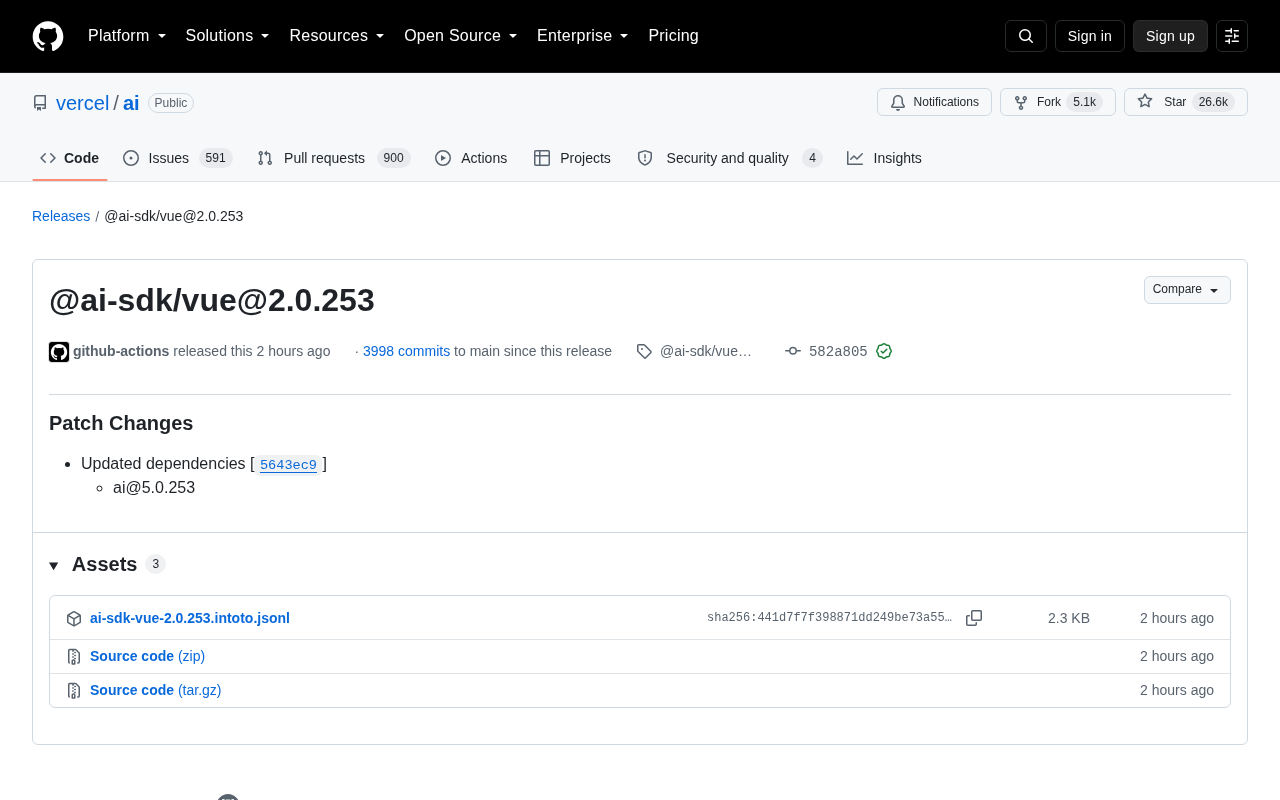
Analyzing Vercel AI SDK Vue 2.0.253's patch update and its multi-framework adaptation strategy.
Vercel AI SDK released @ai-sdk/vue@2.0.253, a patch update that syncs with the core ai@5.0.253 package. This article examines the SDK's layered architecture of core package plus framework adapters, explains how it delivers equal AI capabilities to Vue developers including streaming responses and tool calling, and discusses what the high-frequency release cadence means for the broader AI development ecosystem.
Continuous Iteration of the AI SDK
Vercel recently released the @ai-sdk/vue@2.0.253 update. As a popular open-source project on GitHub with over 26.6k Stars and more than 5.1k Forks, the Vercel AI SDK has become a core piece of infrastructure for frontend and full-stack developers building AI applications.
Although this update is a patch-level release with seemingly minor changes, it reflects the mature strategy of the entire AI SDK ecosystem in terms of framework adaptation. This article will examine the update, outline Vercel AI SDK's design philosophy for multi-framework support, and analyze its practical implications for developers.
Breaking Down This Update
Core Changes in the Patch Version
According to the official release notes, the update in @ai-sdk/vue@2.0.253 is highly focused — it's a dependency synchronization update (Patch Changes). Specifically:
Updated dependencies [
5643ec9]
ai@5.0.253
This means the Vue adapter package itself didn't introduce any new features. Instead, it was upgraded in sync with the core package ai@5.0.253. This approach ensures that Vue ecosystem users receive the core SDK's underlying improvements and fixes as soon as possible while maintaining API-level stability.
Why Patch Updates Still Matter
In the Semantic Versioning (SemVer) system for open-source software, a patch version (incrementing the third digit) typically represents backward-compatible bug fixes. Semantic Versioning is a version numbering specification proposed by GitHub co-founder Tom Preston-Werner, following the format MAJOR.MINOR.PATCH. MAJOR (major version number) increments when introducing incompatible API changes, MINOR (minor version number) increments when adding backward-compatible features, and PATCH (patch version number) increments when making backward-compatible bug fixes. This specification has been widely adopted by major package managers such as npm, Maven, and Cargo, becoming a cornerstone of dependency management in modern software engineering. For Monorepo projects like the AI SDK that contain multiple sub-packages, SemVer is particularly important — it allows consumers to quickly assess upgrade risk through version numbers, while version constraint symbols like ~ (tilde) and ^ (caret) make automated dependency updates possible.
For a rapidly iterating project like the AI SDK, a version number like 2.0.253 itself speaks to the intensity of its release cadence — the 3,998 commits on the main branch further demonstrate the high level of development activity.
For developers in production environments, keeping up with patch versions often brings stability improvements and potential bug fixes without the migration costs associated with breaking changes.
Vercel AI SDK's Multi-Framework Strategy
Unified Core, Layered Adaptation
The Vercel AI SDK adopts a "core package + framework adapter packages" architectural design. This pattern is essentially a classic application of Monorepo (single-repo, multi-package) architecture — managing multiple related but independently published packages within the same code repository, leveraging tools like Turborepo, Nx, and Lerna for unified build, test, and release workflows. This architecture is already very common in the frontend ecosystem; Vue 3 itself splits modules like reactivity, compiler, and runtime into independent packages.
The core ai package provides a unified abstraction layer for interacting with major model providers (such as OpenAI, Anthropic, Google, etc.), encapsulating the protocol layer for communicating with large models (such as Server-Sent Events parsing, streaming JSON processing, Tool Calling protocols, etc.). Adapter packages like @ai-sdk/vue, @ai-sdk/react, and @ai-sdk/svelte are responsible for bridging these capabilities to specific frontend frameworks, transforming them into each framework's idiomatic reactive primitives — such as Vue's ref and composable, or React's useState and hook. This separation of concerns enables bug fixes in the core logic to benefit all framework users through a single code change.
The advantages of this layered architecture:
- Consistent developer experience: Whether using React or Vue, developers face a similar API mental model
- Independent version iteration: Framework adapter packages can be updated independently based on each ecosystem's needs — this Vue package update is a perfect example of this mechanism
- Reduced maintenance costs: Core logic is maintained centrally, minimizing duplicated code across frameworks
Filling the AI Capability Gap for the Vue Ecosystem
For a long time, React has been the "first-class citizen" in AI application development, with many tools prioritizing React support. Vercel AI SDK's continuous maintenance of a dedicated Vue adapter package effectively provides Vue developers with AI integration capabilities on par with React, including streaming response handling, chat state management, tool calling, and other common scenarios.
Among these, streaming response handling is one of the most critical interaction patterns in AI application development. Large Language Models (LLMs) generate text far slower than traditional APIs return structured data. If you wait for the complete response before rendering, users might face seconds or even tens of seconds of blank waiting. Streaming technology, through Web standards like Server-Sent Events (SSE) or ReadableStream, pushes each token to the frontend as soon as the model generates it, creating a "typewriter" effect where text appears character by character. The AI SDK encapsulates the differences in streaming protocols across various providers at the underlying level — for example, OpenAI uses the text/event-stream format, while Anthropic's Messages API uses different event types — and exposes a unified streaming consumption interface to the upper layer. In the Vue adapter package, this streaming data is bridged to reactive ref objects that automatically trigger view updates when new tokens arrive, freeing developers from manually handling the low-level stream parsing logic.
Tool Calling is another core capability of modern LLM applications. It allows models to "decide" to invoke external tools during a conversation — such as querying a database, calling a weather API, or performing code calculations — rather than just generating text. The typical workflow is: developers define available tools using JSON Schema descriptions in the request; the model determines whether to call a specific tool based on user intent and outputs structured calling parameters; the application layer executes the actual call and passes the result back to the model, which integrates it into a final answer. This mechanism upgrades LLMs from "pure text generators" to "intelligent agents" (Agents), serving as the technical foundation for building RAG (Retrieval-Augmented Generation) systems, AI assistants, and automated workflows. The AI SDK provides a type-safe abstraction for tool calling, allowing developers to define tool parameters with TypeScript/Zod Schema for compile-time type checking and runtime automatic validation.
For teams using Vue as their primary tech stack, this means they can access the latest AI interaction capabilities without switching frameworks.
Practical Implications for Developers
Version Upgrade Recommendations
For Vue projects currently using the Vercel AI SDK, here are some recommendations:
- Regularly follow patch versions: Patch updates are low-risk and offer stable benefits — incorporate them into your routine dependency maintenance workflow
- Monitor the core package changelog: Since the Vue package follows
aicore package updates, understanding core package changes helps assess the value of upgrading - Lock minor versions: In production environments, consider using the
~2.0.xversion constraint to automatically receive patch updates while avoiding unexpected minor version changes
A Signal of Ecosystem Prosperity
From a broader perspective, the AI SDK's high-frequency release cadence reflects that the AI application development toolchain is in a period of rapid evolution. Vercel was founded in 2015 (originally named ZEIT) by Next.js creator Guillermo Rauch and is currently valued at over $2.5 billion. The company's core product matrix includes: Next.js (React full-stack framework), Vercel deployment platform (edge computing and Serverless hosting), Turbopack (a high-performance bundler written in Rust), and the AI SDK. Vercel's strategic logic is clear — capture developer mindshare through open-source frameworks, then monetize through its cloud platform. The AI SDK plays a key role in this strategy: it deeply integrates AI capabilities with Vercel's deployment platform. Scenarios like streaming AI responses on Edge Runtime and model invocations in Serverless Functions are naturally suited to Vercel's infrastructure.
As an important player in frontend infrastructure, Vercel has "productized" AI capabilities through the AI SDK, dramatically lowering the barrier for developers to integrate large models. At the same time, the AI SDK's multi-framework support (not limited to Next.js/React) also reflects Vercel's broader ambitions in the developer tools space.
The 26.6k Star count and active community contributions also confirm the strong market demand for such "out-of-the-box" AI development tools.
Conclusion
While @ai-sdk/vue@2.0.253 is a seemingly unremarkable patch update, it's a microcosm of the Vercel AI SDK's robust iteration strategy. For Vue developers, a continuously maintained framework adapter package means they can always stay at the forefront of AI application development.
In an era of rapidly changing AI toolchains, choosing an SDK that is promptly updated, has an active ecosystem, and features a clear architecture is itself a wise decision for reducing technical risk.
Related articles
DuckFightClub: An AI Robot Duck Fighting Arena
DuckFightClub combines reinforcement learning with open-source robots. Teams train MicroDuck AI strategies, competing from simulator battles to real-world combat in a multi-agent adversarial arena.
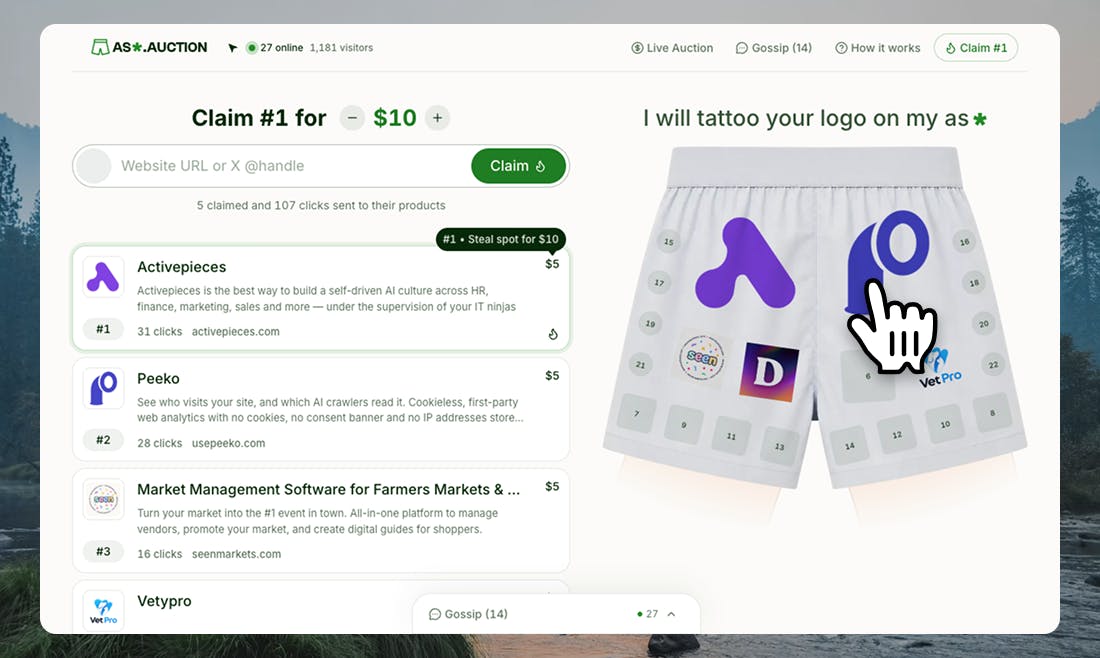
Ass Auction: The Marketing Logic Behind an Absurd Ad Bidding Experiment
Ass Auction earned 90 votes on Product Hunt: brands bid to print logos on underwear. A deep dive into the bidding mechanics, viral design, and attention economy behind this marketing experiment.
Rails 8 Deep Dive: New Features and Upgrade Guide
Deep dive into Rails 8 core features: Kamal 2 deployment, Solid Trifecta, built-in authentication. Covers runtime requirements, upgrade paths, and best practices for migration.