Vercel AI SDK Vue 3.0.276 Update Analysis: Dependency Sync and Practical Recommendations
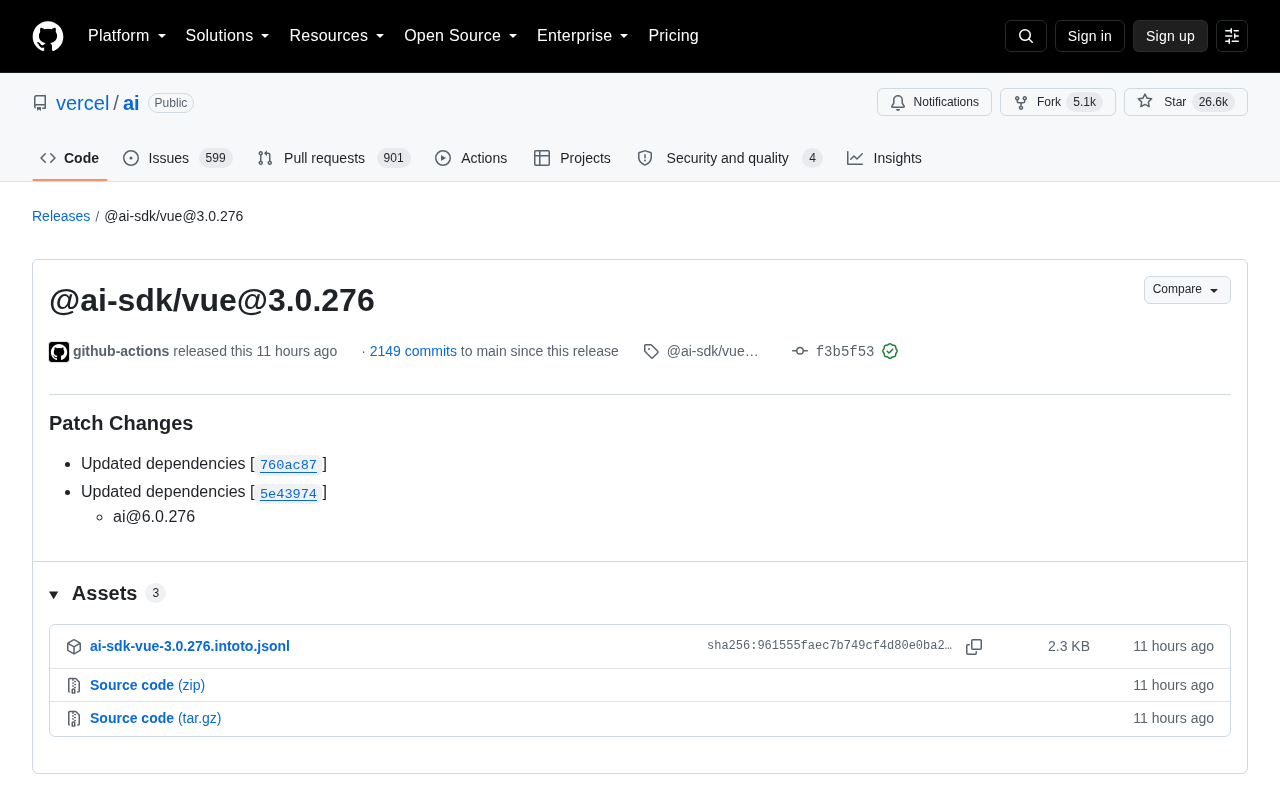
Vercel AI SDK Vue adapter syncs dependencies to ai@6.0.276 in routine patch release.
Vercel released @ai-sdk/vue@3.0.276, a patch update that syncs dependencies with the core ai@6.0.276 package. While no new features are introduced, this release reflects the Monorepo coordinated release strategy that keeps all framework adapters aligned. The article explains streaming responses, tool calling, SemVer conventions, and offers practical upgrade advice for Vue developers building AI applications.
Overview
Vercel's open-source project AI SDK has released version @ai-sdk/vue@3.0.276. With 26.6k Stars and 5.1k Forks on GitHub, this project has become a core toolkit for frontend developers building AI applications. This patch release for the Vue ecosystem was published on September 3rd. While the version number change is small, it reflects AI SDK's continuous iteration and rapid response to ecosystem demands.
For teams building AI-powered applications with the Vue framework, keeping up with SDK version updates not only provides security fixes for dependencies but also ensures compatibility with the upstream core package (the ai main package).
Update Details
Patch-Level Dependency Sync
According to the official Release Notes, this @ai-sdk/vue@3.0.276 release is a Patch Changes update, primarily consisting of dependency updates:
- Updated dependencies [
760ac87] - Updated dependencies [
5e43974] - Synced to
ai@6.0.276
This means the release doesn't introduce new features but rather maintains version alignment with the AI SDK core package. Vercel AI SDK uses a Monorepo (single repository) management model, where the core package ai and framework adapter packages (such as @ai-sdk/vue, @ai-sdk/react, @ai-sdk/svelte) are released in coordination. When core logic is updated, the Vue adapter layer needs to sync accordingly to ensure API consistency and underlying capability alignment.
Monorepo is a software engineering strategy that manages multiple related projects or packages within a single version control repository. In contrast, the Polyrepo (multi-repository) model maintains a separate repository for each package. The core advantages of Monorepo include: atomic commits across packages (a single commit can modify multiple packages simultaneously), unified CI/CD pipelines, simplified dependency management, and more efficient code reuse. Tech giants like Google and Meta have long used Monorepo strategies to manage billions of lines of code. In the JavaScript ecosystem, tools like Lerna, Nx, and Turborepo (owned by Vercel) provide mature build and release support for Monorepo setups. AI SDK's adoption of this model means that when a streaming parsing bug is fixed in the core ai package, all framework adapter packages can be adapted and released together in a single Pull Request, significantly reducing the risk of version fragmentation.
Why Frequent Patch Updates Matter
Since going open source, AI SDK has accumulated over 2,149 commits, and this high-frequency iteration has become the norm in the rapidly evolving AI landscape. Standards for LLM interfaces, streaming response handling, Tool Calling, and other capabilities are still in flux, requiring the SDK to continuously adapt to API updates from providers like OpenAI, Anthropic, and Google. Frequent patch versions are a direct reflection of this "rapidly follow upstream changes" strategy.
Streaming response handling is a critical interaction pattern in modern AI applications. Large language models generate text through token-by-token inference, and if users had to wait for the entire response to be generated before receiving it, they might wait seconds or even tens of seconds. Streaming output leverages HTTP Server-Sent Events (SSE) or the ReadableStream API to push each generated token to the frontend in real time, creating a progressive "typewriter effect" display. This involves complex engineering challenges: the frontend needs to handle incomplete JSON fragment concatenation, support mid-request cancellation, manage memory and rendering performance as tokens accumulate, and handle reconnection logic after network interruptions. AI SDK encapsulates these low-level details at the framework level, so developers don't need to manually manage EventSource connections or parse response bodies byte by byte.
Tool Calling is the key capability that elevates large language models from "pure text generation" to "intelligent agents." It works as follows: developers predefine a set of available tools (such as querying weather, searching databases, performing calculations, etc.) along with their parameter schemas. During conversation, the model determines when to invoke a tool and generates a structured call request (containing the tool name and parameters). The application executes the tool and returns the result to the model, which then generates a final answer based on the real data returned by the tool. OpenAI first introduced Function Calling in June 2023, followed by similar implementations from Anthropic (Claude), Google (Gemini), and others, though each provider's API format differs. AI SDK's abstraction layer plays a crucial role here — it unifies the tool calling protocols of different providers into a consistent interface, allowing developers to define tools once and seamlessly switch between different models.
Technical Positioning of AI SDK
A Unified Abstraction Layer for AI Application Development
The core value of Vercel AI SDK lies in providing developers with a unified abstraction that works across frameworks and model providers. Whether the backend connects to the GPT series, Claude, or open-source models, developers can use a consistent API to accomplish text generation, streaming output, structured data extraction, and tool calling.
@ai-sdk/vue serves as the bridge that seamlessly integrates these capabilities into the Vue ecosystem. It provides composable functions such as useChat and useCompletion, enabling Vue developers to quickly build chat interfaces, AI assistants, and other interactive applications in a framework-idiomatic way.
Composables are the core code reuse pattern that emerged after Vue 3 introduced the Composition API. Unlike the Mixins of the Vue 2 era, Composables are ordinary JavaScript functions that internally use Composition API features like ref, reactive, watch, and onMounted, exposing reactive state and logic to components via return values. This pattern solves the classic problems of Mixins — naming conflicts, implicit dependencies, and unclear origins. The useChat provided by @ai-sdk/vue is a typical Composable — it encapsulates complex logic such as HTTP connection management with the AI backend, incremental streaming token reception and state updates, and message history maintenance. Developers simply call the function in their components to get reactive variables and methods like messages, input, and handleSubmit, greatly simplifying the development of AI chat interfaces.
The Relationship Between Version Numbers 6.0 and 3.0
It's worth noting that the Vue adapter package is at version 3.0.276, while the core ai package has reached 6.0.276. This version number discrepancy is quite common in Monorepo projects — different sub-packages may have different major version numbers due to varying introduction times and evolution paces. However, the patch number (.276) stays in sync, ensuring release coordination across the entire SDK family.
This involves the Semantic Versioning (SemVer) specification widely followed in the open-source community, with the format MAJOR.MINOR.PATCH. The core conventions are: a MAJOR version change means incompatible API changes (Breaking Changes); a MINOR version change indicates new backward-compatible features; a PATCH version change includes only backward-compatible bug fixes or dependency updates. This update from 3.0.275 to 3.0.276 is a PATCH-level change, meaning it won't break existing code. Developers using ^3.0.276 in package.json accept all updates within the same MAJOR version, while ~3.0.276 only accepts PATCH-level updates. Given the rapid changes in AI model interfaces, understanding and properly utilizing SemVer is crucial for maintaining production environment stability.
Practical Recommendations for Developers
Upgrade Promptly but Stay Cautious
For production environment projects, developers should adopt the following strategy:
- Watch for Breaking Changes: This is a Patch update, theoretically backward-compatible, so you can upgrade with confidence. However, when encountering major version jumps, be sure to carefully read the migration guide.
- Lock Dependency Versions: Use appropriate version constraints in
package.jsonto avoid accidentally introducing incompatible changes. Also consider committing lock files likepackage-lock.jsonorpnpm-lock.yamlto version control to ensure team members and CI environments use an identical dependency tree. - Validate Core Functionality: After upgrading, perform regression testing on critical paths such as streaming chat output and tool calling to ensure business stability.
Actively Participate in the Open-Source Community
As an active open-source project, AI SDK's GitHub repository is not just a channel for getting updates — it's a resource for learning best practices in AI application engineering. Developers can stay on top of technical trends in AI frontend development by following release updates and participating in Issue discussions.
Conclusion
While @ai-sdk/vue@3.0.276 is just a routine patch update, it reflects the steady iteration pace that Vercel AI SDK maintains in the rapidly evolving AI ecosystem. For Vue developers, this increasingly mature toolkit continues to lower the barrier to building AI applications, making it smoother than ever to "enhance frontend experiences with AI." Continuously following and effectively leveraging such open-source tools is becoming an essential skill for modern frontend engineers.
Related articles
The MCP Privilege Escalation Blind Spot: Authorization Is Not Authentication
Analyzing the critical gap between scope step-up and authentication step-up in MCP, revealing how AI Agent security architectures lack human presence verification.
AI Token Prices Keep Falling, But Developers Face Higher Stakes Than Ever
AI token costs keep falling as inference optimization and price wars drive prices down, while rising AI capabilities raise the stakes for developer tech choices and product decisions.
GitHub Copilot Cost Optimization Strategy: Reducing AI Programming Costs Through Task Quality
How GitHub Copilot reduces AI programming costs by improving first-attempt task success rates. Reveals why shorter outputs can cost more and a task-based cost methodology.