Vercel AI SDK Vue 4.0.102 Released: Dependency Updates and Patch Fixes
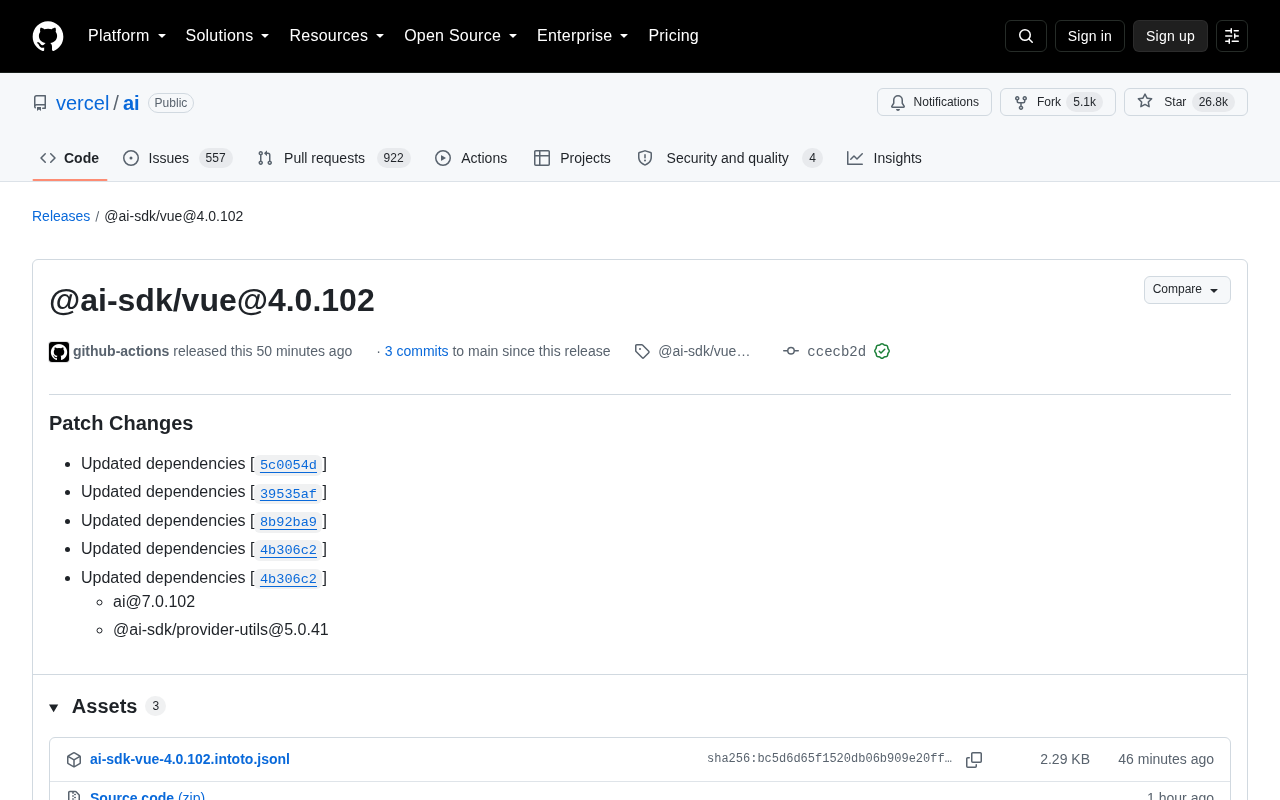
Vercel AI SDK Vue adapter releases patch 4.0.102, syncing core dependencies and strengthening supply chain security.
`@ai-sdk/vue@4.0.102` is the latest patch release of Vercel AI SDK's Vue framework adapter, with no breaking changes. The update syncs the `ai` core library to `7.0.102` and `@ai-sdk/provider-utils` to `5.0.41`. The primary value of this dependency sync is maintaining version consistency across the SDK toolchain, preventing compatibility issues caused by version drift between the adapter layer and core engine. The release is GitHub GPG-signed with vigilant mode enabled for supply chain integrity. For Vue developers building AI apps with this SDK, the upgrade is low-risk — though running tests and checking the lockfile for duplicate dependencies after upgrading is recommended.
Vercel's AI SDK has received another update, with @ai-sdk/vue@4.0.102 officially released via GitHub Actions. As the official Vue framework adapter in the Vercel AI ecosystem, this is a patch-level release focused primarily on dependency synchronization and internal fixes.
What's in This Update
Based on the Release Notes, @ai-sdk/vue@4.0.102 is a typical patch release with no breaking changes. The main work centers on syncing upstream dependencies.
The official changelog lists Patch Changes, including updates to several upstream dependencies:
ai@7.0.102— AI SDK core library@ai-sdk/provider-utils@5.0.41— Provider utilities
These dependency updates correspond to merges from multiple commits: 5c0054d, 39535af, 8b92ba9, and two instances of 4b306c2. For developers building AI applications with Vue, these sync updates matter because they keep the entire SDK toolchain version-consistent, preventing compatibility issues that can arise when the core library and the framework adapter layer fall out of step.
Why Patch Updates Deserve Attention
In the fast-moving AI tooling ecosystem, patch versions are often overlooked by developers — but they carry important stability responsibilities. As the bridge connecting Vue frontends to Vercel AI backend capabilities, @ai-sdk/vue tracks the rhythm of the core ai package closely (synced to 7.0.102 in this release).
It's worth noting the version number gap: the Vue adapter remains at major version 4.x, while the core ai library is already at 7.x. This decoupled versioning strategy allows the framework adapter layer and the core engine to evolve at their own compatibility pace. When upgrading, developers only need to verify that the dependency declarations between the adapter package and the core library are aligned. This release does exactly that through its Updated dependencies entries, ensuring the Vue package stays in sync with the latest core capabilities.
Additionally, this version carries a Verified GitHub signature (GPG key ID: B5690EEEBB952194) with vigilant mode enabled. This provides a baseline guarantee for supply chain security — developers can confirm that the package they're pulling down genuinely comes from the official release pipeline and hasn't been tampered with by a third party.
Semantic Versioning (SemVer) is the foundation for understanding why patch updates matter. SemVer defines version numbers as MAJOR.MINOR.PATCH: a major version bump signals incompatible API changes, a minor bump adds backward-compatible features, and a patch bump covers only backward-compatible bug fixes and maintenance updates. In theory, patch versions can be upgraded safely without modifying any calling code. However, in a fast-evolving ecosystem like the AI SDK, even patch versions can include subtle adjustments to the underlying inference engine, streaming protocols, or Provider interfaces. Version drift in the dependency tree — where different packages resolve the same upstream dependency to different versions — is one of the most common sources of hidden failures in real-world projects. Eliminating that drift is precisely the core value this release delivers.
Practical Advice for Vue Developers
For Vue projects using the Vercel AI SDK to build conversational interfaces, streaming responses, or AI-driven components, upgrading to 4.0.102 is generally a low-risk operation. Patch versions follow SemVer and should not break existing APIs.
Upgrading is straightforward — just run the update via your package manager:
npm install @ai-sdk/vue@4.0.102
Lockfiles play a critical role in multi-package dependency updates. package-lock.json (npm) or pnpm-lock.yaml (pnpm) records the exact version and integrity hash of every package in the entire dependency tree, ensuring consistent installation results across environments. When @ai-sdk/vue upgrades and pulls in new versions of ai and @ai-sdk/provider-utils, if other packages in the project also depend on older versions of those two libraries, the package manager may retain both old and new versions simultaneously in the dependency tree (i.e., dependency duplication). This not only increases bundle size but can also cause two independent state instances to exist at runtime, leading to hard-to-debug context loss or type incompatibility issues. After upgrading, run npm dedupe or pnpm dedupe to attempt merging duplicate dependencies, then commit the updated lockfile to your repository.
# or
pnpm add @ai-sdk/vue@4.0.102
After upgrading, it's recommended to run your existing test suite to confirm that core functionality — streaming output, message state management, etc. — continues to work as expected. Since this update also brings in dependency changes for ai and provider-utils, if your project directly references those packages as well, it's worth checking the lockfile to avoid having multiple conflicting versions in the dependency tree.
Summary
@ai-sdk/vue@4.0.102 is a routine patch release centered on dependency synchronization. While it introduces no flashy new features, it reflects the Vercel AI SDK team's ongoing commitment to toolchain consistency and security. For Vue ecosystem developers who rely on this SDK, this kind of steady, incremental maintenance cadence is exactly the kind of value that comes with choosing a mature framework.
Note: This article is based on the GitHub Release announcement. For detailed dependency change information, refer to the corresponding commit records.
Related articles
Free DeepSeek V4.1 Flash via DSH: Bulk Point Collection & International WorkBuddy Tested
DSH project update tested: WorkBuddy now offers 100 points per claim, rate limits raised beyond 80M tokens with faster resets, and international WorkBuddy supports free Hunyuan 4 and DeepSeek V4.1 Flash.
Capsule: Pack Web Apps and Data into a Single SQLite File
Capsule is a Rust/Tauri 2.0 tool that packs HTML web apps and data into a single SQLite file — privacy-first, local storage, portable sharing, with AI support.
DSH-SUBAGENT-UI Plugin: The Ultimate Sub-Agent Manager for DeepSeek Harness
DSH-SUBAGENT-UI is a DeepSeek Harness browser plugin offering sub-agent overview, search, local categorization, and completion snapshots — install with one command.