Vercel AI SDK Vue 4.0.109 Released: Fixes Completion Request Loading Issue

@ai-sdk/vue 4.0.109 fixes loading and cancellation state issues in rapid successive completion requests.
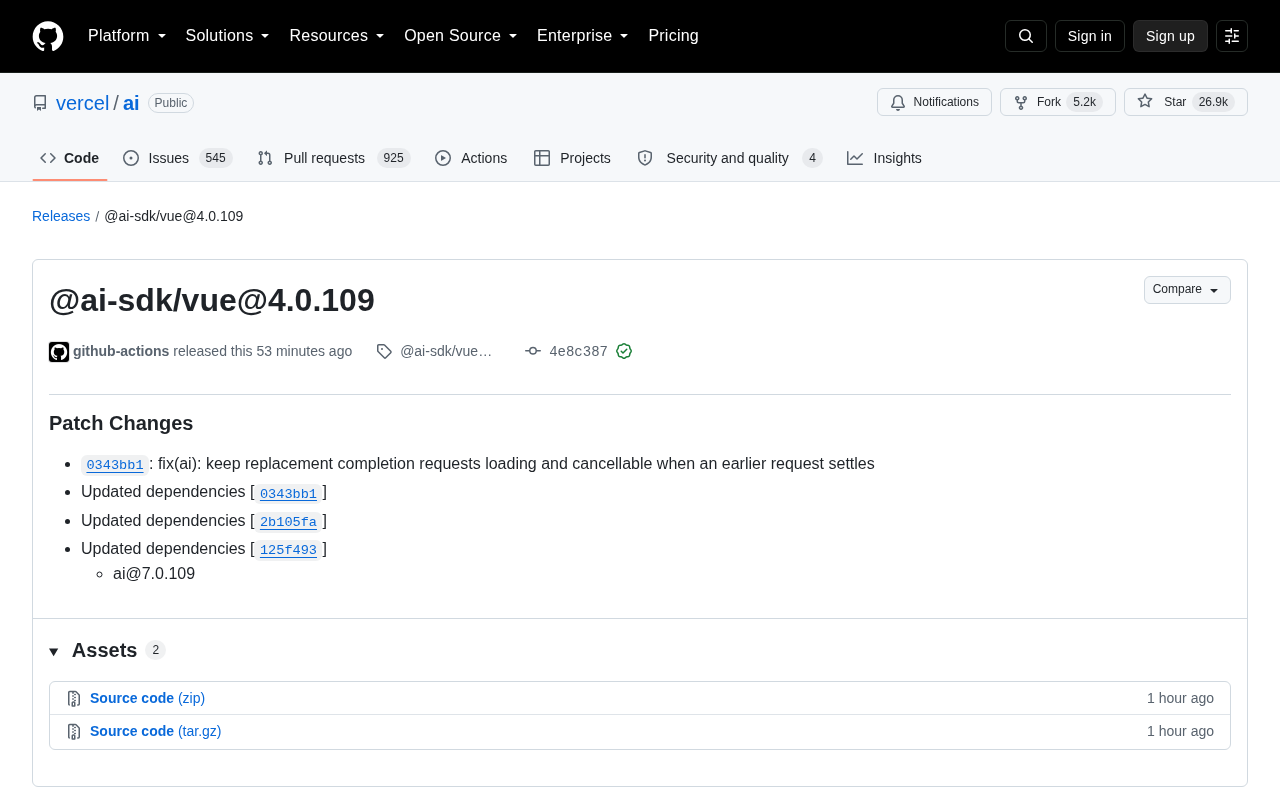
Vercel AI SDK's Vue adapter `@ai-sdk/vue` released patch version 4.0.109, with the core fix ensuring that replacement completion requests correctly maintain their loading state and remain cancellable after an earlier request has settled — preventing UI state confusion caused by older request settlement logic interfering with newer requests. This version also bumps the core `ai` package to 7.0.109, reflecting the monorepo's coordinated release mechanism. Vue projects using composables like `useCompletion` for streaming AI interactions can upgrade directly via npm/pnpm with no expected breaking changes, though regression testing on completion and cancellation logic is advised.
Vercel AI SDK's Vue adapter package @ai-sdk/vue has released version 4.0.109. This is a patch release focused on request lifecycle management, fixing a bug that affected completion scenarios.
What's New in This Release
This is a patch-level update. The core change is a single bug fix: replacement completion requests now correctly maintain their loading state and remain cancellable when an earlier request has already settled.
The specific commit (0343bb1) is described as: fix(ai): keep replacement completion requests loading and cancellable when an earlier request settles. This means that in scenarios where multiple completion requests are triggered in rapid succession, the settlement of an older request will no longer incorrectly terminate or interfere with the loading and cancellation logic of newer requests — preventing state confusion.
Request settled is a concept from the Promise lifecycle, referring to an async request that has reached its final state — whether fulfilled or rejected. In completion scenarios, when a user triggers requests in quick succession, multiple in-flight requests may coexist. The ideal behavior is: a later replacement request should independently manage its own loading state and cancellability, unaffected by the settlement of an earlier request. The previous bug manifested as: once an earlier request settled, it would unexpectedly affect the state machine of subsequent replacement requests, causing the loading flag to be cleared prematurely or cancellation to stop working.
Dependency Sync and Version Relationships
Beyond the fix itself, this version also synchronizes several upstream dependencies across commits 0343bb1, 2b105fa, 125f493, and bumps the core ai package to 7.0.109.
This reflects Vercel AI SDK's monorepo release mechanism — framework adapters (Vue, React, Svelte, etc.) are typically versioned in lockstep with the core ai package. For developers building AI applications with Vue, upgrading @ai-sdk/vue automatically brings along the corresponding improvements in the core library.
Monorepo is an engineering practice of managing multiple related packages within a single Git repository. Vercel AI SDK adopts this architecture, consolidating ai (core logic), @ai-sdk/vue, @ai-sdk/react, @ai-sdk/svelte, and other framework adapters in one place. The benefit is that cross-package changes can be committed and released atomically, with version numbers automatically coordinated via tooling (such as Changesets), ensuring framework adapters always remain API-compatible with the core package. For developers, this means upgrading a framework adapter also updates the underlying core logic — no manual version alignment needed.
What This Means for Developers
Managing cancellation and loading state for completion requests is a common pain point when building streaming AI interfaces. When users rapidly modify input and trigger requests in quick succession, improper handling of older request settlement logic can easily cause UI states to freeze, loading indicators to get stuck, or responses to appear out of order.
This fix directly targets these edge cases, making replacement request behavior more predictable. Projects using composables like useCompletion are encouraged to upgrade to this version for more reliable request handling.
useCompletion is a Vue Composable provided by @ai-sdk/vue that encapsulates the full logic for making requests to an AI completion endpoint — including request state (loading, error), streaming text assembly, and manual stop() cancellation. Its distinction from useChat is that useCompletion targets single-turn text completion scenarios (such as auto-completion or code completion), while useChat targets multi-turn conversation scenarios. This fix directly improves the correctness of useCompletion behavior under high-frequency triggering.
How to Upgrade
Upgrading follows the standard npm package process — update to 4.0.109 via your package manager:
npm install @ai-sdk/vue@4.0.109
# or
pnpm add @ai-sdk/vue@4.0.109
Since this is a patch release (following semantic versioning), it theoretically contains no breaking changes and carries low upgrade risk. However, given that it also bumps the core ai@7.0.109 and several other dependencies, it's recommended to run a regression test on any features involving completion and cancellation logic after upgrading.
Summary
@ai-sdk/vue@4.0.109 is a stability-focused patch update. Its core value lies in fixing the loading and cancellation behavior of replacement completion requests. While the change is small, it's a worthwhile reliability improvement for any Vue project that depends on streaming completion interactions.
Related articles

Random Pruning of the DPO Computation Graph: 1.4x Training Speedup and Lower Peak Memory
DPO training too slow and memory-hungry? This paper proposes a random pruning framework for the DPO computation graph, sampling independently across position, sequence, and branch dimensions; branch pruning achieves a 1.426x step-time speedup and cuts training time by about 30%, with in-depth attribution of memory and time gains.

Why Does JEPA Underperform MLM in Longitudinal EHR Representation Learning?
New study compares JEPA and MLM for longitudinal EHR representation learning on MIMIC-IV: three JEPA variants train stably without collapse but underperform MLM; target size, not heterogeneity, drives prediction error.

Transfer Learning + Visible Light Communication: A New Approach to Energy-Efficient Indoor Positioning
A study proposes a transfer learning-based visible light communication indoor positioning method, achieving 47% accuracy improvement on the BOSCH factory dataset, 67.5% model efficiency under high noise, and introducing the ME composite metric for energy-efficient positioning in energy-constrained industrial IoT scenarios.