Vercel AI SDK zai Provider 3.0.8 Update Analysis
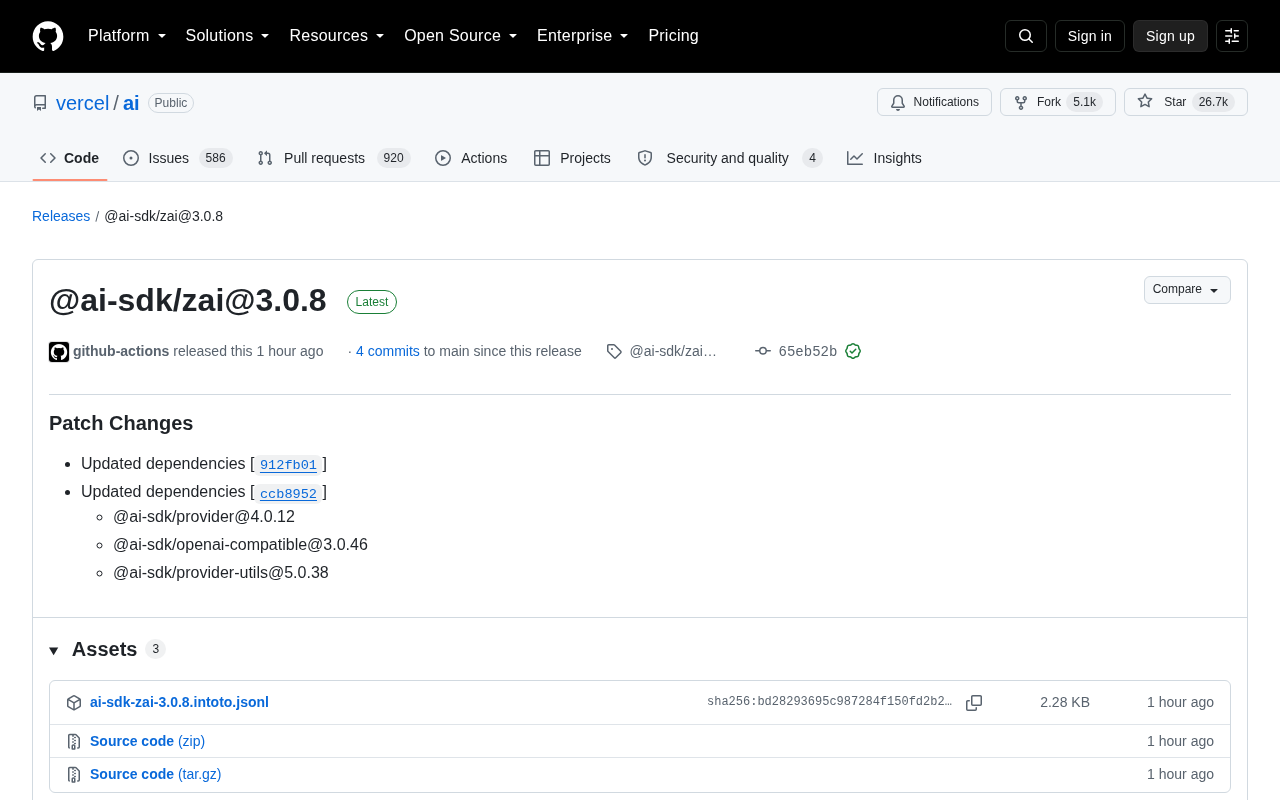
Vercel AI SDK zai Provider 3.0.8 syncs core dependencies for Zhipu AI model integration stability.
The Vercel AI SDK's @ai-sdk/zai package has released version 3.0.8, a patch update that synchronizes upstream dependencies including @ai-sdk/provider, @ai-sdk/openai-compatible, and @ai-sdk/provider-utils. While introducing no new features or breaking changes, this release ensures ecosystem consistency for the Zhipu AI Provider. The article explores the cascading update mechanism in Monorepo projects, supply chain security practices, and actionable upgrade strategies for developers.
The Continuous Evolution of Vercel AI SDK
Vercel AI SDK has become a core piece of infrastructure for building AI applications in the JavaScript/TypeScript ecosystem. The project has garnered approximately 26.7k Stars and 5.1k Forks on GitHub, with steadily growing activity and adoption.
Vercel AI SDK employs a modular Provider architecture, with the core philosophy of abstracting AI model calls into a unified interface so developers don't need to worry about API differences between underlying model vendors. This design borrows from the database ORM approach—just as Prisma lets you use unified syntax to work with PostgreSQL and MySQL, AI SDK lets you call OpenAI, Anthropic, Google Gemini, or Zhipu AI with the same codebase. The entire project is organized as a Monorepo, with key components including a provider abstraction layer, a provider-utils utility library, vendor-specific Provider implementations, and a frontend integration layer for React/Next.js.
Recently, the @ai-sdk/zai package released version 3.0.8, a patch release focused primarily on dependency updates. While the changes are minor, teams building production applications on this Provider benefit from staying current to maintain toolchain stability and compatibility.
Core Changes in This Update
@ai-sdk/zai@3.0.8 is a Patch Changes release, primarily synchronizing upstream dependency packages:
@ai-sdk/provider@4.0.12@ai-sdk/openai-compatible@3.0.46@ai-sdk/provider-utils@5.0.38
This release introduces no breaking changes and no new features. Instead, it ensures SDK ecosystem consistency by aligning underlying dependency versions. This kind of "cascading update" is very common in Monorepo-managed projects—Vercel AI SDK uses a unified release mechanism where specific Provider packages are upgraded in sync whenever core providers or utility libraries are updated.
What Is the zai Provider?
@ai-sdk/zai is the official Vercel AI SDK Provider for Zhipu AI models. Incubated by the Knowledge Engineering Laboratory at Tsinghua University, Zhipu AI is one of China's leading large model vendors. Its core product, the GLM model series, is competitive in Chinese language understanding, long-text processing, and multimodal capabilities, with flagship products including the GLM-4 series and the vision model GLM-4V. For developers building AI applications targeting the Chinese market or requiring strong Chinese language capabilities, Zhipu AI is an important model option, especially given its clear advantages in data compliance and localized deployment.
This Provider is built on @ai-sdk/openai-compatible, reusing the OpenAI-compatible interface abstraction layer so developers can call Zhipu's large models through a unified API without writing vendor-specific code. An important industry context is worth understanding here: OpenAI's Chat Completions API has become the de facto standard interface in the large model industry. Many model vendors (including Zhipu AI, Mistral, DeepSeek, etc.) have chosen to provide endpoints compatible with the OpenAI API format, with largely identical JSON structures for requests and responses. @ai-sdk/openai-compatible is precisely an abstraction over this compatibility layer, handling common logic like HTTP request construction, streaming SSE (Server-Sent Events) parsing, and error mapping. Providers built on it only need to configure the model endpoint URL, authentication method, and a few vendor-specific parameters to work, significantly reducing the development cost of integrating new models.
The upgrade of @ai-sdk/openai-compatible to 3.0.46 in this release is the key reason the zai Provider needed a synchronous update—fixes or improvements in the underlying compatibility layer directly affect all Providers built on it.
Why Patch Updates Still Deserve Attention
For fast-iterating AI toolchains, patch versions often carry important stability fixes and security updates. While 3.0.8 doesn't introduce new features, it reflects several engineering practices worth noting:
Dependency Version Consistency Management
Vercel AI SDK achieves automated version management through tools like Changesets. Changesets is a widely used version management tool in the Monorepo ecosystem, open-sourced by the Atlassian team. In a Monorepo, a single code repository contains dozens or even hundreds of interdependent npm packages, making manual version number and release management virtually impossible. The Changesets workflow works as follows: developers include a changeset file with their code commits, declaring which packages are affected and the type of change (major/minor/patch). After merging to the main branch, the CI pipeline automatically calculates new version numbers for all affected packages, updates CHANGELOGs, and publishes to npm.
This is why when a core dependency (like provider-utils) is updated, related Provider packages automatically generate corresponding patch versions. This ensures compatibility across packages in the ecosystem and reduces runtime issues caused by version mismatches.
Supply Chain Trust Verification
This release was completed automatically by GitHub Actions and signed with a GitHub verifiable signature (GPG key ID: B5690EEEBB952194), marked as Verified.
Software supply chain security has been a topic of intense focus in the developer community in recent years. Notable supply chain attack cases include the 2021 ua-parser-js poisoning incident and the 2024 xz-utils backdoor incident. The npm ecosystem is particularly vulnerable because a malicious version of a popular package can be automatically installed by millions of projects within hours. GitHub's verifiable signature mechanism uses GPG keys to prove that commits and releases genuinely come from authorized CI systems or developers, rather than being impersonated. Combined with npm's provenance feature, developers can trace each published version back to its build source code, CI pipeline, and trigger conditions, forming a complete chain of trust from source code to published artifacts.
This is a positive signal for teams concerned about software supply chain security—the origin and integrity of release artifacts can be verified.
Staying in Sync with the Multi-Model Ecosystem
As domestic large models like Zhipu AI continue to improve their capabilities, ongoing maintenance of official Providers means developers can more confidently integrate these models within Vercel AI SDK, enjoying unified streaming responses, tool calling, structured output, and other capabilities. Streaming allows tokens generated by the model to be pushed to the client in real time rather than waiting for the complete response; Tool Calling (also known as Function Calling) enables models to trigger external function execution, enabling interaction with real-world systems; Structured Output ensures the model returns data conforming to a predefined JSON Schema for programmatic processing. These capabilities are implemented differently across vendors' native APIs, but the AI SDK's Provider system abstracts these differences behind a unified interface.
How Developers Should Respond
For developers already using @ai-sdk/zai in their projects, the following strategies are recommended:
- Upgrade patch versions promptly: Patch updates are typically backward compatible and can be upgraded via
npm update @ai-sdk/zaior the equivalent package manager command - Monitor upstream dependency changes: Since this update is linked to core packages like
providerandopenai-compatible, it's advisable to check whether these dependencies also need updating to avoid version inconsistencies. In projects using pnpm or yarn workspaces, you can quickly identify packages needing updates withpnpm outdatedoryarn upgrade-interactive - Validate in a test environment: Even for patch versions, it's recommended to verify that core AI call chains work correctly in a test environment before deploying to production. Pay particular attention to streaming response completeness, tool calling parameter parsing, and whether error handling logic functions properly
Conclusion
While @ai-sdk/zai@3.0.8 is a "silent" patch update, it reflects the maturity of the Vercel AI SDK team in engineering standards, supply chain security, and multi-model ecosystem support. For developers building AI applications, understanding the mechanisms behind updates like this is more valuable for creating robust and reliable products than simply chasing new features. As the AI SDK ecosystem continues to mature, maintaining ongoing awareness of your dependency chain will be a fundamental skill for every AI application developer.
Related articles
Security Guide for AI/BI Dashboard Embedding: Multi-Tenant Data Isolation and Access Control in Practice
Explore security challenges in AI/BI dashboard embedding, covering multi-tenant data isolation, row-level security, identity propagation, and defense-in-depth architecture for embedded analytics.

Xbox Classic Startup Animations Return: Personalization and Cloud Gaming Experience Get Major Upgrades
Microsoft rolls out classic console startup animations, badge customization, cloud gaming background downloads, and more for Xbox Insiders. Remote Play quality and voice chat also improved.

AI-Assisted Programming Goes Mainstream: A Paradigm Shift in Software Development
How AI tools are reshaping software development: from FAANG adoption to workflow transformation. Explore AI coding assistants, intelligent code review, and the future of human-AI collaboration.