Vercel Build Cache Limit Increased to 5GB: Automatic, No Configuration Required

Vercel raises the build cache limit for all build machines to 5 GB, effective automatically with no extra charge.
Vercel announced that the build cache limit for all build machines is now uniformly 5 GB. Previously, Basic and Standard had 1.5 GB, Enhanced 3 GB, and Turbo 4.75 GB; caches exceeding the limit were discarded, forcing reinstallation on the next build. The change auto-applies to all build machine types, requires no configuration, and costs nothing extra—reducing cache invalidation and reinstall time for large-dependency projects and lowering the barrier to build-cache optimization.
Vercel recently announced that the build cache size limit for all Build Machines has been uniformly raised to 5 GB. Previously, cache limits varied by build machine tier: Basic and Standard had 1.5 GB, Enhanced had 3 GB, and Turbo had 4.75 GB. Once the cache exceeded the limit, it was discarded, preventing the next build from reusing the cache and forcing dependencies to be reinstalled.
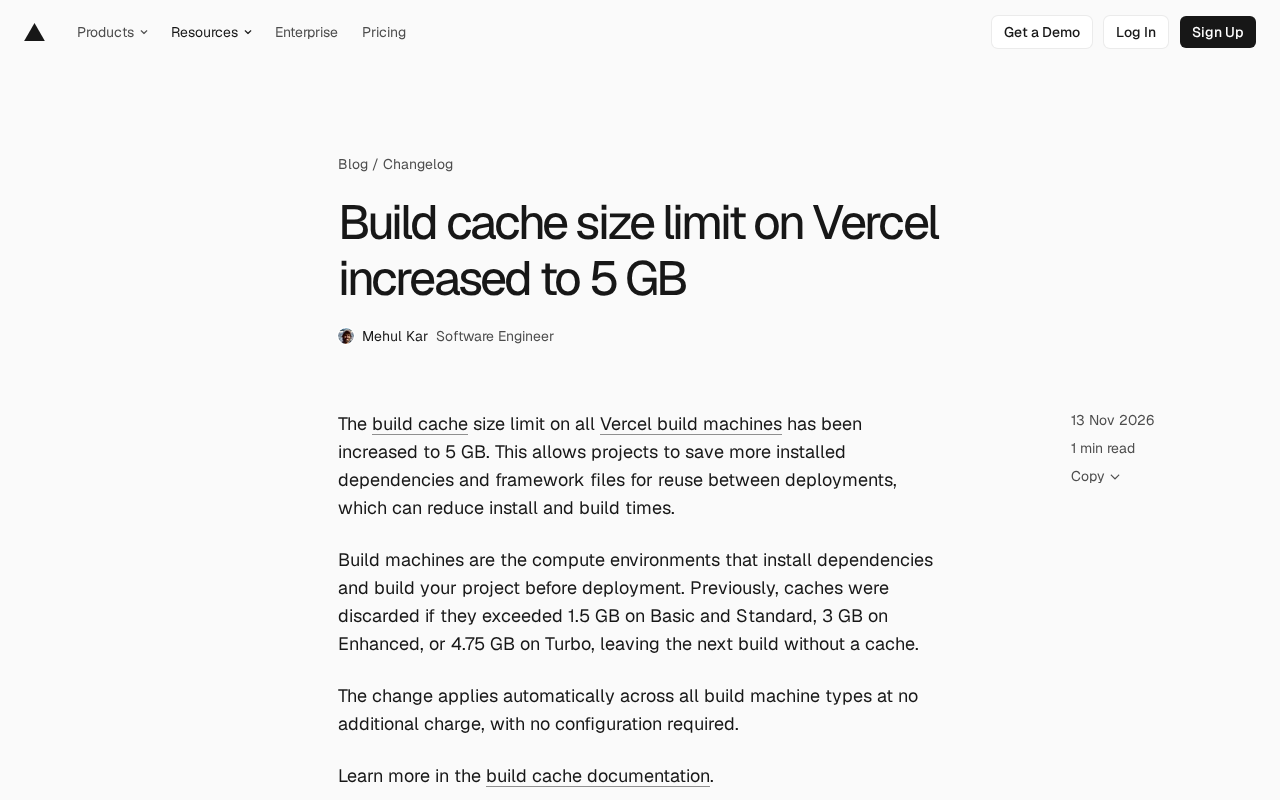
Unified Cache Limit Increase Aims to Improve Build Efficiency
Build Machines are the compute environments Vercel uses to install dependencies and build projects. The caching mechanism allows projects to reuse installed dependencies and framework files across deployments, thereby shortening install and build times. Previously, once the cache exceeded each tier's limit it was discarded, and the next build lost the caching advantage. This was especially true for projects with large dependencies, where reinstalling could significantly slow down the build process.
With this change, the cache limit for all build machine types is uniformly set to 5 GB, taking effect automatically with no configuration required and no additional charge. This means projects using Basic or Standard build machines see their cache space increase from 1.5 GB to 5 GB—more than a threefold increase—while Enhanced and Turbo also see varying degrees of increase.
Build cache is a mechanism in CI/CD systems used to persist intermediate artifacts across multiple builds. In Node.js frontend projects, the core objects cached are typically the node_modules directory and framework-generated build artifacts (such as Next.js's .next/cache). When the cache hits, the builder can directly reuse the previous dependency installation results and skip time-consuming steps like npm install or yarn install.
Common causes of cache invalidation include: changes to dependency manifests (package.json, lock files), cache size exceeding the platform quota, and cache storage expiration. Vercel's previous tiered cache limits fell into the second category—once the cache size crossed the threshold, the entire cache was discarded rather than partially retained, so large-dependency projects often experienced repeated "full reinstalls" after a few builds. Understanding this makes it clear why raising the limit from 1.5 GB to 5 GB matters significantly for medium-to-large projects.
Practical Impact on Developers
For projects with many dependencies and large framework files, more cache space means fewer cache invalidations. Developers no longer need to worry about the cache being discarded due to exceeding the limit, reducing the time spent reinstalling dependencies. In its announcement, Vercel stated that this change helps projects retain more installed dependencies and framework files for reuse across deployments, thereby reducing install and build times.
This adjustment covers all build machine types and incurs no additional cost. For frontend teams using the Vercel platform, this lowers the barrier to optimizing build caching—they can enjoy larger cache space without upgrading to a higher-tier build machine.
Vercel recommends developers consult the build cache documentation for more details. This change has already been automatically applied to all projects.
Build Machine is a temporary compute instance that Vercel allocates for each deployment, responsible for dependency installation, code compilation, and artifact generation. Vercel classifies build machines into tiers such as Basic, Standard, Enhanced, and Turbo based on CPU cores and memory—the higher the tier, the greater the build parallelism and available memory, which also determined the previous cache quotas. It is important to note that build machines are themselves "stateless": the instance is destroyed after each build, and the only state that can be carried across builds is persisted cache. Therefore, the cache limit effectively determines how much work a project can "remember" between deployments. It is an independent dimension from the build machine's compute performance—raising the cache limit won't speed up a single compilation, but it can significantly reduce the time spent repeatedly installing dependencies.
One-line Summary
Vercel has uniformly raised the build cache limit for all build machines to 5 GB, taking effect automatically with no additional charge.
Paragraph Summary
Vercel announced that the build cache limit for all build machines has been uniformly raised to 5 GB. Previously, Basic and Standard had 1.5 GB, Enhanced had 3 GB, and Turbo had 4.75 GB; once the cache exceeded the limit it was discarded, preventing the next build from reusing the cache and forcing dependency reinstallation. After the adjustment, cache space for Basic and Standard increases more than threefold, while Enhanced and Turbo also see increases. The change is automatically applied to all build machine types, requires no configuration, and incurs no additional cost. It reduces cache invalidation and reinstallation time for projects with large dependencies, lowering the barrier for frontend teams to optimize build caching.
Related articles

RePlan-VLA: Progress-Aware Replanning Breakthrough for Long-Horizon Robotic Manipulation
The RePlan-VLA framework converts VLA models' short-horizon capabilities into reliable long-horizon execution through progress-aware adaptive replanning, improving success rates by 21.9% and 10.4% on RoboCasa365 and CALVIN, and validating real-world deployment on a Franka Research 3 robot.

Geometric Bridge Flow Matching: A New Breakthrough in Blind Rigid Motion Correction
Geometric bridge flow matching enables blind rigid motion correction in head CBCT, achieving 37.1 dB PSNR and 0.27 mm RPE on simulated data in ~9.1 minutes, outperforming existing methods.

Google Releases Gemini 4 Hydrogen: 2.5x Faster Without Sacrificing Intelligence
Google releases the lightweight Gemini 4 Hydrogen: 2.5x faster task completion, AA Intelligence Index of 54 beating its flagship sibling, 7.3s single-step on Agent Arena faster than Claude and GPT rivals, four thinking levels with pay-as-you-need pricing, now available across AI Studio and more.