Vercel CLI Lets Agents Buy Domains Autonomously — But Payment Requires Your Approval

Vercel lets AI Agents handle the full domain purchase process, but payment confirmation is still mandatorily reserved for humans.
Vercel's official blog announced that AI Agents can now complete domain search, availability checking, pricing queries, and purchase initiation through the Vercel CLI. When `vercel domains buy` runs in non-interactive mode, it returns a structured machine-readable error instead of completing the transaction, forcing payment confirmation back to humans. Users can confirm pricing, auto-renewal, and whois info in the terminal or Vercel Dashboard. The CLI also includes a built-in Agent skill for guided workflow execution. This design enforces Agent safety constraints at the tool level rather than the prompt level.
AI Agents can write code, run deployments, and check logs for you — and now they can even buy domains on their own. But if you're worried about one secretly maxing out your credit card at 3 a.m., Vercel has built in a safety mechanism by design.
Vercel's official blog announced that Agents can now complete the entire process from domain search to purchase initiation through the Vercel CLI, but the final payment confirmation always stays in human hands.
What does the complete Agent domain-buying workflow look like?
According to Vercel, the Agent domain purchase process consists of three steps, each corresponding to a CLI command.
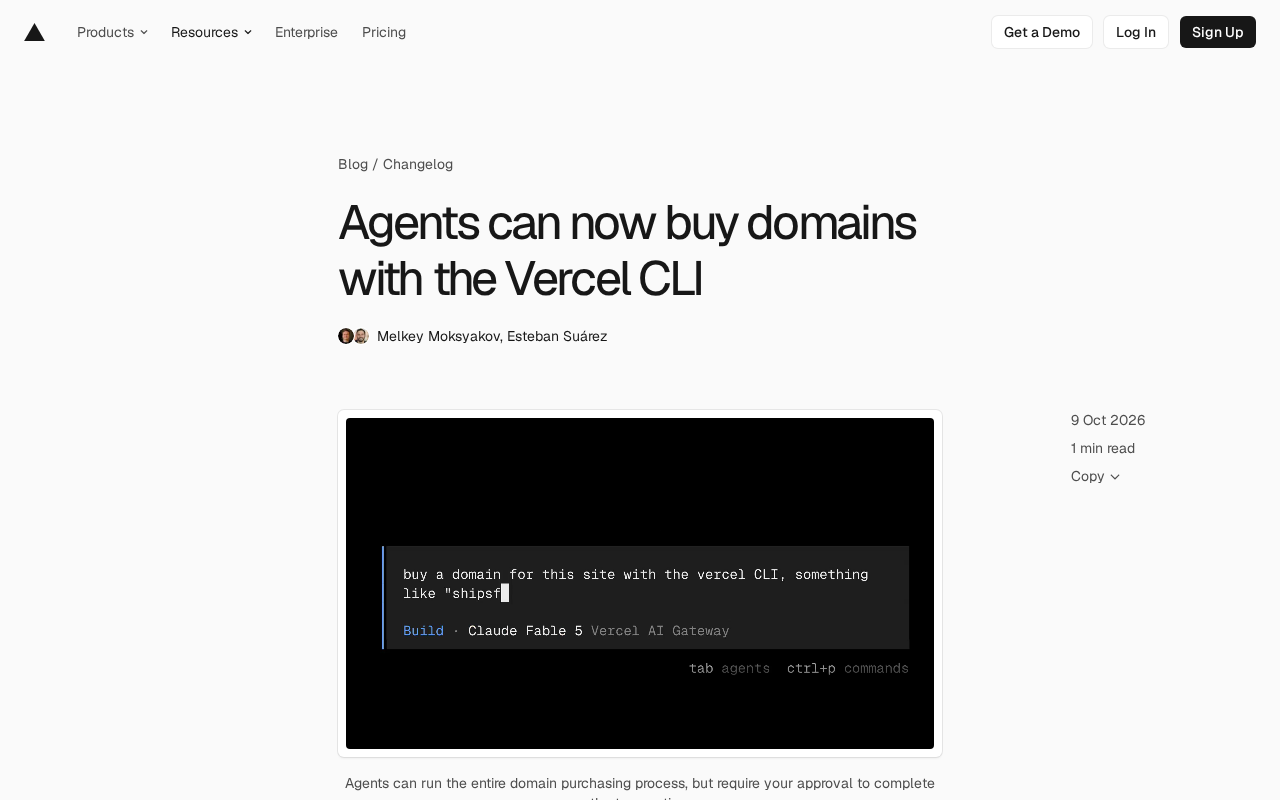
First, the Agent discovers candidate domains via vercel domains search. For example, you can simply instruct the Agent: "Use the Vercel CLI to buy a domain for this site, something like shipsf26," and the Agent will automatically search for matching options.
Next, the Agent uses vercel domains check and vercel domains price to verify domain availability and registrar pricing, respectively. This means the Agent isn't just "blind buying" — it gathers sufficient information before making a decision.
The final step is vercel domains buy to initiate the purchase. But this command's behavior is carefully designed: when run in non-interactive mode, it doesn't complete the transaction directly. Instead, it returns a structured, machine-readable error along with suggested follow-up commands. Upon receiving this signal, the Agent hands the confirmation step back to the human user.
Why must payment confirmation stay with humans?
Vercel states explicitly in its announcement: "The purchase decision itself stays with you by design." This reveals a clear stance — the Agent can help you research, compare prices, and filter options, but when it comes to spending money, a human must personally press the confirm button.
This design choice is worth noting. The capability boundaries of AI Agents are rapidly expanding, from code generation to automated operations, and more and more tasks can be delegated. But "spending money" is fundamentally different from writing code: code errors can be rolled back, but recovering money that's already been spent is far more costly. Vercel enforces this constraint at the CLI level — even if the Agent attempts a non-interactive purchase, the command itself refuses to execute, rather than relying on the Agent's "self-discipline."
From an engineering perspective, this is a safety mechanism implemented at the tool level rather than the prompt level, making it more reliable. You can't guarantee that an Agent will follow instructions in a prompt every time, but you can guarantee that a structured CLI error return value makes it impossible to bypass.
Non-interactive mode refers to the way command-line tools run in environments without real-time human input (such as a TTY terminal). When scripts, CI/CD pipelines, or AI Agents call a CLI, they are typically in non-interactive mode — the program cannot display a prompt and wait for user input, and can only execute based on pre-passed parameters and environment variables. Traditional CLIs in this mode either complete the operation directly or exit with an error. Vercel's clever approach is to have vercel domains buy return a semantic, structured error (typically in JSON format) in non-interactive mode, containing not only the failure reason but also suggested follow-up commands. This allows the caller (the Agent) to understand that "human intervention is needed" and adjust its behavior accordingly, rather than simply retrying or giving up.
What information does the interactive confirmation include?
When the purchase step returns to human hands, you can confirm three key pieces of information in an interactive terminal or the Vercel Dashboard:
- Price: The actual registration cost of the domain
- Auto-renewal option: Whether to enable auto-renewal to prevent the domain from being released upon expiration
- Registrant contact information: The domain's whois information
These three items cover the most error-prone aspects of domain purchasing — price misunderstandings, forgetting to renew, and incorrect registration information. Making the confirmation step a complete review panel rather than a simple "confirm/cancel" binary choice shows that Vercel positions Agent workflows as "proposal + human approval" rather than fully automated execution.
Whois is a public protocol and database used on the internet to query domain registration information, returning fields such as the registrant's name, email, phone number, registration and expiration dates, and the registrar used. In the early days, whois information was fully public, and anyone could query the registrant's real contact information, which led to massive spam and privacy breaches. After GDPR took effect, most registrars redacted personal registration information, showing only placeholders like "REDACTED FOR PRIVACY" in whois. Therefore, confirming "registrant contact information" is not just about the public display in whois — it also involves the legally responsible party information recorded in the registrar's backend. Incorrect information could lead to domain ownership disputes or failure to pass ICANN's verification process. For Agents, this type of information typically needs to be provided by the user personally, as it involves real identity data of individuals or businesses.
Agent Skill: Letting the Agent know what to do
The Vercel CLI also includes a built-in skill for Agents, covering domain discovery, pricing queries, and the purchase workflow. This means you don't need to tell the Agent step by step which commands to run — the Agent will automatically execute the entire workflow in the correct order.
This detail reflects a trend in the current AI toolchain: tools themselves are starting to design interfaces for Agents. Traditional CLIs are made for humans, who learn command usage through --help and documentation. But when Agents become important consumers of CLIs, tools need to encode knowledge of "how Agents should use me" internally, not just "how humans can use me." Vercel packages this skill directly into the CLI, lowering the barrier for Agents to use the tool correctly.
Vercel's move, viewed in a broader context, is another signal of AI Agents moving from "assistive tools" to "executing entities." Agents are gaining more and more operational permissions, and tool providers need to set reasonable boundaries for these permissions. The domain purchase scenario happens to sit at the intersection of "complex enough to need automation" and "sensitive enough to need human oversight," and Vercel's approach provides a reference sample worth studying.
If you'd like to try it, check Vercel's official documentation for specific configuration steps.
Agent Skill in Vercel's context is structured metadata packaged into the CLI (typically described in Markdown or JSON) that tells the Agent: what this tool can do, what commands are available, the recommended order of use, and the input/output format for each. Traditional CLIs output instructions for humans through --help and man pages, with free-form formats and ambiguous semantics that are error-prone for Agents to parse. Skills encode "the tool's self-description" in a machine-friendly way, allowing Agents to invoke best practices without first reasoning and exploring. This pattern aligns with Anthropic's Agent Skills concept and OpenAI's function calling schema approach — both let tools proactively adapt to Agents rather than having Agents repeatedly trial-and-error to adapt to tools, significantly improving the success rate and reliability of automated workflows.
One-line Summary
Vercel lets AI Agents handle the entire domain purchase process, but payment confirmation is still mandatorily reserved for humans.
Paragraph Summary
Vercel's official blog announced that AI Agents can now complete the full workflow of domain search, availability checking, pricing queries, and purchase initiation through the Vercel CLI. When vercel domains buy runs in non-interactive mode, it returns a structured machine-readable error rather than completing the transaction directly, forcing the payment confirmation step back to humans. Humans can confirm the price, auto-renewal options, and registrant whois information in an interactive terminal or the Vercel Dashboard. The CLI also includes a built-in Agent-oriented skill, allowing Agents to execute the entire workflow in the correct order without step-by-step instructions. This design embodies an engineering approach to implementing Agent safety constraints at the tool level rather than the prompt level, providing a reference sample for boundaries as Agents move from assistive tools to executing entities.
Related articles

Chain of Thought Isn't Just for AI: How Humans Can Use CoT to Improve Thinking Quality
Chain of Thought isn't just a prompt trick for large models. Starting from a Hacker News discussion, this article analyzes why CoT works for human thinking too, breaks down actionable ways to transfer it, and highlights the key differences between human CoT and machine CoT.
Cloudflare Teams Up with OpenAI: Closi…
Cloudflare Teams Up with OpenAI: Closing the Loop from Vulnerability Discovery to Defense with AI
Cloudflare uses OpenAI Daybreak to investigate security vulnerabilities and generate reviewable remediation plans, while developers use Codex to boost coding efficiency and quality.

Orca Multi-Agent Orchestration in Practice: A Guide to Parallel Collaboration with Claude and Codex
Orca is Stable AI's free open-source agent workbench supporting 34 agents like Claude Code and Codex in parallel. Learn its Git worktree isolation, multi-model orchestration, and mobile management.