Vercel for Enterprise Launches: A Unified Control Plane to Govern Developers, Apps, and AI Agents
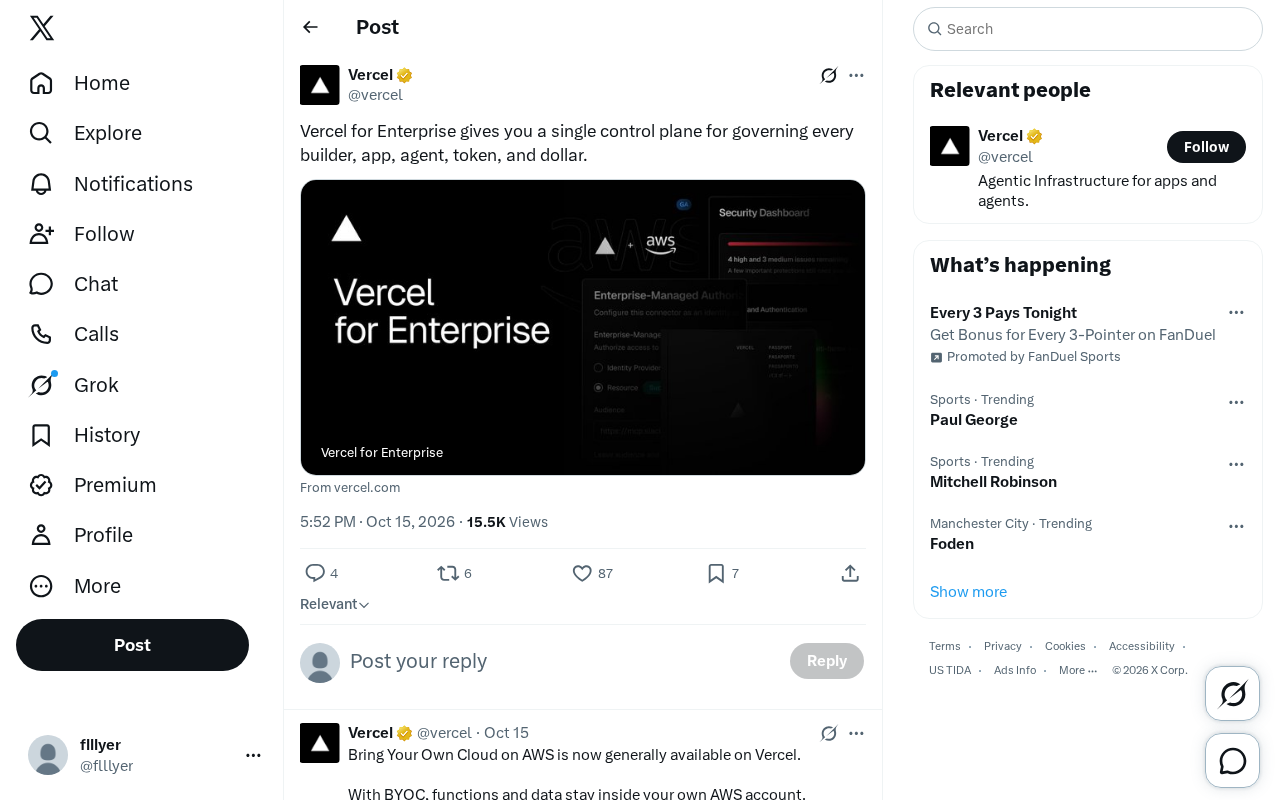
Vercel launches its enterprise edition, positioned as a single control plane that brings AI agents and tokens into unified governance.
Vercel announced the launch of Vercel for Enterprise, positioning it as a single control plane for governing builders, apps, AI agents, tokens, and costs within the enterprise. This marks Vercel's extension from the frontend hosting platform developers know well toward an enterprise governance layer covering the entire development lifecycle and AI resource consumption. The article breaks down the meaning of the five governance objects and points out that elevating AI agents and API tokens to the same level as apps is a key move responding to the challenges of permission boundaries and cost attribution in enterprise AI adoption. Competitively, Vercel enters the enterprise DevOps and cloud vendor console market with its developer experience DNA, but the official announcement only discloses a conceptual description—implementation details such as the permission model, audit granularity, and cost allocation have not yet been made public, and enterprise users need to watch for smooth migration of billing models and permission systems.
Vercel recently announced the launch of Vercel for Enterprise via its official Twitter account, positioning it as a "single control plane" for governing every builder, app, AI agent, token, and every dollar spent within the enterprise. Though the tweet is brief, it reveals a significant strategic upgrade for Vercel in the enterprise market—shifting from a pure frontend hosting platform to a unified governance layer covering the entire development lifecycle and AI resource consumption.
A Positioning Leap from Hosting Platform to Enterprise Governance Layer
Vercel has long been known to developers as the hosting provider for the Next.js framework, with its core selling points being a minimalist deployment experience and edge network performance. But enterprise customers need far more than "fast deployment"—they need permission controls, cost visibility, compliance auditing, and order across cross-team collaboration. The official description of Vercel for Enterprise explicitly lists five categories—"builder, app, agent, token, dollar"—side by side, indicating that its governance scope has expanded from traditional people and projects to new types of resource entities such as AI agents and API tokens.
The signal is clear: Vercel is no longer content to be "the developer's deployment tool" but aims to become "the enterprise's resource governance hub." For enterprises already running large numbers of frontend projects, Serverless functions, and edge middleware on the platform, a unified control plane means fewer tool switches and more consistent security policies.
Edge Network and Serverless Functions: Vercel's core infrastructure is built on edge computing. The edge network refers to deploying code to nodes geographically closest to users for execution, thereby reducing latency and improving response speed. Vercel's edge network covers multiple regions worldwide, and static assets and some dynamic logic can be handled directly at the edge. Serverless functions are compute units that run on demand without server management; developers write functions and the platform automatically scales and bills by invocation. Edge middleware is lightweight code executed before a request reaches its final processing logic, commonly used for authentication, redirects, A/B testing, and similar scenarios. Together these three form Vercel's technical foundation and the basis on which enterprise customers run production workloads. Understanding these concepts helps grasp why Vercel can extend governance from deployment to runtime resources.
The Product Logic Behind the Five Governance Objects
The five categories listed in the tweet deserve individual analysis. Builder corresponds to team members and role permissions, app corresponds to projects and deployment units, agent points to new runtime entities like AI agents, token involves API keys and access credentials, and dollar directly targets cost accounting and budget control.
Elevating AI agents and tokens to the same governance level as apps is the most era-defining part of this launch. As enterprises deploy more and more AI agents in production environments, agent identity management, permission boundaries, and invocation costs become new management challenges. By bringing such resources into a unified control plane, Vercel is effectively responding to the governance vacuum in enterprise AI adoption.
The Governance Challenges of AI Agents: An AI agent refers to a software entity capable of autonomously perceiving its environment, making decisions, and executing actions, typically built on large language models and able to call external tools and APIs to accomplish complex tasks. In enterprise environments, AI agents often need to access internal data, call third-party services, and consume compute resources, bringing three types of governance challenges: identity and permissions—under what identity the agent runs and which resources it can access; behavior auditing—whether every invocation and decision of the agent is traceable; and cost control—the agent's inference calls and tool usage generate ongoing costs that are difficult to attribute to specific teams or projects. Traditional IAM and cost management tools are mostly designed for people and static applications and are hard to apply directly to dynamic, high-frequency, autonomously running agents. Bringing agents into a unified control plane means establishing dedicated identity systems, permission boundaries, and metering methods for them—precisely the weaker link in current enterprise AI adoption.
Competitive Considerations in the Enterprise Market
From an industry landscape perspective, this move by Vercel also intensifies direct competition with enterprise DevOps platforms and cloud vendors. The unified control plane narrative resembles the "console" concept of major cloud vendors, but Vercel's differentiation lies in its developer experience DNA—if the control plane can provide governance capabilities without sacrificing deployment fluidity, it will be strongly appealing to enterprise technical teams.
However, the official tweet only provides a conceptual description, and key details such as the specific permission model, audit granularity, and cost allocation mechanisms have not yet been disclosed. For enterprises evaluating whether to migrate or upgrade, these implementation details are the basis for decision-making. Vercel needs to publish more complete product documentation in the future for "single control plane" to become a verifiable capability rather than a slogan.
Unified Control Plane: The control plane originates from the networking and distributed systems field, originally referring to the layer responsible for decision-making, routing, and policy distribution, as opposed to the "data plane" that actually processes data. In the enterprise software context, the control plane typically refers to a unified interface or service layer for centrally managing configuration, permissions, policies, auditing, and costs. Cloud vendor consoles, the Kubernetes control plane, and the management plane of API gateways all fall into this category. The value of a unified control plane lies in eliminating tool silos: enterprises no longer need to switch between multiple systems to manage different resources, and security policies and cost views can remain consistent across teams and projects. But its implementation difficulty lies in coverage granularity—too coarse and governance is ineffective, too fine-grained and it increases operational burden. By introducing the control plane narrative into frontend and AI resource governance, Vercel is essentially positioning itself as a policy hub within the enterprise technology stack rather than merely a deployment target.
What Enterprise Users Should Watch For
For teams already using Vercel, this launch means that changes in platform positioning may bring adjustments to billing models and permission systems. Three areas are worth watching: first, whether the role permissions of existing projects can map smoothly to the new governance model; second, the metering methods and cost transparency for AI agent-related resources; third, whether the control plane supports integration with existing identity providers and auditing systems.
The launch of Vercel for Enterprise marks the extension of the frontend cloud platform toward the enterprise governance layer, and the inclusion of AI agents in the resource governance landscape is a common trend across this generation of enterprise software. The concept has been thrown out; what comes next is the test of how deeply the product can be implemented.
One-line Summary
Vercel launches its enterprise edition, positioned as a single control plane that brings AI agents and tokens into unified governance.
Paragraph Summary
Vercel announced the launch of Vercel for Enterprise, positioning it as a single control plane for governing builders, apps, AI agents, tokens, and costs within the enterprise. This marks Vercel's extension from the frontend hosting platform developers know well toward an enterprise governance layer covering the entire development lifecycle and AI resource consumption. The article breaks down the meaning of the five governance objects and points out that elevating AI agents and API tokens to the same level as apps is a key move responding to the challenges of permission boundaries and cost attribution in enterprise AI adoption. Competitively, Vercel enters the enterprise DevOps and cloud vendor console market with its developer experience DNA, but the official announcement only discloses a conceptual description—implementation details such as the permission model, audit granularity, and cost allocation have not yet been made public, and enterprise users need to watch for smooth migration of billing models and permission systems.
Related articles

5 Practical Ways Real Estate Agents Can Use AI to Boost Efficiency (2026 Edition)
How can real estate agents use AI to boost efficiency? Based on a YouTube walkthrough, this breaks down five methods — ChatGPT for listing descriptions, Canva for marketing materials, forms for open house leads, Zapier for automated follow-up, and seller meeting prep — and flags risk boundaries like fair housing laws, photo authenticity, and price verification.

Grok Bot vs ChatGPT Agent: Which AI Agent Is More Powerful?
How does Grok Bot differ from ChatGPT Agent? This comparison examines how they work: Grok Bot has a cloud computer and runs persistently inside tools to execute multi-step tasks automatically; ChatGPT Agent operates web pages in a browser and is more mature at general tasks. Includes selection advice.

Walmart Agent Gateway: AI Shops for You Automatically—Why Is Amazon Going the Opposite Way?
Walmart's Agent Gateway lets ChatGPT, Gemini and other AI assistants access its product catalog to search, compare and add to cart, with spending limits and per-purchase approval. Amazon blocks external AI agents—two retail giants, opposite paths. Currently US-only, India may follow.