Vercel Functions Request Body Limit Raised to 20MiB: What It Means and Migration Guide

Vercel Functions request body limit raised from 4.5MB to 20MiB, requiring an env var and 4GB memory; Edge not covered and middleware no longer receives body.
Vercel announced that the inbound request body limit for Functions has been raised from 4.5MB to 20MiB (Public Beta), covering Node.js, Python, Bun runtimes, and Routing Middleware. However, it requires actively setting the environment variable VERCEL_SUPPORT_LARGE_REQUEST_BODY=1 along with a 4GB memory configuration, and the toggle takes effect per environment, so you can validate in Preview first. Edge runtime still maintains the 4.5MB limit and returns 413 when exceeded, requiring a switch to Node.js runtime. After enabling, Routing Middleware no longer receives the request body and retains only headers, to avoid the cost and TTFB increase from duplicate transfers. When handling large request bodies, read them as quickly as possible and avoid memory retention. This update benefits scenarios like file uploads and large webhooks, with limited impact on lightweight APIs.
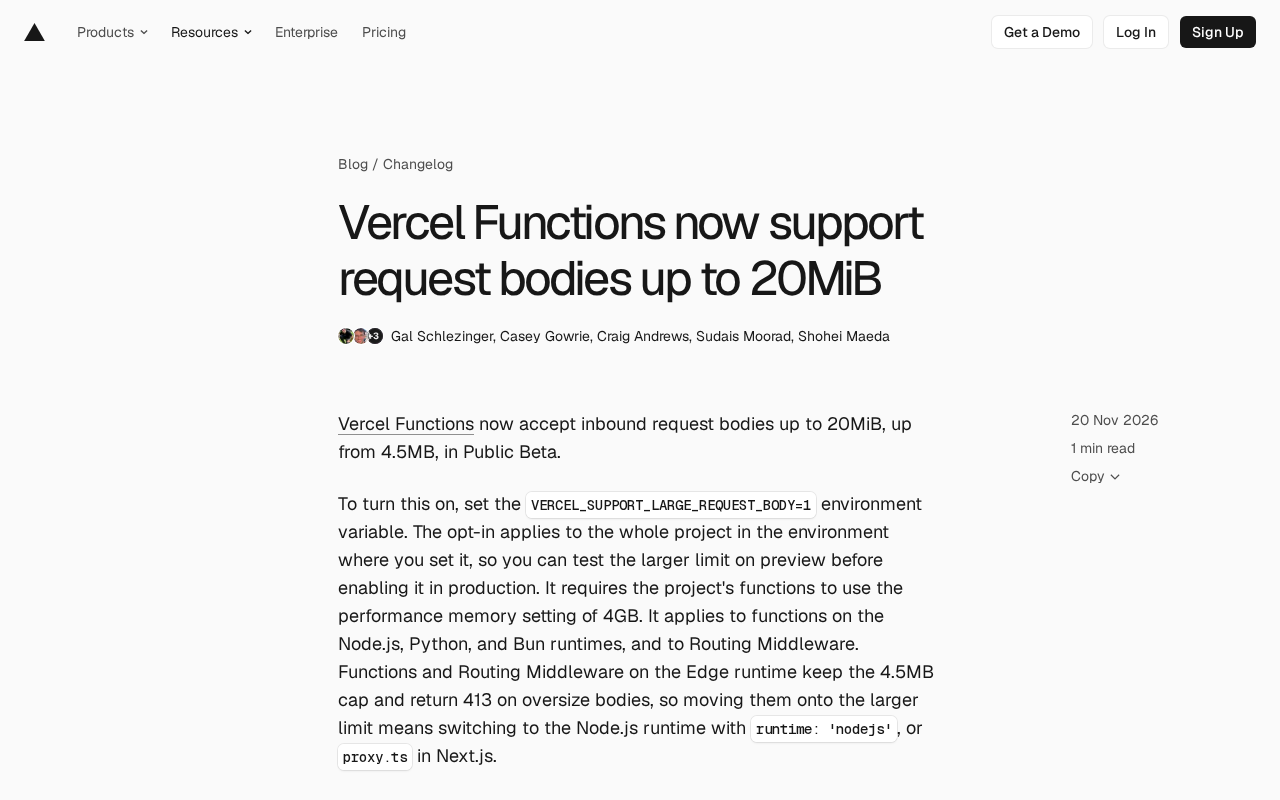
Vercel has officially announced that the inbound request body limit for Functions has been raised from 4.5MB to 20MiB, currently in Public Beta. This isn't just a simple numeric adjustment—it involves a series of cascading changes around runtime selection, memory configuration, middleware behavior, and more, and deserves serious attention from developers.
Core Change: From 4.5MB to 20MiB, But With Conditions
In the past, the request body limit for Vercel Functions was always 4.5MB, and this limit frequently became a bottleneck when handling file uploads, large JSON payloads, or webhook callbacks. The new limit is raised to 20MiB, roughly four times the original, and covers Functions on the Node.js, Python, and Bun runtimes, as well as Routing Middleware.
However, this increase must be actively enabled. Developers need to set the environment variable VERCEL_SUPPORT_LARGE_REQUEST_BODY=1 in the project, and the project's Functions must use the 4GB performance memory configuration. Both conditions are required—you can't have one without the other—which shows that large request bodies require higher resource guarantees behind the scenes.
Enabling at Environment Granularity: Validate in Preview First
The scope of this toggle is per "environment" rather than per "project". That is, you can enable and test it in the Preview environment first, and then enable it in Production once confirmed. For services that need to handle large file uploads or heavy APIs, this gradual rollout path is quite practical—after all, with larger request bodies, memory and latency behavior may change, and stress testing in preview ahead of time can help avoid production incidents.
Edge Runtime Not Covered
An easily overlooked detail: Functions and Routing Middleware on the Edge runtime still maintain the 4.5MB limit, returning a 413 status code when exceeded. If your service relies on large request bodies while using Edge Runtime, the only way out is to switch to the Node.js runtime—specify runtime: 'nodejs' in your code, or use proxy.ts in Next.js.
This actually continues the division of capabilities between Edge and Node.js: Edge pursues low latency and global distribution, but makes trade-offs in resource-intensive and I/O flexibility. Large request bodies fall into the latter category.
Edge Runtime is a lightweight runtime provided by Vercel, based on an isolated environment of the V8 engine (similar to Cloudflare Workers). Code executes on edge nodes worldwide, with extremely fast cold starts and very low latency. However, it has limited API support: no complete Node.js built-in modules, no file system access, and stricter limits on request body size and memory. In contrast, the Node.js runtime provides the full Node.js API and more flexible resource control, making it suitable for heavy tasks like large files and streaming I/O. Vercel's runtime choice is essentially a trade-off between latency and capability: Edge is suitable for lightweight, low-latency middleware and simple APIs, while Node.js is suitable for functions requiring large memory, large request bodies, or complex dependencies.
Middleware No Longer Receives Request Body: A Behavior Change to Watch
After a project enables large request body support, Routing Middleware still runs and can still see all other request headers, but no longer receives the request body. This restriction is enforced at the project level.
Vercel's explanation is: sending the request body to both the middleware and the target function would cause the body to be transferred twice, increasing costs and time to first byte (TTFB). This is a reasonable engineering trade-off, but for projects that rely on middleware reading the body for validation, authentication, or logging, it's a real behavior change. Before migrating, you need to review middleware logic and move body-related processing into the function itself.
Routing Middleware is lightweight logic executed by Vercel before a request reaches the target function, typically used for redirects, authentication, A/B testing, header rewriting, and similar scenarios. It runs on Edge Runtime, so it is inherently limited by the 4.5MB request body limit. After enabling large request body support, middleware still executes but no longer receives the request body, which means middleware logic relying on request.body or request.json() will fail. Developers need to migrate body parsing, signature verification, logging, and similar operations into the target function, or use request headers to pass necessary information. For projects using Next.js, related code in proxy.ts or middleware.ts also needs corresponding adjustments.
Practical Recommendations for Handling Large Request Bodies
The official documentation gives a clear reminder: when handling large request bodies, read them as quickly as possible and avoid keeping them in memory for long periods, to prevent backpressure and memory issues. If a 20MiB request body is fully buffered, the memory pressure on the function instance cannot be underestimated, especially in concurrent scenarios. Streaming processing, timely release, and limiting concurrency per invocation are all considerations worth incorporating into your design.
Who Should Pay Most Attention to This Update
The most obvious beneficiaries include: file upload services, integration endpoints receiving large webhook payloads, and APIs that need to process batch data. Previously, these scenarios were either forced to split requests or route through direct object storage uploads; now they can directly handle larger payloads at the function layer.
But for purely lightweight APIs, this change has limited impact—unless you're stuck right at the 4.5MB boundary. Whether to enable it depends on your actual load patterns, not on "bigger is always better."
Summary
Vercel has raised the request body limit to 20MiB this time, covering Node.js, Python, Bun runtimes, and Routing Middleware, but it requires both an environment variable and a 4GB memory configuration. Edge runtime keeps its original limit, and middleware no longer touches the request body. For teams that need to handle large payloads, this is a capability expansion worth evaluating; for projects that heavily rely on middleware accessing the body, it's a migration that needs advance planning.
One-line Summary
Vercel Functions request body limit raised from 4.5MB to 20MiB, requiring an env var and 4GB memory; Edge not covered and middleware no longer receives body.
Paragraph Summary
Vercel announced that the inbound request body limit for Functions has been raised from 4.5MB to 20MiB (Public Beta), covering Node.js, Python, Bun runtimes, and Routing Middleware. However, it requires actively setting the environment variable VERCEL_SUPPORT_LARGE_REQUEST_BODY=1 along with a 4GB memory configuration, and the toggle takes effect per environment, so you can validate in Preview first. Edge runtime still maintains the 4.5MB limit and returns 413 when exceeded, requiring a switch to Node.js runtime. After enabling, Routing Middleware no longer receives the request body and retains only headers, to avoid the cost and TTFB increase from duplicate transfers. When handling large request bodies, read them as quickly as possible and avoid memory retention. This update benefits scenarios like file uploads and large webhooks, with limited impact on lightweight APIs.
Related articles

ChatGPT Plus Subscription Pitfall Guide: Go/Plus/Pro Tier Comparison and Quick Activation
A complete ChatGPT Plus subscription guide based on a Bilibili tutorial: from registering an account, comparing Go/Plus/Pro tiers, to the practical steps for quickly completing your subscription.

GPT-6.2 Sol/Astra Released! A Step-by-Step ChatGPT Plus Subscription Guide and Tier Comparison
GPT-6.2 Sol/Astra is out—here's a ChatGPT Plus subscription guide: register an account, compare Go/Plus/Pro tiers, and subscribe in a minute.

Comparing Three Channels for Subscribing to GPT Plus in China: Is Website Top-Up the Easiest?
How to subscribe to GPT Plus in China? This article compares website top-up, credit card, and mobile top-up channels—process, cost, and risk—with steps and tips to help you choose wisely.