Vercel Launches durable-harness: AI Agents Can Run Persistently for Months

Vercel launches durable-harness, giving AI agents automatic failure recovery and long-running durability.
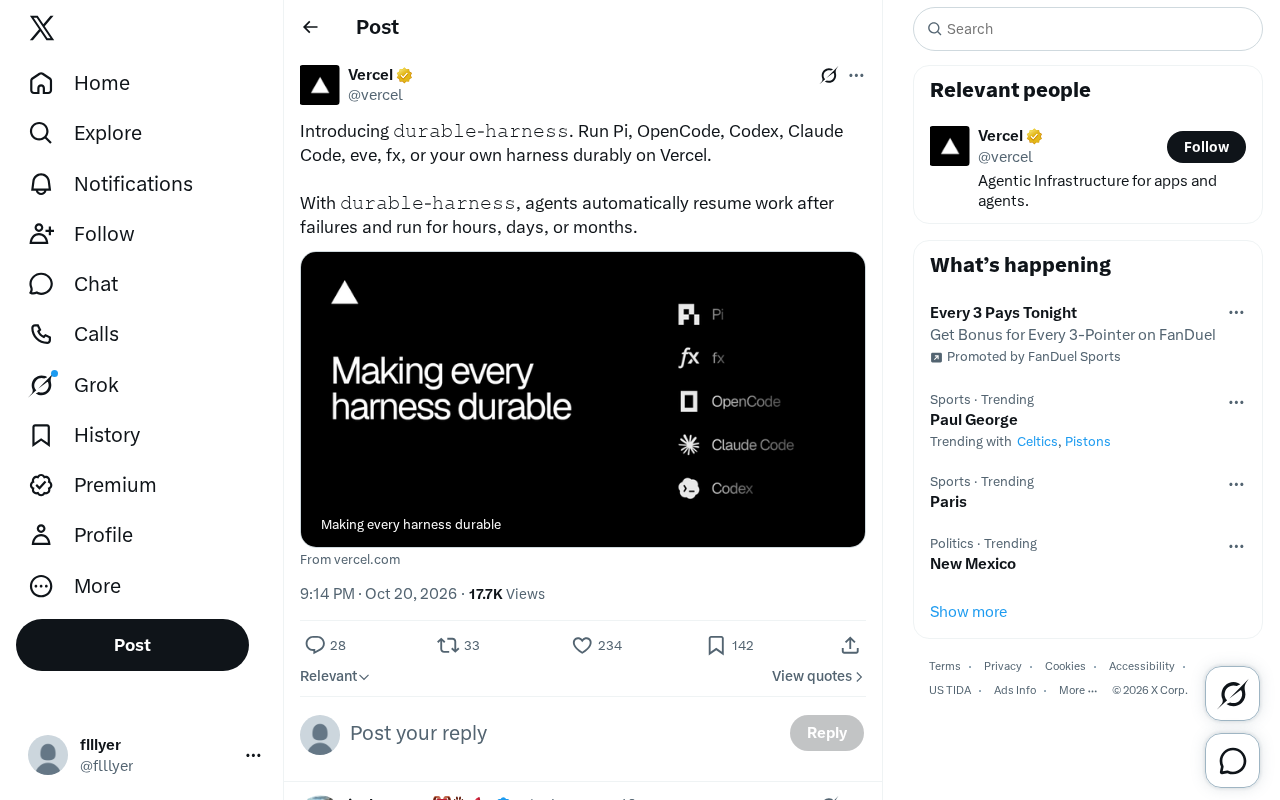
Vercel has released durable-harness to address the engineering pain point that long AI coding agent tasks are easily lost to process crashes or network jitter. It provides durable execution so agents can resume from breakpoints after failure and run continuously for hours to months. The tool claims compatibility with Pi, OpenCode, Codex, Claude Code, eve, fx, and custom harnesses, and its cross-vendor openness indicates it is positioned as general execution infrastructure rather than a companion to a single agent. The article analyzes why durability is essential for coding agents: both long-chain tasks and asynchronous background scenarios cannot tolerate starting over. It also notes that only an official tweet has been disclosed so far, and technical implementation, pricing, and compatibility depth all remain to be verified.
Vercel Launches durable-harness: An Engineering Solution for Making AI Agents Run Persistently for Months
Putting AI coding agents into production has long been stuck at an awkward point: model capabilities are already decent, but tasks fall apart as soon as they get long. Network jitter, process restarts, context timeouts—if any one link fails, an agent that has been running hard for dozens of minutes loses all its work. Vercel's newly released durable-harness targets exactly this engineering pain point.
What Problem Does durable-harness Solve?
According to Vercel's official tweet, the core capability of durable-harness is to let agents automatically resume work after failure, and to keep running for "hours, days, or even months." Behind this statement is a long-underestimated infrastructure problem in the AI agent field: durability.
In traditional approaches, an agent's execution state is bound to a single process lifecycle. Once the process crashes or a deployment update occurs, the in-progress task is lost. The idea behind durable-harness is to detach execution state from the process and hand it to the underlying runtime for management, so that after a failure it can continue from the breakpoint instead of starting over.
The tweet does not disclose specific technical implementation details, such as how state is persisted or whether recovery granularity is at the step level or the tool-call level. But the phrase "run for hours, days, or months" suggests that its design goal goes beyond a single conversation and points toward long-running autonomous agent scenarios.
Durable Execution is an engineering pattern originating from the workflow engine field, with representative implementations including Temporal, Azure Durable Functions, Restate, and others. Its core idea is to record the execution state of business logic (which step it has reached, what the intermediate results are) in a replayable way, with the runtime responsible for recovery after a crash. Implementation usually relies on event sourcing—each operation is first written to a durable log, and recovery replays the log to rebuild in-memory state; this is paired with a deterministic replay constraint, meaning business code cannot depend on nondeterministic factors such as random numbers or system time, otherwise replay would produce different results. This pattern is especially suitable for AI agents, because an agent task is itself a sequence of dependent tool calls, naturally suited to step-by-step checkpointing.
Supported Harness Ecosystem
durable-harness claims compatibility with multiple mainstream coding agent runtimes, including Pi, OpenCode, Codex, Claude Code, eve, fx, and user-built harnesses.
What is notable about this list is its openness. Codex (OpenAI) and Claude Code (Anthropic) belong to different vendors, while OpenCode is a community-driven open-source project. By bringing them all under the same persistence layer, Vercel signals that durable-harness is not positioned as a companion tool for a specific agent, but rather aims to become a general-purpose execution infrastructure layer.
For developers, this lowers migration costs: existing agent workflows do not need to be torn down and rebuilt; they only need to connect to the persistence layer to gain failure recovery capability. However, different harnesses vary considerably in API abstraction and state models, so the actual depth of compatibility still needs verification.
In the agent context, the term Harness refers to the execution shell wrapped around a large model, responsible for prompt assembly, tool-call parsing, loop control, context trimming, and so on. It is decoupled from the model itself: the same Claude or GPT model can be driven to different behaviors by different harnesses such as Claude Code and OpenCode. Precisely because the harness controls the agent's complete control flow, if the persistence layer is to take over failure recovery, it must embed itself at the harness's loop boundaries and checkpoint before and after each round of model calls and tool execution. This is also why durable-harness must adapt to multiple harnesses one by one—each has a different state model and loop structure, and no unified interface can solve it once and for all.
Why Durability Is Critical for AI Coding Agents
Coding agent tasks are inherently long chains. A refactor may involve reading and writing dozens of files, multiple rounds of test runs, and dependency installation; failure at any intermediate step causes the entire task to roll back. In environments lacking persistence, developers can only restart tasks repeatedly, wasting both tokens and time.
A more realistic scenario is asynchronous tasks. If an agent needs to run for hours or even days (for example, continuously monitoring a codebase, batch migration, or long-running background tasks), requiring users to stay connected or keep a process resident is unrealistic. Durable execution makes "submit the task and leave" possible, which is a key step for agents moving from demos to production.
Vercel's entry into this layer as a deployment platform also makes logical sense: it already provides function compute and runtime environments, and by packaging persistence capability into a harness layer, it can directly take on agent workloads running on the platform.
There is a structural tension between an agent's context window and task duration. The context a model can process in a single pass is limited, and long tasks must rely on compression, summarization, or external memory to span multiple context windows. Process restarts invalidate all these in-memory context management strategies. In a sense, durable execution provides "externalized continuity": it not only restores task progress but may also restore key intermediate state (such as the list of modified files or passed test results), thereby preventing the agent from re-exploring and re-consuming tokens after recovery. This also explains why "running for months" is not only a reliability metric but also a cost metric.
Limitations of Current Information
A quick note: currently the only public information is a single launch tweet from Vercel. Regarding durable-harness pricing, technical documentation, state serialization mechanisms, integration methods with each harness, and the actual resource consumption performance of "months"-level runs, nothing has been disclosed. The link attached to the tweet points to the official page; teams with practical needs are advised to consult the original documentation directly and conduct small-scale validation.
For teams building long-running agents, durable-harness offers an option worth watching, especially for projects already deployed on Vercel. However, the actual reliability of "automatic recovery" usually can only be tested in real failure scenarios.
Conclusion
durable-harness addresses the engineering gap between AI agents moving from short-task demos to long-running production operation. Multi-harness compatibility and automatic failure recovery are its two core selling points, while its real-world effectiveness remains to be verified through technical documentation and actual usage feedback.
One-line Summary
Vercel launches durable-harness, providing AI agents with automatic failure recovery and long-running durability.
Related articles

OpenAI Partners with Shield: How the Astra Agent Revolutionizes IT Troubleshooting
OpenAI and Shield launch the Astra agent, which autonomously logs into computers and legacy systems to fix IT issues in real time, 35-40% faster than traditional models, with humans involved only when judgment is needed.

iPhone Duo Battery Life Tested: One Charge a Day Is Unavoidable, and the Large Screen Is the Culprit
iPhone Duo battery test: heavy use needs at least one charge a day, and about 30% remains after 6.5 hours of screen-on time. How often the large screen is unfolded is key; a MagSafe battery pack helps, and long-term degradation is also worth watching.

Kimi K3.1 Pro Open-Sourced: 2.8 Trillion Parameters Close In on Opus
Moonshot releases the open-source MoE model Kimi K3.1 Pro, with 2.8T total parameters and 104B activated, trailing Opus 5.5 by under 1 point on Terminal Bench 4.0.