Vercel MCP Lets AI Agents Manage AI Gateway Directly
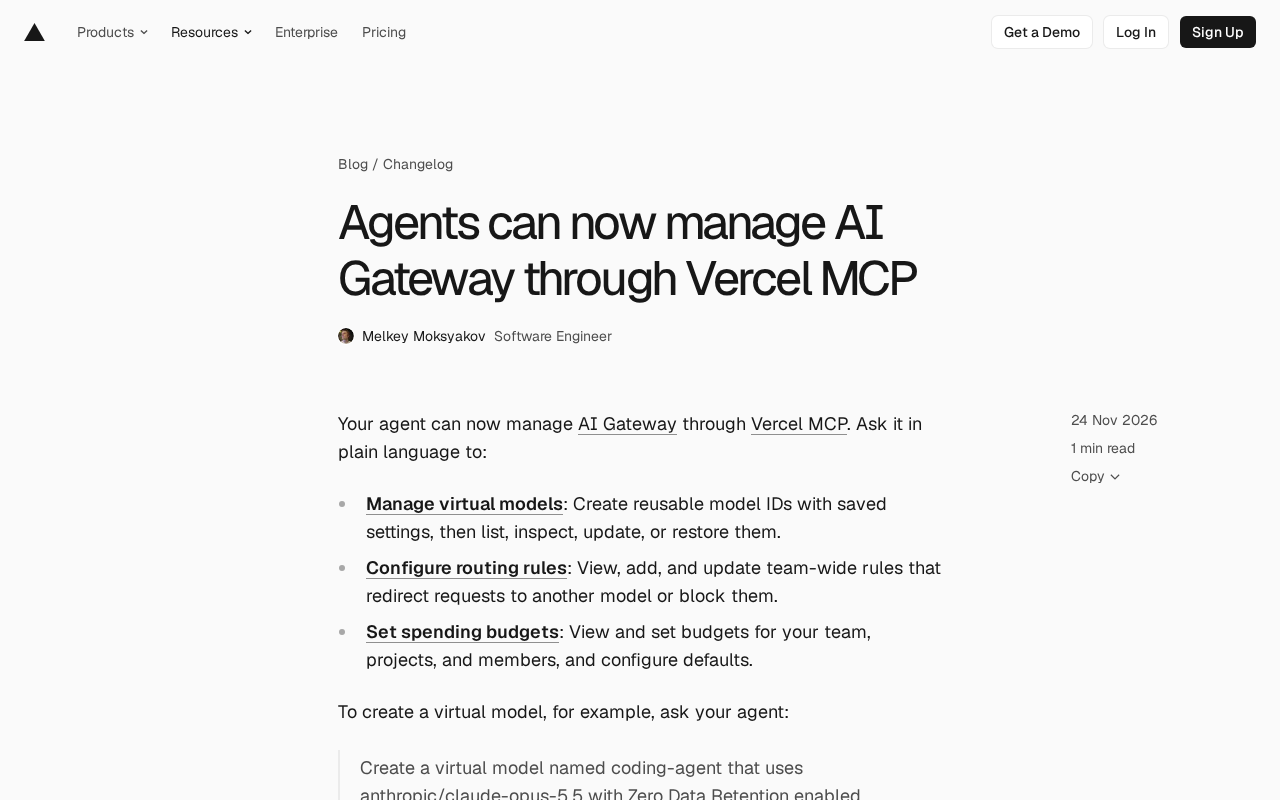
Vercel MCP lets agents manage AI Gateway's models, routing, and budgets in natural language.
The official Vercel blog announced that agents can now manage AI Gateway directly through Vercel MCP, completing virtual model creation, routing rule configuration, and spending budget setup in natural language. Its core is encapsulating Gateway's management capabilities as agent-callable tools exposed through the MCP protocol, extending agents from calling models to configuring the model invocation chain itself. The virtual model mechanism is the most noteworthy, as it decouples client calls from underlying model selection through a stable model ID, so switching models or adjusting configurations later requires no client changes or redeployment. Routing and budgets lower the barrier to team governance actions to a single instruction. The article also emphasizes that permissions have not been relaxed—agents still operate within existing team permission boundaries—but auditing, review, and rollback processes around agent changes still need to be designed by teams themselves.
From manual configuration to natural language management
In the past, managing AI Gateway's virtual models, routing rules, and budgets typically required going into the console and operating item by item. Now, according to an announcement on the official Vercel blog, agents can manage AI Gateway directly through Vercel MCP. You simply give the agent instructions in natural language, and it can carry out these management tasks on your behalf. This marks a shift in how AI infrastructure is operated toward conversational interaction, with the interface between developers and underlying services moving from graphical interfaces to language interfaces.
The core of this change is encapsulating AI Gateway's management capabilities as tools that agents can call, then exposing them through the MCP protocol. Agents no longer just call models to generate text—they can also configure the model invocation chain itself.
MCP (Model Context Protocol) is an open protocol proposed by Anthropic and now widely adopted, used to establish standardized bidirectional connections between AI agents and external tools and data sources. You can think of MCP as the "USB interface" of the agent world: service providers implement an MCP Server that declares their capabilities (querying databases, calling APIs, modifying configurations, etc.) as callable tools; the MCP Client on the agent side discovers these tools, reads their parameter structures, and initiates calls when needed. Compared with writing a separate plugin or function-calling adapter layer for each service in the past, MCP lets the same agent plug into services from different vendors out of the box. Vercel MCP implements the management capabilities of the Vercel platform (including AI Gateway) as an MCP Server, so that any MCP-compatible agent can operate it in a unified way.
What Vercel MCP can do
According to the official documentation, agents can perform three types of operations through Vercel MCP:
- Manage virtual models: Create reusable model IDs with preset configurations, and list, inspect, update, or restore these models.
- Configure routing rules: View, add, and update team-level rules to redirect requests to another model or block them outright.
- Set spending budgets: View and set budgets for teams, projects, and members, and configure defaults.
Taking virtual model creation as an example, you can simply tell the agent: "Create a virtual model named coding-agent that uses anthropic/claude-opus-5.5 and enables zero data retention." After that, applications and coding agents using AI Gateway can call it via the vmc/coding-agent model ID.
AI Gateway is Vercel's unified entry point for model calls, sitting between applications and model providers. Applications only need to send requests to Gateway and specify a model identifier; Gateway handles forwarding, authentication, routing, and usage tracking, shielding differences among providers in API formats, billing methods, and availability. On top of this, Gateway also provides caching, fallback, observability, and cost control. The virtual models, routing rules, and spending budgets described in this article are all Gateway-level configuration items—they don't change application code, but change how requests are processed inside Gateway.
The decoupling value of virtual models
Virtual models are the most noteworthy mechanism in this capability release. They decouple "model selection" from "client calls": the application side only needs to reference a stable model ID, while which underlying model it actually points to and what settings are enabled can be adjusted on the server side at any time.
The official example scenario is typical: when you later want to switch models or change configurations, you don't need to update those clients or redeploy the application. For teams sharing the same model configuration across multiple environments and projects, this decoupling can significantly reduce the operational burden caused by configuration drift and repeated releases.
Zero Data Retention (ZDR) refers to a data processing mode in which model providers commit not to store request and response content for training or later retrieval, commonly used in scenarios with high compliance and privacy requirements (such as healthcare, finance, or applications handling sensitive user data). In AI Gateway, ZDR is typically a configuration switch for model calls, bound to a specific model. Hardcoding it on a virtual model means all calls made through that model ID uniformly inherit this policy, without needing to declare it repeatedly in each client or on each request—this is also one expression of the value of virtual models as "carriers of preset configurations."
Routing and budgets: handing governance to conversation
Routing rules and spending budgets are typical team governance needs. Routing rules can switch requests between different models or block them outright under specific conditions; budgets constrain spending limits for teams, projects, and members.
Handing these two types of operations to agents to complete in natural language lowers the barrier to governance actions. What used to require administrators to click through the console item by item can now be viewed or modified with a single description. For teams that need to frequently adjust resource allocation and cost strategies, this interaction style is closer to actual workflows.
The permission model has not been relaxed
It's worth noting that opening up agent management capabilities does not mean permissions are expanded. The official documentation states clearly that before use, the agent must be connected to Vercel MCP and granted team-level access and the required AI Gateway permissions. Existing Vercel team permissions still apply.
In other words, the agent only executes operations on your behalf within existing permission boundaries and will not bypass team role controls. For teams introducing agents into production environment management workflows, this is a necessary prerequisite safeguard.
Team-level access permissions refer to the role and authorization model in the Vercel account system based on Teams, with common roles including Owner, Member, Viewer, etc. Different roles have different scopes of operations for resources such as projects, environment variables, domains, and billing. When an agent connects through MCP, it does not gain a super identity above the role system; instead, it acts as an authorized credential, and its executable operations are jointly constrained by the role to which that credential belongs and the explicitly granted scopes. Therefore, when auditing agent operations, what is actually traced is the authorized identity behind it—which also explains why teams need to carefully decide which level of permission to grant to agents.
Impact on development workflows
From a broader perspective, this update advances MCP from "letting agents read external tools" to "letting agents modify infrastructure configurations." When model routing, budgets, and virtual models can all be managed by agents, configuration management begins to have the potential for conversational automation.
However, this also raises new requirements for teams: who reviews configuration changes initiated by agents, how to track these changes, and how to quickly roll back when misoperations occur. The restore capability of virtual models provides some fallback, but auditing and process constraints around agent operations still need to be designed by teams themselves.
One-line Summary
Vercel MCP lets agents manage AI Gateway's models, routing, and budgets in natural language.
Paragraph Summary
The official Vercel blog announced that agents can now manage AI Gateway directly through Vercel MCP, completing virtual model creation, routing rule configuration, and spending budget setup in natural language. Its core is encapsulating Gateway's management capabilities as agent-callable tools exposed through the MCP protocol, extending agents from calling models to configuring the model invocation chain itself. The virtual model mechanism is the most noteworthy, as it decouples client calls from underlying model selection through a stable model ID, so switching models or adjusting configurations later requires no client changes or redeployment. Routing and budgets lower the barrier to team governance actions to a single instruction. The article also emphasizes that permissions have not been relaxed—agents still operate within existing team permission boundaries—but auditing, review, and rollback processes around agent changes still need to be designed by teams themselves.
Related articles
GLM-5.4 vs. Opus and Neon: How Far From the Top?
No official benchmarks for GLM-5.4. Based on a YouTube deep test and developer trials, we analyze its gap vs. Claude Opus 5.5 and Gemini Neon, the speed bottleneck from marathon-style thinking, and its real position in enterprise agent scenarios.

From Gobbler to Sloppy Joe: The Hit-Making Playbook of a New Jersey Deli Institution
NYT Cooking visits Milburn Deli in New Jersey to break down the hit logic behind the Gobbler turkey sandwich and the local Sloppy Joe: bread sliced to order, house-made sauces, a group shout culture, and customer co-creation behind six locations.
In the Age of AI Programming, When Do You Still Need to Write Code by Hand?
Is handwritten code still valuable once AI programming agents are widespread? This article outlines three scenarios where handwriting is essential—learning, style development, and prototype validation—and provides a division-of-labor framework between AI and humans to help developers balance efficiency and skill growth.