Vercel's New Backend Push: Python GA, Containers, and Daemons

Vercel completes its backend stack with Python, containers, and resident daemons, pivoting to a full-stack runtime platform.
At Vercel Ship in San Francisco, Vercel announced three backend updates: Python on Vercel reaching GA with support for FastAPI, Flask, Django, already used by 150K teams; container runtime opening up to package any language and system libraries with Active CPU pricing that only bills compute time; and Vercel Daemons entering public beta, running containers as resident background workers on Fluid compute with per-region instance counts and automatic capacity maintenance. Combined, applications previously reliant on ECS, Kubernetes, or standalone worker clusters can theoretically migrate entirely to Vercel. After migrating from AWS ECS, Delphi's team of ten engineers with no dedicated infrastructure role ships over a hundred times per day. However, Daemons is still in public beta, and the cost model for resident processes and multi-region capacity planning remain to be validated.
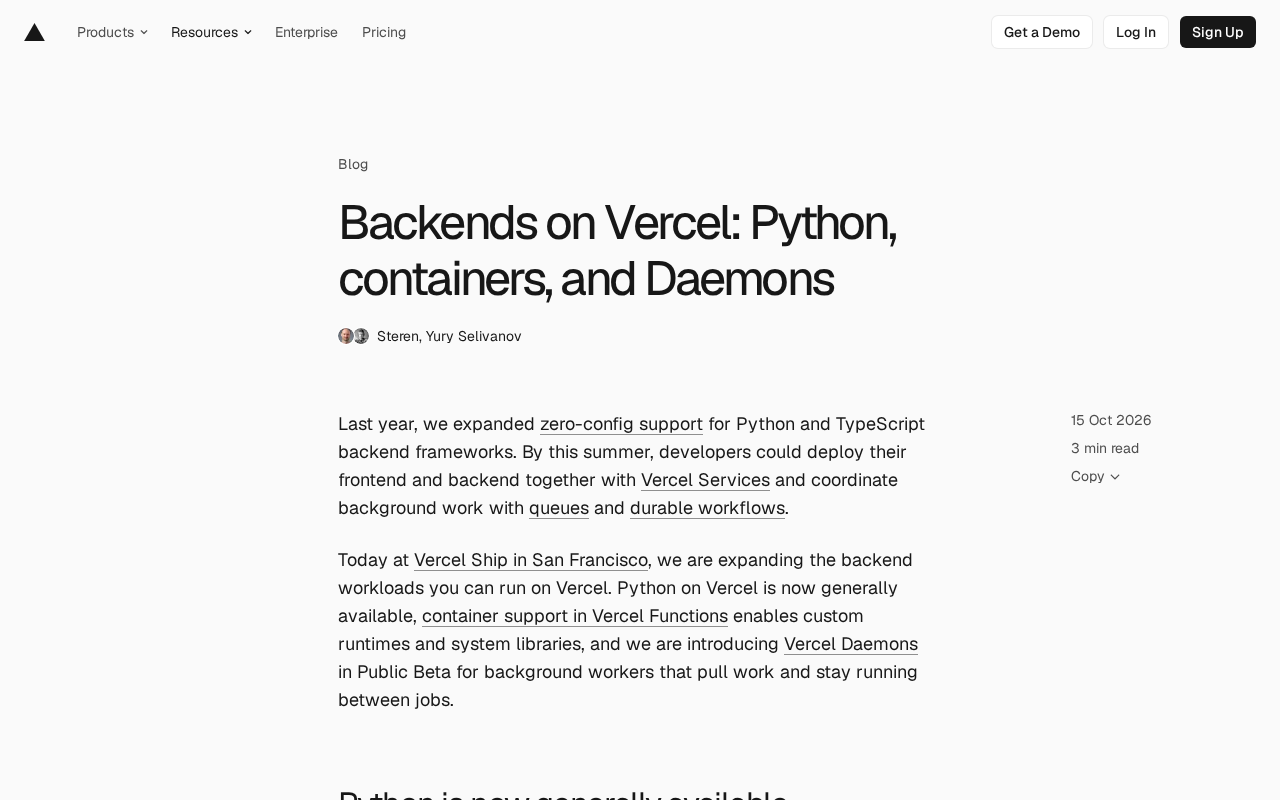
Vercel is transforming from a "frontend deployment platform" into a "full-stack application runtime platform." At the Vercel Ship conference in San Francisco, the company unveiled three backend capability updates in one go: Python support reaching general availability, the opening of container runtime, and Vercel Daemons entering public beta for long-running background tasks.
Python Backend Now Generally Available, 150K Teams Already Running It
Python on Vercel has exited preview and moved to general availability (GA). Developers can use familiar Vercel workflows — local development, preview deployments, production releases — to run frameworks like FastAPI, Flask, and Django, backed by standard CPython plus dependencies from PyPI. Framework detection, builds, and elastic scaling are handled by Vercel.
According to official disclosures, 150,000 teams are already running Python backends on Vercel, including high-profile companies like OpenAI, Polymarket, and Exa. The accompanying Python SDK lets applications directly call Vercel's product suite: storing files with Vercel Blob, dispatching background tasks with Queues, orchestrating persistent steps with Workflows, running untrusted code in Sandbox, and streaming model responses and tool calls via the AI SDK for Python.
One notable case is Delphi — a company building "AI digital minds" from books and speeches — which migrated its entire Python backend from AWS ECS to Vercel. The team has only ten engineers, no dedicated infrastructure role, yet ships to production over 100 times per day and uses Queues to handle background tasks. Founding engineer Spencer Schoeben put it bluntly: "With Vercel, we barely have to think about infrastructure at all."
GA (General Availability) is a lifecycle milestone for cloud services, sitting between preview (Preview/Beta) and full commercial availability. Entering GA typically means three things: the API and behavior are frozen with a backward-compatibility commitment, service-level agreements (SLAs) take effect, and it can be confidently used in production. Before GA, platforms often reserve the right to change interfaces or pause capabilities at any time, which is why many enterprise teams deliberately avoid preview-stage features. Python on Vercel moving from preview to GA essentially turns a previously "usable but not recommended for production" state into a formal capability that can carry mission-critical workloads — which is precisely why the official emphasis on the "150,000 teams" figure matters.
Container Runtime: Any Language Can Run on Vercel
Vercel's container runtime allows deploying applications written in any language, bundling the required OS libraries and executables together. Since its public beta, 5,000 teams have completed 150,000 container deployments.
Containers are positioned as a form of "Vercel Functions," running on Fluid compute, scaling with traffic, and using Active CPU pricing — idle time spent waiting for API responses, database queries, or LLM inference is not billed. Combined with Vercel Services, frontend and backend can be developed and deployed together, with the CDN handling traffic distribution, WAF providing protection, logs for troubleshooting, and rollbacks to restore earlier versions.
Officially, a video application example was given: using containers for post-processing, generating playback copies and thumbnails for each uploaded clip. The Dockerfile bundles the Python processor, dependencies, and ffmpeg into a single image; when deployed via Git or the Vercel CLI, Vercel builds the image and stores it in the Vercel Container Registry.
FROM python:3.12-slim
RUN apt-get update \
  && apt-get install -y --no-install-recommends ffmpeg \
  && rm -rf /var/lib/apt/lists/*
WORKDIR /app
COPY requirements.txt .
RUN pip install --no-cache-dir -r requirements.txt
COPY processor.py .
CMD ["python", "processor.py"]
Fluid compute is Vercel's approach to reworking the traditional serverless execution model. Classic FaaS maps one request to one function instance, destroying the instance when idle, which limits both cold-start performance and resource reuse efficiency. Fluid compute lets multiple concurrent requests share a single instance and preserves the initialized runtime environment between requests, reducing cold-start overhead and improving resource utilization. The direct pricing impact: you're only billed when the CPU is actually computing, while time spent waiting on external I/O (such as calling third-party APIs, querying databases, waiting for LLM tokens) is not counted. This is exactly the technical prerequisite that makes "Active CPU pricing" viable, and it's especially advantageous for AI applications dominated by model inference.
Daemons: Long-Running Background Worker Processes
Traditional serverless functions are triggered per request and exit after execution, making them unsuitable for scenarios that require continuous task polling. Vercel Daemons fill exactly this gap: deploying containers as continuously running background worker processes on Fluid compute, where you can specify the number of instances per region, and Vercel maintains that capacity — automatically restarting processes when they exit or crash.
During the public beta, Daemons supports "pull-based" workloads, meaning code actively requests tasks from other systems and processes them, such as consuming queue messages or pulling pending jobs from a database. In the video application example, Daemons keep the video processor running continuously, pulling tasks from Vercel Queues.
Configuration goes in vercel.toml: define the Next.js frontend service and route requests to it, then declare the processor as a daemon using a Dockerfile.
#:schema https://openapi.vercel.sh/vercel.json

[services.frontend]
framework = "nextjs"
root = "."

[[routes]]
src = "/(.*)"
destination.service = "frontend"

[daemons.videos]
root = "."
entrypoint = "Dockerfile"
instances.iad1 = 1
This configuration means: keep one video processor instance resident in the iad1 (Washington, D.C.) region.
Pull-based vs. push-based are two typical paradigms for background task processing. In push-based, the scheduler actively "pushes" tasks to workers, and workers usually need to expose a callable endpoint. Pull-based is the reverse: workers continuously poll a queue or database and actively claim tasks. The advantages of pull-based are that workers don't need to expose an external entry point, naturally support horizontal scaling, and have queue-controlled consumption rates and retries — making it better suited for long-running, retryable, peak-shaving scenarios. Daemons supporting only pull-based during the public beta means it's closer to a traditional worker cluster usage pattern rather than event-driven short functions; this also explains why it can run resident — even when no external requests come in, the process is still polling and waiting.
What These Three Updates Mean for Developers
Looking at all three threads together, Vercel's backend narrative becomes complete: Python GA addresses mainline language support, containers address "non-Node ecosystem dependency" compatibility, and Daemons address the "functions can't be resident" execution model. Stacked together, an application that previously required ECS, Kubernetes, or a separate worker cluster can theoretically be moved entirely to Vercel.
From the Delphi case, the value of this consolidation isn't how strong any single capability is, but that operational complexity gets absorbed by the platform — a ten-person team, no dedicated SRE, over a hundred deploys per day — a combination that's hard to achieve on self-managed infrastructure. Of course, Daemons is still in public beta; the cost model for resident processes, multi-region capacity planning, and failure recovery behavior all need more real-world load validation. Whether Vercel can carry heavier backend scenarios, upcoming practice will provide the answer.
SRE (Site Reliability Engineer) is a dedicated role responsible for system availability, capacity planning, monitoring and alerting, and incident response, whose responsibilities often heavily overlap with infrastructure operations. When the article mentions Delphi has "no dedicated infrastructure role" and "no dedicated SRE," it doesn't mean this work disappeared — rather, it's been taken over by platform automation: elastic scaling is scheduled by Vercel based on traffic, process crashes are automatically restarted by Daemons, and logging, rollbacks, and WAF protection are provided built-in by the platform. The key to judging whether a managed platform can truly replace a self-built stack lies in how much of this human-labor operational responsibility it absorbs, and whether, after absorption, the team still has sufficient observability and control over anomalous behavior.
One-line Summary
Vercel completes the backend puzzle with Python, containers, and resident daemons, transforming into a full-stack runtime platform.
Paragraph Summary
At the Vercel Ship conference in San Francisco, Vercel announced three backend capability updates: Python on Vercel reaching GA with support for FastAPI, Flask, Django, and more, already used by 150,000 teams; container runtime opening up to package any language and system libraries, using Active CPU pricing that only bills compute time; and Vercel Daemons entering public beta, running containers as resident background workers on Fluid compute with per-region instance counts and automatic capacity maintenance. Combined, applications previously reliant on ECS, Kubernetes, or separate worker clusters can theoretically migrate entirely to Vercel. After migrating from AWS ECS, Delphi's team of ten engineers with no dedicated infrastructure role ships over a hundred times per day. However, Daemons is still in public beta, and the cost model for resident processes and multi-region capacity planning remain to be validated.
Related articles

Random Pruning of the DPO Computation Graph: 1.4x Training Speedup and Lower Peak Memory
DPO training too slow and memory-hungry? This paper proposes a random pruning framework for the DPO computation graph, sampling independently across position, sequence, and branch dimensions; branch pruning achieves a 1.426x step-time speedup and cuts training time by about 30%, with in-depth attribution of memory and time gains.

Why Does JEPA Underperform MLM in Longitudinal EHR Representation Learning?
New study compares JEPA and MLM for longitudinal EHR representation learning on MIMIC-IV: three JEPA variants train stably without collapse but underperform MLM; target size, not heterogeneity, drives prediction error.

Transfer Learning + Visible Light Communication: A New Approach to Energy-Efficient Indoor Positioning
A study proposes a transfer learning-based visible light communication indoor positioning method, achieving 47% accuracy improvement on the BOSCH factory dataset, 67.5% model efficiency under high noise, and introducing the ME composite metric for energy-efficient positioning in energy-constrained industrial IoT scenarios.