Vercel Sandbox with Drives Starts Up 2.4x Faster, Median Creation Time Drops to 0.7 Seconds

Vercel's Sandbox with Drives starts up to 2.4x faster with zero migration cost.
Vercel announced a major speedup for Sandbox instances with Drives mounted: median creation time dropped from 1.7s to 0.7s and p95 from 2.2s to 1.6s, up to 2.4x faster. The optimization applies automatically to all Sandboxes using Drives, with no SDK upgrade or config changes and unchanged pricing. Both median and p95 dropped, indicating the optimization covers typical and slow-request scenarios rather than just a few cases. For high-frequency workflows like AI code execution, preview deployments, and automated testing, faster cold starts directly reduce end-to-end latency and pipeline time.
Vercel recently announced a significant speedup in the startup time of Sandbox instances with Drives mounted. According to official figures, the median creation time for Sandbox dropped from 1.7 seconds to 0.7 seconds, while the p95 creation time fell from 2.2 seconds to 1.6 seconds. Vercel says startup speed improved by up to 2.4x.
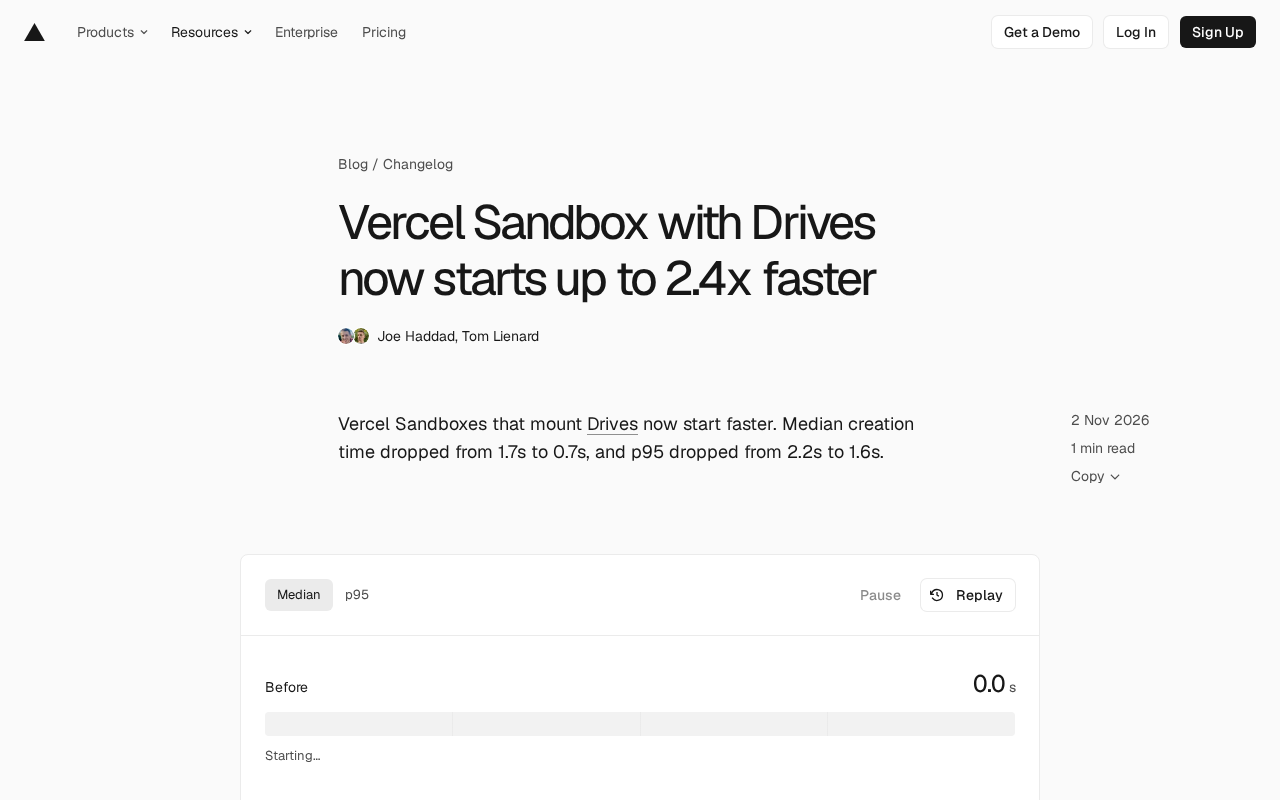
The Specific Performance Numbers
In the announcement, Vercel provided changes for two key metrics: median creation time dropped from 1.7 seconds to 0.7 seconds, and p95 creation time fell from 2.2 seconds to 1.6 seconds. The median reflects the typical user experience, while p95 represents the slower portion of requests—both dropping at the same time indicates the optimization covers the vast majority of scenarios, not just a few cases.
In absolute terms, the median dropped by a full second, a relative improvement of about 2.4x; p95 dropped by 0.6 seconds. For developers relying on Sandbox for code execution, build previews, or automation tasks, the time saved per instance creation adds up with call frequency, and is especially significant in CI/CD pipelines or high-frequency API call scenarios.
Difference between median creation time and p95: Median creation time refers to the value in the middle when all Sandbox instance creation times over a period are sorted from smallest to largest. It reflects the actual experience of a "typical" user and is not affected by extreme slow requests. p95 creation time is the 95th percentile value, meaning 95% of instance creations are faster than this time, and only 5% of requests are slower. p95 is typically used to measure tail latency and is an important indicator for evaluating system stability and the "worst experience." When both drop simultaneously, it often indicates the optimization addressed a common bottleneck in the creation path, rather than merely improving cache hits or a few fast paths.
No Upgrade Needed, Takes Effect Automatically
A key feature of this speedup is zero migration cost. Vercel explicitly states that the speed improvement applies automatically to every Sandbox using Drives, and developers do not need to upgrade the SDK or modify any configuration. Pricing remains unchanged.
For teams already using Drives in production, this means no additional upgrade windows or regression testing are needed—the performance gains arrive directly. This kind of "silent optimization" is uncommon in infrastructure products; typically performance improvements come with API version iterations, but Vercel chose a completely transparent approach for users.
How Drives and Sandbox Work Together
Sandbox is an isolated execution environment provided by Vercel for safely running untrusted code. Drives provide persistent storage mounting for these Sandboxes, enabling instances to directly access pre-prepared filesystem content at startup.
A Sandbox with Drives mounted needs to complete storage volume attachment and initialization during creation, and this overhead was previously one of the main sources of startup latency. This optimization clearly addresses this step, compressing median creation time to under 1 second. Vercel did not elaborate on the specific implementation details in the announcement; developers can consult the Vercel Drives documentation for more information.
Initialization overhead of persistent storage mounting: Mounting persistent storage in an isolated execution environment typically requires completing storage volume attachment, filesystem metadata loading, and possibly cache warm-up. These operations involve network communication and disk I/O, and if executed serially, can significantly lengthen instance cold-start time. Common optimization approaches include pre-establishing storage connections, parallelizing initialization steps, or moving some preparation work earlier into the scheduling phase. Vercel compressing median creation time to under 1 second this time very likely involved targeted improvements to the initialization chain for mounting Drives, but the official announcement did not disclose the specific implementation.
Impact on Developer Workflows
Shorter startup times have a direct impact on several scenarios. In AI code execution scenarios, Sandbox is often used as an isolated environment for running model-generated code, and faster cold starts mean shorter end-to-end response latency. In preview deployments and automated testing, instance creation speed affects the overall time of pipelines.
One detail: once median creation time enters the sub-second range, Sandbox startup overhead is already nearly "imperceptible" in many interactive scenarios. For workloads that frequently create and destroy instances, this improvement directly reflects on resource utilization efficiency and user experience.
Summary
Vercel optimized the startup path of Sandbox with Drives mounted, reducing median creation time from 1.7 seconds to 0.7 seconds and p95 from 2.2 seconds to 1.6 seconds, with up to 2.4x speedup, no SDK upgrade or configuration changes required, and unchanged pricing. For developers relying on Sandbox for code execution and automation tasks, this is a performance upgrade obtained without any migration cost.
Related articles

AI Can Read Neural Network Weights Directly: Do Models Already Exceed Expectations?
A Reddit developer experiment shows language models can directly read neural network weights and infer their function. Astra, Opus 5.5, and Muse Spark 1.3 all passed the test, sparking discussion on model generalization and training sources.

India's Microdrama Market Explodes: EloElo Secures $80M Investment from NBCUniversal
EloElo secures $80M from NBCUniversal to boost StoryTV, its microdrama platform with over 33M monthly active users, as India's microdrama market draws global capital.

Acoustic Detection of Multi-Rotor UAVs: Fusing Handcrafted Features with Pre-Trained Embeddings
Study reveals data leakage from random splits in UAV acoustic detection, proposes source-disjoint protocol with stacked ensemble of handcrafted features and YAMNet embeddings, achieving 95.29% accuracy for low-cost drone detection.