VerdantPulse: Building an Off-Screen Offline Hiking Companion with Gemma 2 and TabPFN

VerdantPulse uses offline TabPFN and Gemma 2 to compress hiking app screen time to 48 seconds.
VerdantPulse is an open-source offline AI field companion designed to limit screen interaction to under 60 seconds. It combines two open-source models: TabPFN uses in-context learning to predict fall foliage indices and trail mud conditions from just 5–10 historical records in milliseconds, while Gemma 2 (2B, 4-bit quantized at ~1.6 GB) synthesizes predictions into 120-word sensory guidance cards covering touch, sight, and smell. A "Slip Into Pocket" mode switches the display to pure black and delivers haptic mindfulness reminders every 15 minutes. Field testing achieved 48 seconds of screen time against 1 hour 42 minutes of outdoor immersion. The choice of open-weight models was driven by three hard constraints: zero signal coverage, location privacy, and zero operational cost.
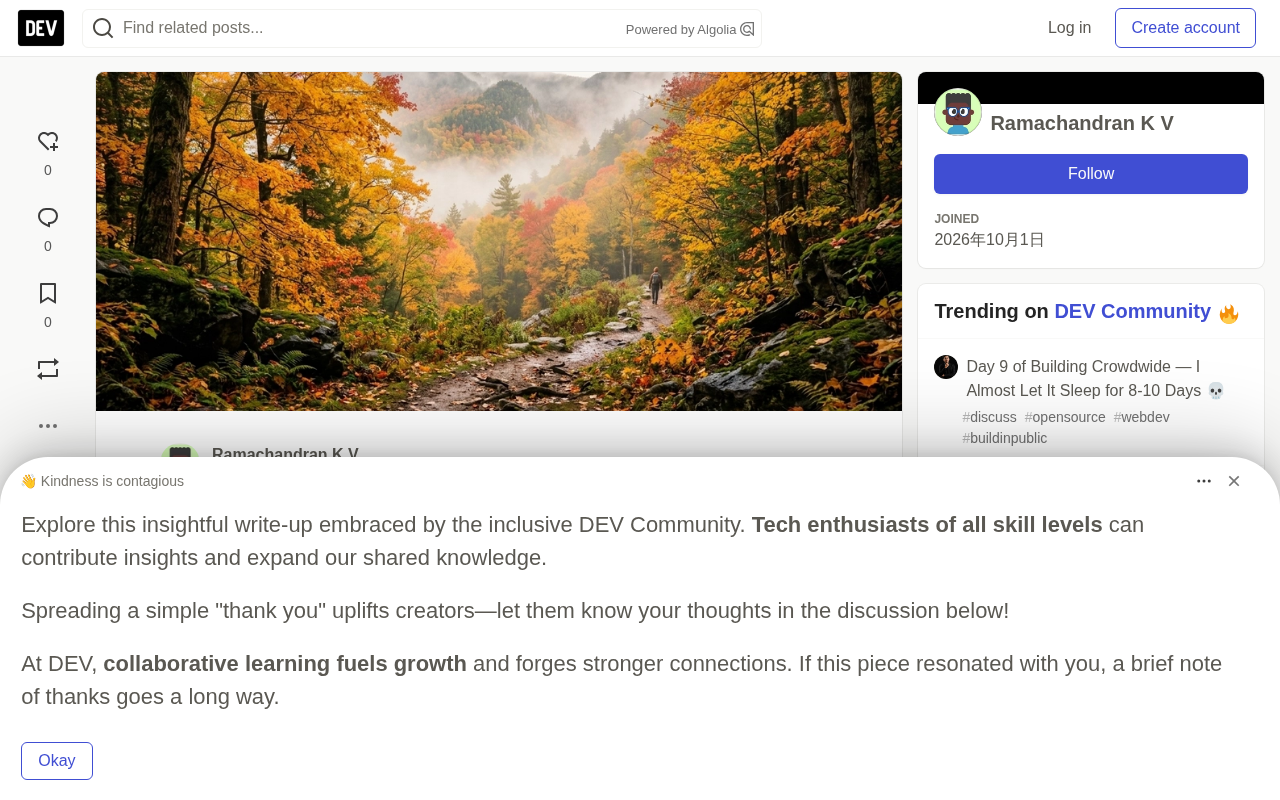
When technology is supposed to bring us closer to nature but ends up turning the wilderness into yet another backdrop for screen time — that's the paradox VerdantPulse sets out to solve. This open-source AI project, built for the Hacktoberfest Open Source AI Challenge, is built around a simple yet counterintuitive premise: make the screen the shortest part of the entire journey (under 60 seconds).
A Hike Held Hostage by Screens
The developer describes a scene almost everyone has witnessed: someone spends two hours scrambling up a rugged ridge, reaches a breathtaking viewpoint, and then spends the next forty minutes hunched over their phone — checking the route map, snapping twenty photos to upload to a cloud-based plant identification model, scrolling social feeds, or staring at a spinning loading icon with one bar of signal.
VerdantPulse flips that experience entirely. It's positioned as an offline-first, open-source AI field companion for hikers, trail runners, and foragers — designed from the ground up to get you off your phone and back into the actual forest as quickly as possible.
Two Open-Source Models, One Core Experience
The project's technical backbone rests on two open-source AI foundation models, each handling a distinct role.
TabPFN: The Phenology Prediction Engine
Autumn foliage and trail mud conditions are fundamentally tabular phenology problems, driven by a set of structured features: day of year (DayOfYear), elevation (ElevationMeters), latitude (Latitude), recent mean temperature (MeanTempC), and rainfall over the past seven days (RainLast7dMm).
Training a regression model for this kind of problem with a traditional neural network typically requires hundreds of thousands of samples and lengthy training runs. Prior Labs' TabPFN is a Transformer foundation model pretrained on synthetic tabular priors, capable of performing in-context learning in milliseconds. The developer notes that with just 5–10 historical seasonal records per mountain region, TabPFN can predict a continuous foliage color percentage for the current day and generate a 7-day forward-looking curve — no retraining required. The final output is two key metrics: a fall foliage progress index (0–100%) and a trail mud/footing coefficient.
In-context learning is the key concept for understanding TabPFN's advantage. Traditional machine learning requires two distinct phases — training and deployment: first, model weights are updated with large amounts of labeled data, then the model is deployed for inference. In-context learning skips the weight update step entirely. During inference, the model receives a small set of examples (called a "support set") alongside the new input, and leverages the meta-learning capabilities acquired during pretraining to infer the mapping pattern on the fly. For TabPFN, this means a developer simply concatenates 5–10 historical seasonal records with the current day's features into a single forward pass, and the model outputs a prediction — no backpropagation, no GPU training cluster, no persistent new model file to save. This is precisely what makes it packageable into an offline edge application. TabPFN's pretraining corpus consists of massive synthetic tabular priors — virtual datasets generated programmatically according to statistical rules — covering a wide diversity of tabular data structures, giving it cross-domain generalization that holds up even in small-sample domains like phenology prediction.
Gemma 2: The Language Core for Pocket Field Cards
Once TabPFN's predictions are in hand, Google's open-weight model Gemma 2 (google/gemma-2-2b-it) synthesizes the data into a high-density "pocket field card" of no more than 120 words. The developer chose it for its strong instruction-following capability at a compact parameter scale — 4-bit quantized, it requires only about 1.6 GB of memory and can run on a standard laptop, handheld edge device, or even a browser-based edge runtime.
The card delivers three specific sensory tasks:
- 🌿 Touch: Feel a specific texture — like the velvety wet moss on granite, or the papery bark of a birch tree.
- 🍂 Vision: Look up at the forest canopy and observe the specific color gradients at your current elevation.
- 💨 Smell and Sound: Close your eyes, identify the resinous scent of cold, damp fir needles, or the rhythm of a woodpecker at work.
The developer also published the carefully crafted system prompt, which boils down to three core instructions: keep output under 120 words, include specific touch/visual/smell tasks, and end with an explicit "lock the screen and put the device away" instruction.
4-bit quantization is the key compression technique that makes large language models viable on consumer devices. Standard neural network weights are typically stored as 32-bit or 16-bit floating point numbers; quantization compresses each weight to a 4-bit integer representation, reducing storage to 1/4 to 1/8 of the original. For Gemma 2 (2B parameters): the original BF16 weights require roughly 4 GB of memory, which drops to about 1.6 GB after 4-bit quantization — well within the integrated VRAM of a typical laptop or a phone's RAM. Quantization inevitably introduces some precision loss, but for a task like "generate 120 words of sensory guidance text," the slight degradation has virtually no impact on practical output quality. The project supports calling quantized models through a local Ollama daemon — a lightweight runtime designed specifically for running open-source LLMs locally. Developers can pull and launch Gemma 2 with a single command, without manually configuring CUDA environments or handling model format conversions, dramatically lowering the barrier to offline deployment.
Programmatic Offline Soundscape
To avoid downloading bulky MP3 files over cellular data, the project uses the browser-native Web Audio API to generate organic brown noise, modulated through a low-pass filter driven by a 0.18 Hz LFO. This programmatically simulates the sound of autumn wind rustling through a broadleaf forest canopy — zero network bandwidth required, functional even at 3,000 meters elevation.
Brown noise is a random signal whose power spectral density falls with the square of frequency, making its low-frequency content more prominent than white or pink noise. It sounds deeper and warmer — often described as "distant thunder" or "strong wind through trees" — closely matching the acoustic character of wind and flowing water in nature. An LFO (Low-Frequency Oscillator) is a slow-cycling oscillation signal used in audio synthesis to modulate other parameters, typically operating below 20 Hz (below the threshold of human hearing). VerdantPulse uses a 0.18 Hz LFO to drive the cutoff frequency of a low-pass filter, completing roughly one open-and-close timbral cycle every 5.5 seconds — simulating the natural rhythm of gusts rising and falling through a forest canopy. The Web Audio API is a browser-native audio processing interface that supports building audio node graphs directly in JavaScript (oscillator → filter → reverb → output), with no audio files to load, making it the ideal solution for a zero-bandwidth, offline-capable soundscape.
One Tap Into "Slip Into Pocket" Mode
Beyond the card itself, VerdantPulse offers a hands-free voice narration companion that reads the card aloud, paired with the programmatic forest soundscape — so you don't even need to look at the text.
The most distinctive feature is "Slip Into Pocket" mode: a single tap switches the screen to an AMOLED pure-black low-power display and starts an "off-screen presence" timer. From there, a gentle haptic pulse every 15 minutes prompts you to pause and re-engage your senses — while your phone can stay safely in your pocket or pack for up to two hours.
Why It Has to Be Open-Source Models
The developer is emphatic: this project cannot be built with closed-source cloud APIs, and offers three reasons why.
The Zero-Signal Reality
The best hiking trails, national parks, and ridgelines are often exactly the places with no cell signal whatsoever. An app dependent on closed APIs like GPT-4 or Claude would hit a fatal 503 Service Unavailable error the moment a hiker reached the trailhead. Gemma 2 and TabPFN are open-weight models that run directly on-device — even in airplane mode in the middle of the White Mountains, VerdantPulse maintains 100% functionality with sub-200ms latency.
Location Privacy and Sovereignty
Outdoor enthusiasts are generally highly sensitive about their location data. Cloud applications routinely log GPS coordinates, movement patterns, and timestamps to remote corporate servers. Local open-source AI means coordinates, hiking habits, and logs never leave your physical storage.
Zero Cost, Full Freedom to Modify
Commercial APIs charge per token and impose rate limits. VerdantPulse costs $0.00 whether you run it once or a million times. Gemma's open-weight nature also allows fine-tuning on hyper-regional plant databases — Pacific Northwest native lichens, Appalachian deciduous flora — without licensing restrictions or corporate content filtering policies.
Field Test: 48 Seconds of Screen Time
The developer took VerdantPulse to a local state nature preserve for a real-world test. Opening the app on the bench at the trailhead, total screen time came to exactly 48 seconds: TabPFN reported an 88% foliage index and flagged slippery moss near streamside rocks; Gemma 2 delivered the instructions — "Touch the rough, peeling bark of a yellow birch, listen for the breeze threading through the tall red oaks, and put your phone away right now."
He tapped "Slip Into Pocket," phone went into his jacket. Every 15 minutes, a mindfulness chime prompted him to look up at the golden canopy and breathe in the scent of damp earth — no phone required. Final tally: 1 hour and 42 minutes of outdoor immersion, 48 seconds of total screen time.
Tech Stack and Open-Source Links
VerdantPulse is live (verdant-pulse.vercel.app) with full source code on GitHub. The stack covers HTML5 / vanilla CSS3 / modern JavaScript (ES6+) / Web Audio API / Python FastAPI, layered on top of Gemma 2 and TabPFN. Key architecture components include: tabpfn_predictor.js handling continuous foliage curve and mud coefficient tabular regression; gemma_engine.js managing Gemma 2 prompt templates and inference (supporting both a local Ollama daemon and embedded offline edge inference); and server.py as the reference backend using tabpfn.TabPFNRegressor and Hugging Face transformers.pipeline.
For developers looking to get hands-on with edge AI, VerdantPulse is a compelling case study — combining two emerging open-source foundation models (Gemma 2 on the language side, TabPFN on the tabular side) into a genuinely offline-capable product, while using a minimalist interaction philosophy to answer an old question: how should technology actually serve the connection between people and nature?
Related articles

How Big Can Stars Really Get? The Physical Limits of the Largest Stars
Red supergiants are the largest stars by volume, with radii up to 2,000 times the Sun, engulfing the inner solar system. But there is no precise upper limit on stellar size—models predict up to 15,000 solar radii. The most massive blue stars are far smaller than red supergiants—biggest and heaviest are two different things.

Apple HomeView Smart Display Full Feature Breakdown: Wall-Mount or Desktop, $299
Apple launches HomeView, a $299 smart display with wall-mount and desktop options, 12MP camera for facial recognition, smart home control, music playback, and recipe step-by-step cooking. Full breakdown of watch faces, apps, privacy, and cooking integration.

Where Did the Promised New Studio Go? Craft Computing Answers After Five Years
Craft Computing's host responds to viewer questions: the new studio promised five years ago was shelved as construction costs soared from $30,000 to $75,000, and was replaced by a 168-square-foot garage conversion.