Verifiable LLM-Guided SMT Solving: An Analysis of the LinguaArray Framework

LLMs propose semantic focus sets to guide SMT solvers, with solver verification ensuring soundness and boosting quantified array solving.
The LinguaArray framework proposes letting LLMs guide formal reasoning through a narrow verifiable interface: the LLM suggests a semantic focus set (key ground terms or constraints), and the SMT solver verifies as the sole proof engine. Targeting instantiation failures in quantified array SMT when critical terms are hidden, it draws on SAT backdoor sets and uses LLM pattern recognition to find the critical minority. On 1015 SMT-LIB instances, LinguaArray solves up to 69.1%, increasing solved counts by 105%-397% over backends, with bounded interaction and fallback to prevent regressions. The work shows a pragmatic path for LLMs as semantic guides in formal methods.
Large language models (LLMs) have shown potential in identifying semantic structure within formal artifacts, but their outputs cannot directly serve as proofs or solver decisions. A recent research paper proposes a new approach: let LLMs guide formal reasoning systems through a narrow, solver-verifiable interface. The work focuses on SMT solving for quantified arrays and introduces a framework called LinguaArray.
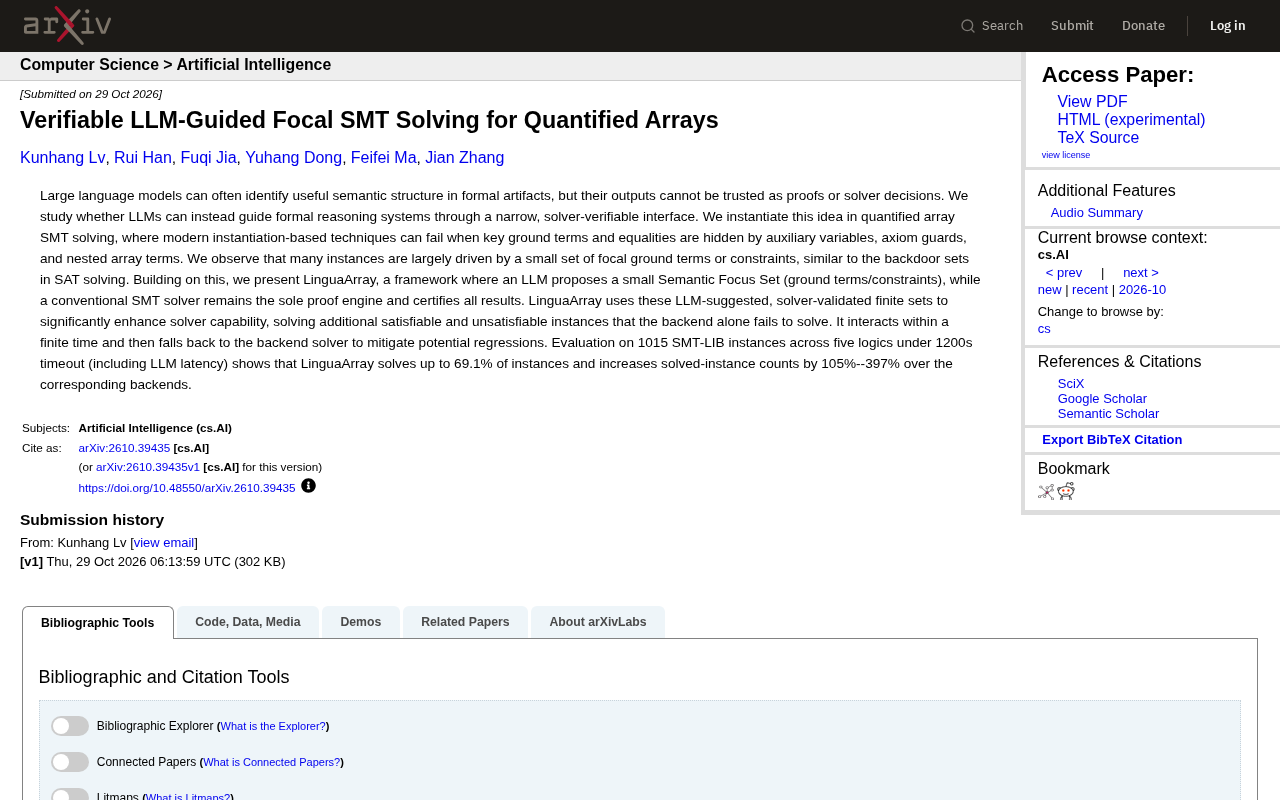
When Instantiation Techniques Hit a Bottleneck
In SMT solving for quantified arrays, modern instantiation-based techniques often fail when critical ground terms and equalities are hidden behind auxiliary variables, axiom guards, and nested array terms. The researchers observed that many instances are largely driven by a small set of focal ground terms or constraints—similar to the concept of backdoor sets in SAT solving. In other words, if this "critical minority" can be accurately identified, the solver can work more efficiently.
This observation forms the core insight of LinguaArray: rather than having the LLM directly provide answers, let it suggest a small Semantic Focus Set—a set of ground terms or constraints—and then have a traditional SMT solver serve as the sole proof engine to verify all results.
SMT Solving and Instantiation Techniques
SMT (Satisfiability Modulo Theories) problems involve deciding satisfiability of first-order logic formulas while background theories (such as arrays, arithmetic, bit-vectors) must satisfy their axioms. The theory of quantified arrays involves array operations with quantifiers, such as read/write and extensionality. Instantiation-based techniques (such as E-matching) eliminate quantifiers by instantiating them into ground terms, but instantiation quality depends heavily on term selection: if critical terms are obscured by auxiliary variables or nested structures, instantiation may be insufficient or explosive. LinguaArray targets exactly this pain point, letting the LLM suggest which ground terms are worth instantiating.
Backdoor Sets
Backdoor sets are a concept in SAT solving: for a given instance, there exists a set of variables such that, once these variables are assigned specific values, the remaining formula can be solved in polynomial time. Backdoor sets characterize the "tractable core" of an instance, and their identification often relies on heuristics or machine learning. In the SMT quantified array setting, there similarly exists a small set of focal ground terms or constraints that, if prioritized for instantiation or processing, would greatly improve solver performance. LinguaArray uses the LLM as a proposer of backdoor sets, but all proposals must be verified by the solver to ensure soundness.
How LinguaArray Works
LinguaArray's design follows the principle of "LLM proposes, solver verifies." The LLM is responsible for proposing a finite semantic focus set, and the SMT solver uses these suggestions to enhance its capabilities. Specifically, the solver attempts to use these LLM-suggested and verified finite sets to solve additional satisfiable and unsatisfiable instances that the backend alone cannot handle.
To prevent the LLM from introducing errors or causing performance regressions, LinguaArray interacts with the LLM within a bounded time and then falls back to the backend solver. This fallback mechanism ensures system robustness: LLM guidance enhances rather than replaces.
The paper evaluates on 1015 SMT-LIB instances across five logics with a timeout of 1200 seconds (including LLM latency). Results show that LinguaArray solves up to 69.1% of instances and increases the number of solved instances relative to the corresponding backend solvers by 105% to 397%. These data indicate that LLM-guided focus sets can significantly enhance solver capabilities.
SMT-LIB and Evaluation Benchmarks
SMT-LIB is the standard input language and benchmark library for SMT solvers, containing a large number of instances from industry and academia, covering theories such as arrays, arithmetic, and bit-vectors. LinguaArray is evaluated on 1015 instances across five logics with a timeout of 1200 seconds (including LLM latency), a setting that balances solving difficulty and LLM response time. The improvement ratios relative to backend solvers (105%-397%) are based on the number of solved instances, reflecting the gains of LLM guidance on hard instances rather than a universal speedup across all instances.
Key Design for Verifiability
The core value of this work lies in "verifiability." LLM outputs are not trusted as proofs but serve as heuristic suggestions subject to final verification by the solver. This addresses a fundamental problem of LLMs in formal reasoning: how to leverage their semantic understanding capabilities without sacrificing reliability.
By restricting the LLM's role to proposing focus sets, LinguaArray preserves the solver's soundness. All results are certified by the traditional SMT solver, and the LLM's contribution is limited to guiding the search direction. This division of labor fully exploits the LLM's pattern recognition capabilities and the solver's rigor.
Implications for the Integration of Formal Methods and AI
LinguaArray's success demonstrates another possible path for combining LLMs with formal methods. Traditionally, the role of LLMs in mathematical reasoning has often been envisioned as directly generating proofs, but their unreliability limits application. By positioning the LLM as a "semantic guide" that collaborates with the solver through a verifiable interface, the approach both leverages the LLM's strengths and circumvents its weaknesses.
The method echoes the concept of backdoor sets in SAT solving, suggesting broader applicability: in other formal reasoning tasks, identifying key structures and guiding the solver may be equally effective. Future work might explore how to automatically learn or generalize this focus-set proposal capability, and how to extend the framework to more logics and theories.
Overall, LinguaArray provides a pragmatic example: within a framework of trusted verification, LLMs can become powerful assistants to formal reasoning systems rather than replacements.
One-line Summary
LLMs propose semantic focus sets to guide SMT solvers, with solver verification ensuring soundness and significantly enhancing quantified array solving capabilities.
Paragraph Summary
The LinguaArray framework proposes letting large language models guide formal reasoning through a narrow verifiable interface: the LLM does not directly generate proofs but suggests a semantic focus set (key ground terms or constraints), which the SMT solver verifies as the sole proof engine. Targeting the failure of instantiation techniques in quantified array SMT solving when critical terms are hidden, the method draws on the backdoor set concept from SAT solving and uses the LLM's pattern recognition to locate the "critical minority." On 1015 SMT-LIB instances, LinguaArray solves up to 69.1% of instances, increasing the number solved relative to backend solvers by 105% to 397%, and includes bounded-time interaction and a fallback mechanism to prevent performance regressions. The work demonstrates a pragmatic path for integrating LLMs as semantic guides with formal methods.
Related articles
DeepSeek Open-Sources DeepInfer: What Is an Inference Framework Actually For?
DeepSeek open-sources its inference framework DeepInfer under Apache 2.0, supporting DeepSeek V4.1 Flash offline inference. This article explains its request scheduling, FlashMLA/DeepGEMM compute optimization, DSPark speculative verification acceleration, and what it means for developers and ordinary users.
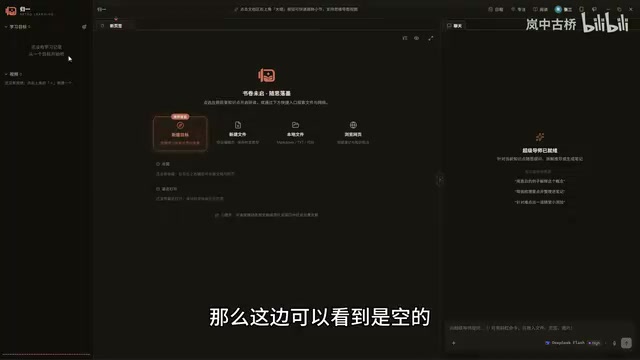
Open-Source AI Learning Agent: A Full Workflow Experience from Topology Graphs to Exam Generation
Explore an open-source AI learning agent: built on DeepSeek API, it constructs knowledge systems via topology graphs, with automatic document generation, notes, super documents, and exams. Learn about its Agent workflow and design highlights.

DeepSeek Whale Girl Open-Source MV Meme: AI Industry Coded Slang About Pivoting to Closed Source
Bilibili's DeepSeek Whale Girl rap MV uses fictional memes to tease the AI open-source vs. closed-source debate, with lyrics full of industry slang. This article explains the meme culture, the Whale Girl symbol, and the open/closed tension.