Vibe Coding: A Full-Stack Development实战 Course for One-Person Companies
A Bilibili course advocates using Vibe Coding to direct AI to write code for full-stack one-person company development.
The article introduces the Bilibili creator "分镜影院"'s "Vibe Coding: Zero-to-Hero Practical Tutorial." The core idea of Vibe Coding is that people no longer write code themselves but direct AI to complete page generation, coding, database integration, testing and bug fixing, and even documentation and promotional content generation, thereby eliminating the technical barrier. The course opposes equating AI development with workflow orchestration tools like Coze, Dify, and n8n, and argues that industrial-grade implementation requires a system of AI + code + agents + engineering. The course covers the full closed loop from requirements analysis, UI design, front-end and back-end development, database, testing and deployment to operations and marketing, involves tools such as Claude Code, Stitch, MCP, Skills, and Figma, and uses UniApp to achieve develop-once, run-everywhere. The course has 80 episodes and targets zero-foundation learners, developers seeking efficiency gains, and one-person company entrepreneurs.
AI is evolving from a tool into a new kind of productivity, and the way software is developed is being redefined. The Bilibili creator "分镜影院" (Storyboard Cinema) has released "Vibe Coding: Zero-to-Hero Practical Tutorial" as a response to this trend. The course asserts that in the future, a single person can complete the entire closed loop from requirements analysis, UI design, front-end and back-end development to testing, deployment, and operations/marketing—and Vibe Coding is the core methodology for achieving this.
What Is Vibe Coding?
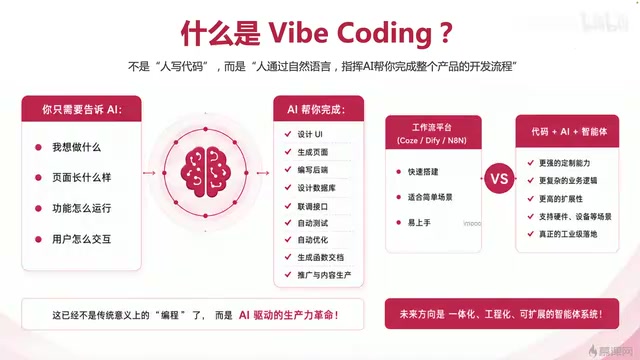
The core idea of Vibe Coding can be summed up in one sentence: It's no longer people writing code, but people directing AI to write code. You only need to tell AI what page you want, what the page should look like, and how the functionality should work. AI can then generate the page, write the code, integrate the database, automatically test, fix bugs, and even generate documentation and promotional content.
What this model does is eliminate the technical barrier. In the past, developing a product required coordination among multiple roles: product manager, designer, front-end, back-end, testing, operations, and more. Many people don't lack ideas—they lack the ability to turn ideas into reality. AI is changing this, gradually shifting from "people adapting to code" to "AI understanding human language."
Don't Mistake AI Development for Workflow Orchestration
The course points out a common misconception: many people understand AI development as workflow orchestration tools like Coze, Dify, or n8n, thinking that building a few nodes and running a few processes means they know AI development. The creator argues that these are just the basics of AI. The direction that can truly achieve industrial-grade implementation and build complex systems must be a system of AI + code + agents + engineering.
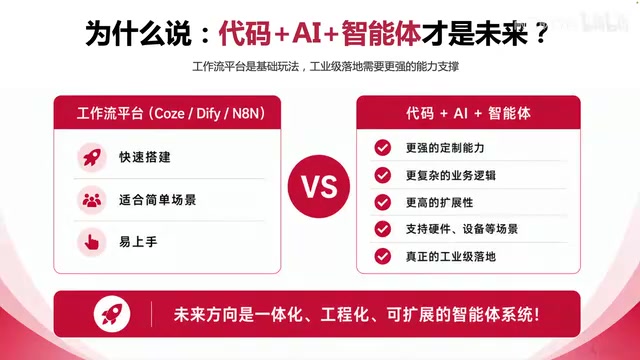
What will truly be valuable in the future is not simple chatbots, but AI applications—such as AI e-commerce, digital humans, automation systems, and enterprise AI platforms. These applications ultimately all come back to engineering capability. The course is therefore positioned as a "practical course for one-person companies in the AI era" rather than a pure tools course. It has two goals: first, to help learners master the engineering implementation capability of AI development; second, to seize the opportunities for AI entrepreneurs and super-individuals.
MCP (Model Context Protocol) is an open-source protocol standard proposed by Anthropic for enabling large language models to connect to external tools, data sources, and services in a unified way. You can think of MCP as "the USB interface for AI": with it, AI doesn't need custom integrations for every tool but can invoke capabilities such as databases, file systems, APIs, and browsers through a standardized protocol. In AI development, MCP upgrades agents from "only able to chat" to "able to actually operate the external world," making it key infrastructure for building complex AI applications. Skills are encapsulated, reusable capability modules that, together with MCP, allow AI to stably execute tasks in engineering scenarios.
Stitch is an AI interface design tool launched by Google that can directly generate UI design drafts from natural language descriptions and export them as front-end code. It is often used to quickly turn ideas into visual pages. Figma is the industry's mainstream collaborative design platform that supports design-to-code delivery. In the Vibe Coding workflow, such tools serve as the bridge from "requirements → design → code," allowing AI to intervene at the design stage and reducing the cost of repeated manual communication.
The Full Closed Loop: From Requirements to Operations
What the course emphasizes is not building a simple demo, but taking learners through the complete zero-to-one process of a full product: requirements analysis, UI design, page development, back-end logic, database, testing, deployment, and operations/marketing—all connected together.
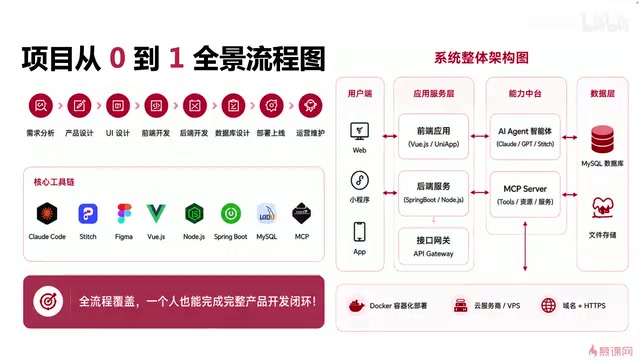
At the tool level, the course covers the collaborative use of tools such as Claude Code, Stitch, MCP, Skills, and Figma, enabling AI to participate in every stage of design, development, testing, optimization, and operations. For multi-platform development, the course teaches UniApp combined with AI-generated code and component reuse to achieve "develop once, run everywhere," significantly reducing the maintenance cost of three separate codebases for Web, App, and mini-programs. This is also an important foundation for making the "one-person company" possible.
UniApp is a cross-platform development framework based on Vue. A single codebase can be compiled and published to multiple platforms including Web, iOS/Android apps, WeChat/Alipay mini-programs, and quick apps. Its core value lies in using conditional compilation and a unified component system to mask platform differences, thereby significantly reducing multi-platform maintenance costs. In the Vibe Coding model, AI can generate pages and components according to UniApp's syntax specifications, and developers only need to describe requirements and do a small amount of proofreading to quickly produce code that runs on multiple platforms. This is exactly the technical foundation that enables a "one-person company" to cover all platforms with a minimal team.
AI Operations: Let the Product Promote Itself
Many people think a product is done once it's developed, but the real difficulty often lies in promotion. The course points out that AI has entered the operations field and can automatically generate WeChat official account articles, promotional copy, video scripts, and even product promotional videos, letting the product "promote itself."
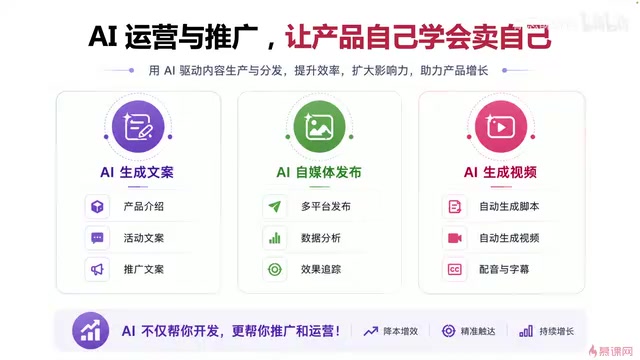
This also means that the people with true competitiveness in the future will be those with dual capabilities in "development + AI operations." After completing the course, learners should possess the abilities to independently develop products, collaborate across the full AI chain, apply AI engineering, develop for multiple platforms, and run AI-automated operations—ultimately gaining the ability to build products solo.
Who Should Take This Course
The course is aimed at zero-foundation beginners, progressing from shallow to deep, with practical content throughout, totaling 80 episodes. It is suitable for people who have product ideas but lack technical ability, developers who want to use AI to improve development efficiency, and entrepreneurs who want to explore the one-person company model. In the introduction, the creator mentions that in the coming years AI will eliminate a large amount of repetitive labor while also giving rise to a large number of super-individuals and one-person companies. Opportunities belong to those who prepare in advance.
Vibe Coding is not about turning everyone into a programmer, but about enabling everyone to use AI to turn their ideas into products. The value of this course lies in providing a complete path from tool usage to engineering implementation, and it is worth the attention of anyone who wants to enter the AI development era.
One-line Summary
A Bilibili course advocates using Vibe Coding to direct AI to write code and achieve full-stack development for one-person companies.
Paragraph Summary
The article introduces the Bilibili creator "分镜影院"'s "Vibe Coding: Zero-to-Hero Practical Tutorial." The core philosophy of Vibe Coding is that people no longer write code themselves but direct AI to complete page generation, coding, database integration, testing and bug fixing, and even documentation and promotional content generation, thereby eliminating the technical barrier. The course opposes equating AI development with workflow orchestration tools like Coze, Dify, and n8n, and argues that industrial-grade implementation requires a system of AI + code + agents + engineering. The course covers the full closed loop from requirements analysis, UI design, front-end and back-end development, database, testing and deployment to operations and marketing, involves tools such as Claude Code, Stitch, MCP, Skills, and Figma, and uses UniApp to achieve develop-once, run-everywhere. The course has 80 episodes and targets zero-foundation learners, developers seeking efficiency gains, and one-person company entrepreneurs.
Related articles

A 19-Year-Old's Rental Horror Story: Ceiling Collapse, Bug Infestation, and the Lessons It Taught Me
At 19, my first off-campus rental brought bug infestations, no heat, a collapsed ceiling, and a ruined laptop with no renter's insurance. Here are the hard-won lessons for first-time student renters.

Veda Nurse's Cranial Nerve Exam: Why ASMR Role-Play Is Going Viral
Bilibili creator Veda's cranial nerve exam ASMR video goes viral, blending humor and sensory triggers through nurse role-play. This article analyzes its unique appeal and the audience psychology behind ASMR role-play.

LG Cinebeam AI Review: 120-Inch Giant Screen + 3000 Lumens, a New Choice for the Living Room Theater
LG Cinebeam AI projector review: 3000 ANSI lumens, 4K, 100 inches from about 8 cm and 120 inches from about 18 cm. Built-in webOS, AI Concierge voice recommendations, AI Sound Pro 11.1.2 virtual surround, and Game Optimizer—positioned for fixed living room installation, complementing the portable Cinebeam S.