Vibe Coding Beginner's Guide: A Complete Learning Path to Master AI Programming from Scratch

A complete guide to learning Vibe Coding, the AI-assisted programming paradigm using natural language.
This guide breaks down Vibe Coding—the AI programming paradigm coined by Andrej Karpathy—into a structured learning path. It covers the core tool ecosystem (Codex, Claude Code, Cursor, SDD, Agents), three learning stages from building an AI programming mindset to hands-on projects, and offers a balanced view of both the opportunities and current limitations of AI-assisted programming.
What is Vibe Coding
Vibe Coding is becoming a hot topic in the AI programming space. It represents an entirely new programming paradigm: instead of relying on traditional code memorization and writing line by line, you leverage AI tools to generate, debug, and optimize code through natural language descriptions of your requirements.
This term was first coined by Andrej Karpathy (former Tesla AI Director and OpenAI co-founder) in early 2025. He described on social media a programming approach where you "fully surrender to the vibes, embrace exponentials, and forget that the code even exists." This concept was born from breakthrough advances in Large Language Model (LLM) code generation capabilities—from GPT-4 to Claude 3.5, AI models have reached near mid-level developer proficiency in code understanding, generation, and debugging, turning "programming with natural language" from concept into reality.
According to tutorial creators on Bilibili, the core of this learning system isn't about teaching people to "copy code," but rather helping learners develop an "AI programming mindset"—understanding the underlying logic of AI-assisted programming so they can adapt flexibly and apply knowledge broadly. This addresses a common pain point in many programming tutorials today: teaching operations without teaching logic, leaving learners helpless once they step outside fixed examples.

The Vibe Coding Tool Ecosystem
Based on tutorial content, the Vibe Coding tool ecosystem is already quite mature, primarily including:
- Codex: OpenAI's code generation model, trained on billions of lines of public source code using the GPT architecture. It serves as the underlying engine for GitHub Copilot. The core principle of code generation models is mapping natural language intent to programming language expressions, understanding code context through context windows. From early code completion to today's full-file generation, Codex has undergone a paradigm shift from "auto-completion" to "intent programming."
- Claude Code: Anthropic's programming assistant, excelling at complex logic processing, with particularly strong performance in long-context understanding and multi-file collaborative editing
- Cursor: A modern code editor with integrated AI capabilities, built on the VS Code architecture, deeply integrating AI conversation, code generation, and editor functionality into a unified development experience
- SDD (Specification-Driven Development): A methodology for driving AI code generation through specification documents. Its core idea is to describe the system's functional requirements, data structures, interface definitions, and boundary conditions in structured natural language documents before writing code, then use this document as input for AI code generation. This approach borrows from traditional software engineering concepts like TDD (Test-Driven Development) and DDD (Domain-Driven Design), but replaces the "driving source" from test cases or domain models with AI-parseable specification descriptions.
- Agent Development: Having AI complete multi-step programming tasks as autonomous agents. Unlike traditional single-query AI assistants, programming Agents can autonomously decompose tasks, write code, run tests, analyze errors, and iterate on fixes. Typical Agent frameworks like AutoGPT, MetaGPT, and Devin simulate human developer workflows: requirements analysis → architecture design → code implementation → test verification → bug fixing. This autonomous loop capability transforms AI from a passive tool into an active collaborator.
The combined use of these tools constitutes the complete technology stack for AI-assisted programming today. Mastering multi-tool coordination is the key watershed between beginner and advanced levels.
Three Stages of Systematic AI Programming Learning
A complete Vibe Coding learning path typically divides into three levels—foundational, intermediate, and hands-on practice—a structured design that's particularly friendly to beginners with zero prior experience.
Foundation: Building an AI Programming Mindset
The core objective of the foundation stage is establishing a "zero-to-one programming mindset." This phase doesn't trap learners in syntax details but focuses on three aspects: configuring AI programming tools, understanding Vibe Coding's core logic, and learning how to write "universal prompts."
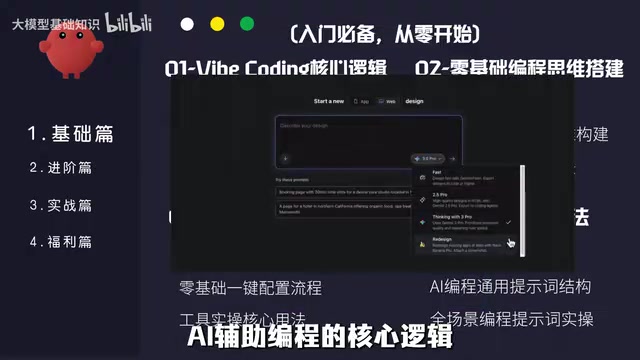
Interestingly, Prompt Engineering has been elevated to an unprecedented status in AI programming. How to precisely describe requirements to AI and how to decompose complex tasks have become more important skills than memorizing syntax.
Prompt engineering in AI programming goes far beyond simply "writing good questions." It involves multiple advanced techniques: Chain-of-Thought guides AI through step-by-step reasoning for complex algorithms; Few-shot Learning provides code examples to help AI understand expected coding styles; System Prompt design sets AI roles and constraints. In practice, a well-crafted prompt might contain multiple layers of information: technology stack specifications, code style requirements, error handling standards, and performance constraints—essentially a new form of "programming language." This reflects a deeper shift in how programming ability is evaluated—from "can you write code" to "can you precisely express intent."
Intermediate: Prompt Optimization and Code Review
The intermediate stage covers precise prompt tuning, multi-AI tool coordination, complex code debugging, and batch automated programming. The keyword here is "high-quality and deployable"—AI can quickly generate code, but discerning code quality and knowing how to optimize and debug is precisely the core judgment that learners need to develop.
Typical quality issues with AI-generated code include: hallucinated code (calling non-existent APIs or libraries), security vulnerabilities (such as unprotected SQL injection or XSS attacks), performance anti-patterns (such as unnecessary nested loops or memory leaks), and contextual inconsistencies (contradictory logic between different parts of code). According to GitHub's research data, approximately 40% of AI-generated code requires varying degrees of modification before being production-ready. Therefore, code review ability—the ability to quickly identify logical errors, security risks, and performance bottlenecks—has actually become more important in the AI programming era.
In other words, AI has lowered the barrier to writing code but raised the requirements for "reading code" and "reviewing code." The ability to judge the quality of AI-generated code will become an important marker distinguishing junior from senior AI programmers.
Vibe Coding in Practice: From Learning to Project Deployment
The real test of learning outcomes is hands-on projects. According to the tutorial content, the practice section covers multiple commercial-grade deployment scenarios:
- Independent personal website development
- Office automation script projects
- Mini-program development
- Web scraping and data collection tools
- AI tool integration projects
- Web feature development
These projects share a common characteristic of "learning by doing"—they directly correspond to real work and side-hustle needs. For learners without a computer science background, this results-oriented learning approach is easier to maintain motivation with compared to the abstract theories of traditional computer science courses.
The Practical Value and Career Opportunities of AI Programming
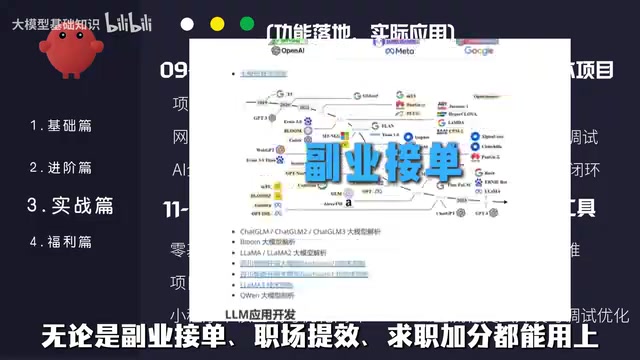
Whether for freelancing, workplace efficiency, or resume building, AI programming skills are becoming a universal competency. The rise of Vibe Coding is essentially a manifestation of programming "democratization"—it enables more people without deep programming backgrounds to accomplish tasks with AI that previously required professional developers.
Programming democratization didn't begin with the AI era. From the birth of BASIC in the 1960s (aimed at enabling non-professionals to program), to visual programming tools in the 1990s (such as Visual Basic and Dreamweaver), to low-code/no-code platforms in the 2010s (such as Bubble and Webflow), each technological iteration has lowered the programming barrier. Vibe Coding can be seen as the latest milestone on this historical timeline—it's the first time "natural language" has become a direct input for programming, completely breaking through the final technical barrier of programming language syntax.
A Balanced View of Vibe Coding: Opportunities and Limitations Coexist
Despite Vibe Coding's promising future, learners should remain rational. AI-assisted programming isn't omnipotent—it's better suited for rapid prototyping and small-to-medium projects. For scenarios involving complex architecture, high-performance optimization, or strict security requirements, a solid computer science foundation remains irreplaceable.
Specifically, current limitations of AI programming manifest in several areas: large-scale system architecture design requires deep understanding of distributed systems and microservice governance, which exceeds the reliable capability range of current AI; performance-critical code (such as high-frequency trading systems or game engine cores) requires precise control over underlying hardware and memory models; financial and medical software development involving compliance and security audits faces potential risks from the unpredictability of AI-generated code. Understanding these boundaries is precisely an essential quality of a mature AI programmer.
Additionally, tutorial quality on the market varies greatly. As the tutorial author themselves observed, "over 85% of videos are a mixed bag." When selecting learning resources, prioritize content that emphasizes logical explanations and provides complete hands-on paths, rather than surface-level tutorials that merely list tool operations.
Vibe Coding represents a new direction in programming education. It lowers the entry barrier, but true mastery still requires understanding logic and developing judgment. Tools will constantly update and iterate, but the underlying programming mindset and problem decomposition abilities are the core competitive advantages that serve you long-term.
Key Takeaways
Related articles

Machine Learning Interview Assignment Pitfalls: Hidden Traps in Open-Ended Tasks and How to Navigate Them
A data scientist was rejected for choosing CatBoost over comparing multiple models. Learn the hidden traps in open-ended ML interview assignments and practical strategies to navigate them.

AI Agent Deployment Monitoring: Automated Babysitting for Every Production Release
How AI Agents take over post-deployment monitoring and decision-making, solving false alarm issues through trend reasoning, cross-signal correlation, and automated rollback with proper risk controls.

Sainsbury's Suspends AI Facial Recognition: Misidentification Incident Exposes Deep Risks in Retail Surveillance
Sainsbury's suspends AI facial recognition after misidentifying a customer as a theft suspect. Analysis of automation bias, privacy regulation, and warnings for retail AI deployment.