Vibe Coding Beginner's Guide: Build a Webpage with AI — No Coding Experience Required

A zero-background intro to Vibe Coding — go from natural language to a real mobile webpage using Claude Code.
Vibe Coding is a new programming paradigm that uses AI tools like Claude Code to turn natural language descriptions into working code, dramatically lowering the barrier to building software. This Bilibili course covers three levels: conceptual understanding, a beginner's guide, and hands-on practice building a mobile webpage viewable on a phone. While no coding background is required, learners still need to articulate ideas clearly and evaluate AI output. The article urges realistic expectations — the course's real value is breaking down fear, establishing workflow intuition, and building early confidence, not instant career readiness.
What Is Vibe Coding
Vibe Coding is a concept that has rapidly gained traction in AI development circles. It describes an entirely new approach to programming: instead of writing code line by line, developers describe what they want in natural language, and AI tools (like Claude Code) generate, debug, and refine the code on their behalf. In short, you handle the intent — the AI handles the implementation.
This introductory course from Bilibili sets a straightforward goal: a "demystification" session that helps people with zero technical background understand what Vibe Coding is and what it can do. The content is structured across three levels — understanding Vibe Coding, a beginner's guide, and hands-on tool practice. This progressive structure, moving from concept to action, is genuinely beginner-friendly.
The core value of Vibe Coding lies in lowering the barrier to programming. In the past, building a webpage or a small app required mastering an entire tech stack — HTML, CSS, JavaScript, and more. Now, with AI coding assistants, you simply need to clearly express what you want and let the tools do the rest.
Can You Really Learn This With Zero Technical Background?
This is the question most beginners ask first, and it's something the course directly addresses. The answer is yes — Vibe Coding exists precisely to lower the technical barrier.
That said, the phrase "zero background" deserves a realistic interpretation. Vibe Coding doesn't require you to write code, but it does require two things: the ability to clearly articulate what you want (you need to know what you're trying to build and what outcome you're after), and basic aesthetic judgment to evaluate whether what the AI generates matches your expectations. AI can turn your idea into code, but it can't decide whether the idea itself is good.
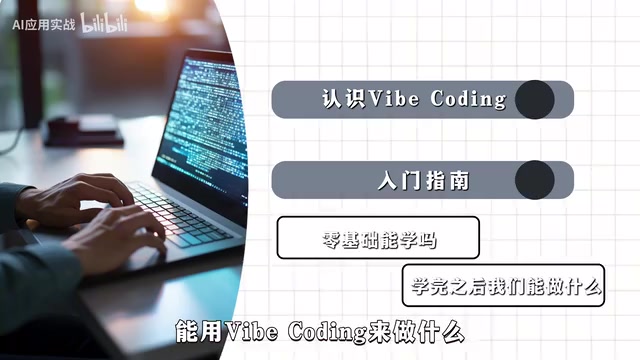
From a curriculum design perspective, the beginner stage addresses the key question: "What will I be able to build after this?" A reasonable expectation is that after learning Vibe Coding, everyday users can independently create lightweight products — personal webpages, small utilities, landing pages, and the like. It won't instantly make you a professional engineer, but it's more than enough to turn ideas in your head into something that actually runs.
Hands-On Practice: Building a Mobile Webpage
The third section of the course is where the real value lies — actually doing it. The instructor recommends tools suited for Vibe Coding, with Claude Code being the standout example. Claude Code is a command-line AI coding assistant developed by Anthropic. It excels at understanding natural language instructions and directly manipulating code files, making it an ideal tool for experiencing the Vibe Coding workflow firsthand.
The practical goal is to walk learners through building a mobile webpage that can be opened and viewed directly on a phone. This design serves two purposes: first, a mobile webpage is the most relatable kind of output — it creates a genuine "I built this" moment; second, seeing your work in real time on a phone screen provides immediate, concrete feedback. As the course puts it, this is what makes learners feel a surge of confidence.
For beginners, this kind of end-to-end experience — from idea to visible result — is far more motivating than hours of theory.
Claude Code is developed by Anthropic and runs in a command-line terminal, which sets it apart from typical chat-based AI assistants: it doesn't just converse — it can read, modify, and create local files directly, functioning as a hands-on coding partner. In practice, you describe what you need in natural language (e.g., "build me a mobile page with a navigation bar and a dark color scheme"), and Claude Code interprets your intent, generates the corresponding code, and writes it to your files. You then refresh the page in a browser or on your phone to see the result. This "describe → AI generates → instant preview" workflow is the quintessential form of Vibe Coding. Other tools in this space include Cursor and GitHub Copilot, each with different strengths. Claude Code stands out for its ability to understand multi-file projects and execute complex instructions, making it particularly effective for working on complete projects end to end.
How to Realistically Evaluate This Kind of Beginner Course
Vibe Coding represents a genuine shift in how programming is done in the AI era — that trend is real. But claims like "job-ready after one course" should be met with healthy skepticism.
The true value of an introductory course like this is helping you quickly build a mental model, overcome your fear of programming, and complete your first project. It can help you understand the logic behind Vibe Coding and get comfortable with tools like Claude Code — a solid foundation for going deeper. But reaching professional-level proficiency still requires working through real projects repeatedly, and building judgment around requirements, architecture, and edge cases.
For anyone looking to get started, treat courses like this as an "icebreaker": follow along to build your first webpage, establish confidence and a basic workflow, then decide based on your interests whether to go further. AI-assisted programming doesn't replace learning — it redefines where learning begins.
The paradigm shift that Vibe Coding represents is rooted in a deeper technical context worth understanding. Traditional software development depends heavily on syntactic precision — a single misplaced semicolon can crash a program, forcing developers to spend enormous amounts of time memorizing rules and debugging details. Large language models (LLMs) changed this: they can interpret vague, conversational natural language and translate it into syntactically rigorous code, bridging the gap between "how humans express themselves" and "how machines execute logic." This means the core skill in programming is shifting from "memorize syntax" to "define the problem clearly" — which is far closer to a natural human ability. That said, LLM-generated code isn't always correct. It can make mistakes with confidence (a phenomenon known in the industry as hallucination), so having basic logical judgment — enough to spot obviously flawed output — remains an essential skill for anyone using Vibe Coding.
Related articles

Random Pruning of the DPO Computation Graph: 1.4x Training Speedup and Lower Peak Memory
DPO training too slow and memory-hungry? This paper proposes a random pruning framework for the DPO computation graph, sampling independently across position, sequence, and branch dimensions; branch pruning achieves a 1.426x step-time speedup and cuts training time by about 30%, with in-depth attribution of memory and time gains.

Why Does JEPA Underperform MLM in Longitudinal EHR Representation Learning?
New study compares JEPA and MLM for longitudinal EHR representation learning on MIMIC-IV: three JEPA variants train stably without collapse but underperform MLM; target size, not heterogeneity, drives prediction error.

Transfer Learning + Visible Light Communication: A New Approach to Energy-Efficient Indoor Positioning
A study proposes a transfer learning-based visible light communication indoor positioning method, achieving 47% accuracy improvement on the BOSCH factory dataset, 67.5% model efficiency under high noise, and introducing the ME composite metric for energy-efficient positioning in energy-constrained industrial IoT scenarios.