Vibe Coding End-to-End in Practice: How a One-Person Company Develops Products with AI

Bilibili's 106-episode Vibe Coding course shows how one-person companies can use AI across the full chain from development to operations.
The article introduces the 106-episode Vibe Coding course by Bilibili creator Fenjing Yingyuan, positioning it as practical training for one-person companies in the AI era rather than a tool course. Vibe Coding means directing AI to write code, flattening technical barriers, but the author stresses that workflow tools like Coze, Dify, and n8n are only basic; true industrial implementation relies on AI + code + agents + engineering, covering the full chain from requirements and design to development, testing, deployment, and AI-driven operations.
Vibe Coding End-to-End in Practice: How a One-Person Company Develops Products with AI
In the past, building a product required collaboration among product managers, designers, frontend and backend developers, testers, and operations staff. Today, one person plus AI can get it done. The complete edition of the "Vibe Coding Course" compiled over a month by Bilibili creator "Fenjing Yingyuan" is a systematic response to this trend. The course has 106 episodes, from beginner to advanced, and attempts to guide learners with zero foundation through the entire chain of AI development.
What Is Vibe Coding? From Writing Code to Directing AI
The course opens by offering a definition: Vibe Coding is no longer about people writing code, but about people directing AI to write code. You only need to tell AI what page you want to build, what the page should look like, and how the functionality should work. AI can then generate the page, write the code, connect to the database, automatically test and fix bugs, generate documentation, and even produce promotional copy and short videos.
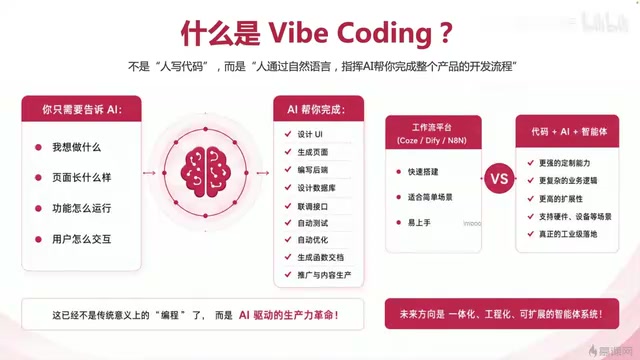
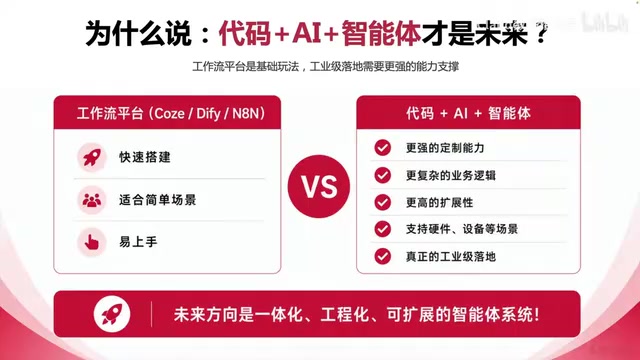
The essence of this shift is that the technical barrier is being gradually flattened. In the past, people had to adapt to code; now AI understands human language. The creator believes that in the future everyone will be able to develop software, but there is a major misconception here: many people understand AI development as workflow orchestration tools such as Coze, Dify, and n8n, and once they build a few nodes and run a few flows, they think they have mastered AI development. These are only relatively basic approaches. The core direction that can truly achieve industrial-grade implementation and develop complex systems is the system of "AI + code + agents + engineering."
Origin of the term Vibe Coding: The term was proposed by OpenAI co-founder Andrej Karpathy in early 2025. Its original meaning is a way of programming in which one is "fully immersed in the vibe," handing code over to AI while personally only making directional judgments and accepting results. What it emphasizes is not "AI helps you complete a few lines of code," but rather that developers step away from syntactic details and focus on expressing intent, making architectural trade-offs, and validating feedback. Therefore, it naturally carries a risk: when people do not read the generated code line by line, correctness and security must be backed by testing, review, and runtime verification. This is also why "engineering" is emphasized later.
Course Positioning: Not a Tool Course, but a Practical Course for One-Person Companies in the AI Era
The creator developed this course for two purposes. The first is learning: to help people truly master AI development and the implementation of AI engineering products, rather than stopping at being able to use a few AI tools. The second is making money, because in the future there will certainly be a large number of one-person companies, AI entrepreneurs, and super-individuals. For many people, the future may no longer be about finding a job, but about using AI to build products.
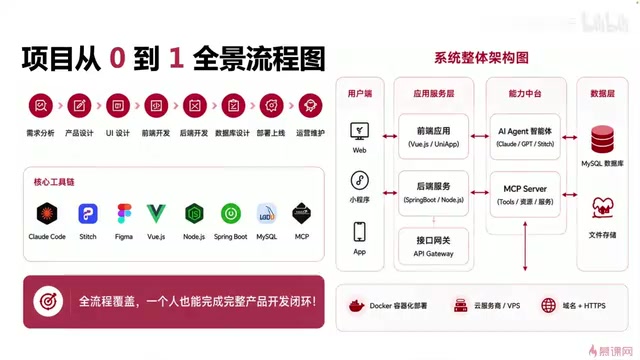
Therefore, the course is not positioned as a simple tool course, but more like a practical course for one-person companies in the AI era. The flow chart for the complete project from zero to one shows that a real product is not just handwritten code; it also includes requirements analysis, UI design, page development, backend logic, database, testing and launch, deployment, operations, and promotion—all connected. The course's biggest feature is the end-to-end closed loop: it does not build a simple demo, but guides learners through building a complete product.
AI Engineering System: Multi-Tool Collaboration and Multi-Platform Development
The AI development system architecture presented in the course emphasizes collaborative AI development. Tools such as Claude Code, Stitch, MCP, Skills, and Figma collaborate with one another. AI is no longer just chatting; it truly participates in design, development, testing, optimization, and operations. This is the direction of future AI engineering.
In terms of multi-platform development, in the past there was one codebase for the web, another for the app, and yet another for the mini program, which was very painful. Now AI is significantly lowering the threshold for multi-platform development. In the course, UNAP (note: as stated in the original text, likely referring to uni-app) is taught, combining AI code generation and component reuse to achieve develop once, run on multiple platforms. This is also an important reason why the creator believes one-person companies will become possible.
What MCP and Skills are respectively: MCP (Model Context Protocol) is an open protocol used to connect large models with external tools and data sources (databases, file systems, third-party APIs, etc.) in a unified way. It is like giving AI a set of standardized "sockets," avoiding the need to write separate integration code for each tool. Skills usually refer to encapsulated, reusable capability modules or sets of operation instructions that allow agents to execute according to established processes on specific tasks. The significance of combining the two is that AI is no longer merely answering passively, but can call real tools within a controlled scope to complete concrete actions such as design, coding, and testing. This is precisely the technical foundation that makes "multi-tool collaboration" possible.
uni-app and "develop once, run on multiple platforms": The UNAP mentioned in the article should refer to uni-app, a cross-platform development framework based on Vue syntax that can compile and publish the same codebase to multiple platforms such as WeChat mini programs, H5, and iOS/Android apps. Its value lies in consolidating the repetitive work of multi-platform adaptation into a single codebase, and AI code generation happens to be good at batch-producing component code that conforms to framework specifications based on page descriptions. Combined, the two can significantly compress the development cycle of multi-platform products. It should be noted that cross-platform frameworks may still require additional adaptation for platform-specific capabilities (such as native payments, push notifications, and hardware calls). Therefore, "develop once, run on multiple platforms" is more accurately understood as covering most common interfaces and business logic, rather than being completely zero-cost.
AI Operations: Let the Product Promote Itself
Many people think product development is over once it is finished, but the real difficulty is promotion. Now AI has entered the operations field: automatically generating WeChat official account articles, promotional copy, video scripts, and even automatically generating product promotional videos. AI can fully help you with promotion, letting your product promote itself.
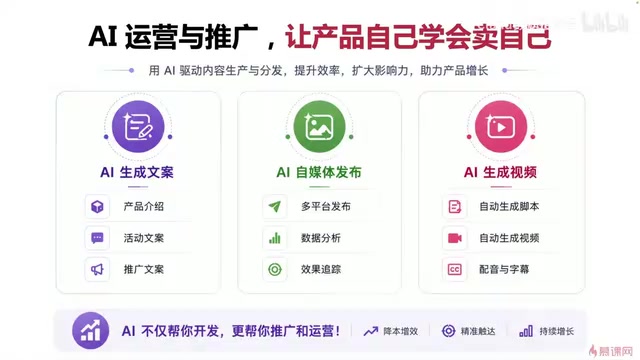
From this, the creator makes a judgment: the truly capable people in the future will definitely be those with dual capabilities in "development + AI operations." After completing the course, learners will have the ability to independently develop products, collaborate across the full AI chain, implement AI engineering, develop for multiple platforms, and automate operations with AI. More importantly, they will have the ability to build products as a one-person company.
A Rational View: Opportunities Belong to Those Who Prepare in Advance
The creator's conclusion is relatively restrained: in the coming years, AI will certainly eliminate a large amount of repetitive labor, and at the same time will certainly give rise to a large number of super-individuals, one-person companies, and AI creators. Opportunities always belong to those who prepare in advance.
That said, the course slogan "get a job immediately after finishing" clearly has a marketing flavor. Vibe Coding does lower the threshold for bringing products to market, but engineering capability, requirements judgment, and operational results still require long-term practical accumulation. For learners with zero foundation, it is reasonable to regard this course as a systematic entry path into the AI development era, but it should not be equated with employment security. Its real value lies in attempting to connect requirements analysis, design, development, testing, deployment, and operations into a reusable full chain, rather than stopping at single-point tool instruction.
At a time when AI is reconstructing the way software is developed, this end-to-end perspective is itself a scarce capability. As for whether you can become a "super-individual" through it, that depends on how deeply you use AI, not on how many episodes of the course you have watched.
One-line Summary
Bilibili's 106-episode Vibe Coding course explains how a one-person company can use AI to cover the full chain from development to operations.
Paragraph Summary
The article introduces the 106-episode "Vibe Coding Course" compiled by Bilibili creator "Fenjing Yingyuan," positioning it as a practical course for one-person companies in the AI era rather than a tool course. Vibe Coding means people direct AI to write code, flattening the technical barrier, but the author emphasizes that workflow orchestration tools such as Coze, Dify, and n8n are only basic approaches; true industrial-grade implementation depends on the system of AI + code + agents + engineering. The course focuses on an end-to-end closed loop, covering requirements analysis, UI design, frontend and backend development, databases, testing and deployment, and AI-driven operations and promotion. It also involves collaboration among tools such as Claude Code, MCP, Skills, and Figma, as well as uni-app multi-platform development. The article also reminds readers that "get a job immediately after finishing" carries a marketing tone, and that engineering capability and operational results still require long-term practice; the end-to-end perspective itself is the scarce value.
Related articles

Prompt Engineering for Beginners: From Writing Prompts to Engineering Thinking
Starting from the essence and four functions of prompts, this article systematically explains the six-step process, four success criteria, learning value, and practical limitations of prompt engineering to help you build a complete understanding.

Anthropic Launches Nasdaq IPO: AI Giant's Listing and Risk Disclosures
Anthropic officially launches its Nasdaq IPO under ticker ANT, with market valuation expected to potentially exceed SpaceX's record. The prospectus devotes nearly 100 pages to AI risks, while first-half revenue grew over 14x but net losses widened sharply, reigniting the AI bubble debate.

Rust cURL Clone Uses 4,832 unsafe Blocks—Is the Memory Safety Myth Broken?
A Rust cURL clone uses 4,832 unsafe keywords, challenging Rust's memory safety narrative. We analyze what unsafe really means, compare Fil-C, and examine rewrite motives.