Vibe Coding for Absolute Beginners: A Six-Step Walkthrough of the Full AI Development Workflow

A Bilibili tutorial breaks Vibe Coding into six steps, guiding zero-background beginners through the full AI development workflow.
This article introduces a Vibe Coding tutorial aimed at absolute beginners. The author points out that beginners often fail not because of insufficient AI capability but because they lack a systematic workflow: they don't know how to use the tools, the output is poor, and they may even mess up their computer—so they give up. The tutorial therefore designs a six-step path—first learn tool operations, then master prompt writing, practice with a small project, explore advanced techniques, take on a large project, and finally share the author's personal hands-on experience. The article emphasizes that learners don't need to become programmers first, but must learn how to collaborate with AI. The tutorial has a clear positioning and suits beginners blocked by the tool barrier; the content is dense and worth repeated viewing.
Vibe Coding for Absolute Beginners: A Six-Step Walkthrough of the Full AI Development Workflow
If you've heard the terms AI programming and Vibe Coding but haven't dared to start, this tutorial on Bilibili is worth a look. It doesn't teach you how to become a programmer—it teaches you how to actually use AI to build products and get work done. The author breaks Vibe Coding into six steps, from tool usage to shipping a project, guiding beginners through their first complete development project.
Why do so many people give up right after starting?
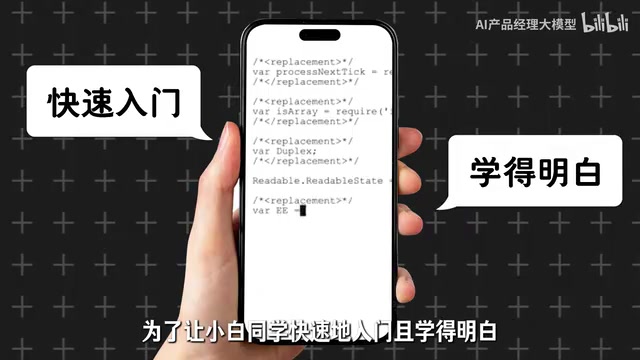
The video opens by pointing out a common phenomenon: people writing code with AI for the first time tend to run into three types of problems—they don't know how to use the tools, the AI's output is poor, and they may even mess up their computer. Stacked together, these problems make many people give up at the entry stage.
According to the creator, this frustration isn't due to insufficient AI capability but to a lack of a systematic workflow. Many people equate AI programming with "saying one sentence to a chat box," which naturally leads to poor results. The author emphasizes that you don't need to become a programmer first, but you do need to learn how to collaborate with AI.

The term Vibe Coding was coined in 2023 by AI researcher Andrej Karpathy. It refers to a programming approach in which developers describe requirements in natural language, a large language model generates code, and a human reviews and adjusts it. The key is that "the human owns intent and acceptance, while the AI produces the first draft"—not a complete hands-off process. The difference from traditional programming is that traditional programming requires mastering syntax and a runtime environment first, whereas Vibe Coding moves the barrier forward to requirement expression and result judgment. For this reason, beginners who lack a basic understanding of the development workflow can easily get stuck on tool configuration and error troubleshooting rather than on writing code itself. Understanding this paradigm difference helps explain why the author emphasizes "learning how to collaborate with AI first."
The six-step learning path: from tools to a complete project
To help beginners get started quickly and learn effectively, the creator designed a six-step path from zero to one.
Step 1: Learn how to use the tools
The first step in Vibe Coding isn't writing code—it's getting familiar with the basic operations of AI programming tools. This includes how to install, how to configure, and how to interact with the tools. These basics determine your efficiency later on.
Step 2: Understand how to write prompts
Prompts are the core of communicating with AI. The video devotes a separate step to prompt writing, which shows the author considers it the part beginners most easily overlook and the part that most affects output quality.
Prompt engineering refers to methods for improving model output quality through structured expression. Common elements include: clarifying the role and goal, providing inputs and constraints, specifying the output format, giving examples (few-shot), and breaking complex tasks into multiple rounds of dialogue that converge gradually. For programming tasks, effective prompts usually need to include context such as the tech stack, file structure, and error messages, and to clearly state boundaries like "only modify this file" and "do not introduce new dependencies." This is exactly why the author makes prompt writing a separate step: with the same model, different prompt quality can lead to a huge gap in the usability of generated code.
Step 3: Find a project to practice with
Theory needs practice. The author suggests beginners first find a project of moderate size to practice with, getting familiar with the skills from the first two steps in a real scenario.
In programming learning, a "practice project" refers to a small-scale hands-on exercise that is manageable in scope, has a clear goal, and can run through the full workflow in a relatively short time—for example, a to-do list, a personal homepage, or a data scraping script. Its value lies in letting learners experience the complete loop of requirement breakdown, code generation, running and debugging, and iterative modification, rather than staying at the level of memorizing scattered knowledge points. For Vibe Coding beginners, when choosing a project, prioritize topics whose business logic you already understand, so that when the AI's output goes wrong you have the ability to judge right from wrong, and it's easier to accumulate reusable prompts and debugging experience.
Step 4: Explore the many ways to use skills
After mastering the basics, this step helps learners expand into advanced uses of AI programming tools so that AI can handle more types of work.

Step 5: Build a large project
After completing a small practice project, the video guides learners to take on a more complete project, connecting all the previous skills and shipping a genuinely usable product.
Step 6: Take away the exclusive secret guide
The final step shares the author's own "exclusive grandma's secret guide"—a set of personally summarized hands-on experience—as the conclusion of the entire tutorial.
Who is this tutorial for?
The video's positioning is very clear: beginners with zero background who want to build products with AI but don't know where to start. It doesn't require you to have programming skills first; instead, it focuses on "how to use AI to complete development."
For people who already have programming experience, this workflow may seem basic, but for beginners blocked by the tool barrier, it provides a clear action framework. At the beginning of the video, the author also reminds viewers that if they don't have time to watch it all now, they can save it for later—indicating the content is dense and suitable for repeated viewing.
Key takeaways
- The core of Vibe Coding isn't learning a particular AI tool, but learning the complete workflow of building products with AI.
- The three common obstacles for beginners are not knowing how to use the tools, poor AI output, and messing up the computer—systematic learning can avoid them.
- The six-step path: tool usage, prompt writing, small project practice, advanced techniques, large projects, and exclusive experience.
- You don't need to become a programmer first, but you do need to master how to collaborate with AI.
- The tutorial emphasizes hands-on execution, with the goal of completing your first full development project.
Related articles
AWS Launches Official Agent Toolkit: Letting AI Agents Directly Build and Manage AWS Applications
AWS launches the official Agent Toolkit, letting AI coding agents directly build and manage AWS apps across CDK, CloudFormation, Serverless, Bedrock Agents, and DevSecOps.
Does Agentic AI Need Its Own "Second Foundation"? A Three-Loop Architecture Explored
Inspired by Asimov's Foundation series, a multi-agent AI architecture hypothesis proposes execute, verify, and adapt control loops to reduce correlated errors and improve trust in AI results.
Rewriting a Commercial Engine in Jai: The Trade-off Between Performance and Productivity
Exploring the engineering practice of rewriting a commercial game engine in Jai: compile-time metaprogramming and data-oriented design advantages, plus ecosystem maturity and learning curve challenges.