Vibe Coding for Beginners: A Guide to Intelligent App Development and Agent Architecture

Intelligent apps = frontend + backend (traditional + AI), with agents as the core building block.
This article provides a systematic introduction to intelligent application development. Intelligent apps differ from traditional software by embedding AI capabilities — from food delivery to customer service. Frontend roles are shrinking as AI handles code generation, while Java/Python backend development remains in high demand. Most enterprises (around 80%) access LLMs via cloud APIs rather than local deployment. Because raw LLMs lack real-time data, tool use, and memory, they must be wrapped into agents to solve real business problems. An agent consists of five modules: perception, memory, reasoning, tool calling, and output. Both traditional and intelligent development skills are essential for career competitiveness.
What Is an Intelligent Application?
Intelligent applications are reshaping how we think about software. Traditional search requires you to type text and click a button to get results — intelligent search, by contrast, has AI baked right in. You can ask questions in natural language, and it will understand your intent, match your needs, and return structured answers. That's the most intuitive difference between intelligent and traditional applications.
Real-world deployments of intelligent applications are already widespread. AI shopping assistants on e-commerce platforms proactively guide users toward products and deliver personalized recommendations. AI customer service agents and virtual representatives are gradually replacing human staff. Music tools like Suno can automatically compose melodies and generate tracks based on your instructions. Video platforms offer one-click AI content generation.
Food delivery apps are another everyday example. Say something like "Give me something non-spicy — I've been feeling a bit run-down and need some trace minerals," and the AI will parse the semantics, search accordingly, and surface a list of matching dishes. Every step — browsing, recommending, ordering — gets intelligently reconstructed. In short, once AI capability is integrated, almost any part of a business can become "intelligent."
Frontend and Backend: How AI Is Reshaping the Job Market
To understand how intelligent applications are built, you first need to grasp the basic architecture of software: frontend and backend.
The frontend handles page rendering. Mobile apps, WeChat Mini Programs, browser-based web interfaces — anything you can see belongs to the frontend. Its one core responsibility is displaying data and presenting visual effects. Complex business logic is not its concern.
It's worth paying attention to how frontend roles are changing. A notable observation from many in the industry: frontend job openings are increasingly scarce, because AI is exceptionally good at generating frontend code. Given a page design from a product manager or UI designer, AI can generate the corresponding frontend code directly. This is one of the clearest examples of AI having a tangible structural impact on development roles.

The backend is an entirely different story. It handles business logic — all the data the frontend displays is provided by the backend. Take login as an example: the backend must verify usernames and passwords, encrypt credentials (using algorithms like MD5 or BCrypt), and prevent data leaks. Or consider a product search: it looks simple, but behind the scenes it involves decisions about which products to show, how to rank popular items, and even paid promotion — merchants who pay the platform get their products shown first. All of this is backend business logic.
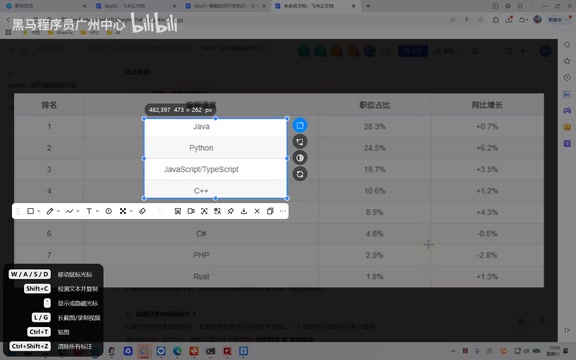
Because the backend carries the real business complexity, demand for backend roles far exceeds that for frontend. The mainstream backend languages today are Java and Python, which have consistently ranked at the top of programming language indexes. C/C++, by comparison, is mainly used in game development and embedded systems — niches with fewer openings, higher barriers, and strict requirements around academic background and algorithms. They're not the right starting point for most people.
Technology Must Be Grounded in Business
One point that gets emphasized repeatedly: technology divorced from business is worth very little.
This shows up clearly in interviews. What interviewers actually care about isn't how many technologies you know — it's your real-world implementation approach and your enterprise-level design and execution experience. Listing a stack of technologies without concrete deployment experience will significantly undermine your competitiveness. Career-wise, you need both legs: technical skill and business understanding.
Intelligent application development is no different. A practical insight from hiring trends: interviews often split roughly 50/50 between intelligent application development and traditional application development. If you only know traditional development, you're likely to command a lower salary. If you only know intelligent development, you risk being filtered out early. Having both gives you real negotiating power. In an e-commerce project, for instance, the traditional side covers CRUD operations and conventional search, while the intelligent side includes AI-powered shopping assistants, customer service bots, recommendation engines, smart ordering, and visual recognition. A novel-reading app follows a similar pattern: beyond standard content management, it adds AI-generated copy, AI-written stories, and text-to-image capabilities.
How Enterprises Use Large Language Models
Enterprises use large language models (LLMs) in two primary ways: local deployment and cloud-based API calls. A key data point: roughly 20% use local deployment; 80% use the cloud. Cloud is the overwhelming default.
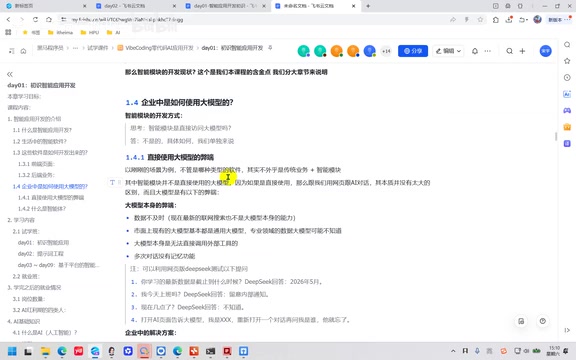
Using an LLM directly has obvious limitations. First, LLMs are trained on historical data and have no real-time internet access. Second, general-purpose models like Qwen or Doubao know publicly available information but are completely unaware of any company's internal proprietary data. Third, an LLM on its own can't call external tools. And fourth, a raw LLM has no conversational memory.
A common misconception is worth clearing up: the reason Doubao can search the web and remember past conversations isn't that the LLM itself has those capabilities — it's because Doubao is fundamentally an intelligent application (an agent) that integrates an LLM internally. When you ask a question, if the model already knows the answer it responds directly; if not, Doubao performs a web search (using traditional application logic), feeds the search results back into the LLM for language synthesis, and returns a structured answer.
Local deployment and cloud-based calling differ significantly in practice. Local deployment means the enterprise downloads model weights and runs them on its own servers — typical examples include open-source models like Llama or Qwen deployed via frameworks like Ollama. The advantage is that data never leaves the corporate network, which is ideal for sectors like finance, healthcare, and government where data compliance is critical. The downside is the significant GPU hardware investment required, which puts it out of reach for most small and medium-sized businesses. Cloud-based calling means accessing LLM services from providers like OpenAI, Alibaba Cloud (Qwen), ByteDance (Doubao), or DeepSeekAd via API, paying per token with no need to provision compute. The reason 80% of enterprises go with the cloud comes down to cost control and low barrier to entry — developers can integrate a model with just a few lines of code, with no need to worry about training or maintenance.
Agents: The Core of Intelligent Application Development
The enterprise solution is to build intelligent applications, and the heart of an intelligent application is the Agent.
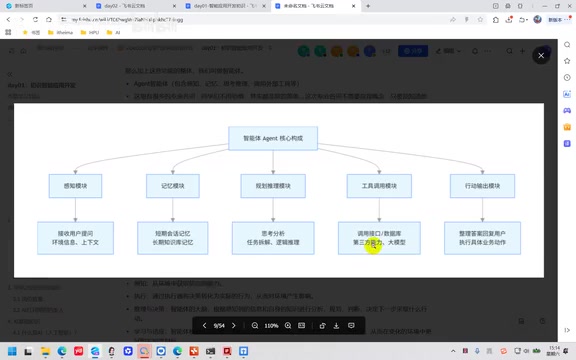
A complete agent is composed of several core modules:
- Perception module: Understands the entire environment, system context, and current state
- Memory module: Stores conversation history to enable contextual continuity
- Reasoning module: The LLM thinks and analyzes, reasoning out concrete execution steps
- Tool calling: Invokes external tools to perform tasks — querying maps (Gaode/Baidu), checking weather, fetching tourist information, etc.
- Output module: Compiles the final answer and presents it to the user
A useful analogy: an agent is like a digital workhorse embedded inside your software. Perception is feeding it data; memory gives it the ability to remember; reasoning gives it a brain (powered by an LLM); tool calling gives it the ability to act.
By this standard: a simple fast-search box is not an agent, because it can't execute tasks. Doubao, Claude Code, Codex, Trae — these are agents, because they can perceive, plan, reason, and execute. This also explains the fundamental difference between intelligent applications and traditional ones: agents transform LLMs from "Q&A tools" into executors capable of completing real-world tasks.
Function Calling is the key technical mechanism that sets agents apart from pure conversational models. When a user asks a question, the LLM doesn't just output text — it can also output structured "function call instructions," such as specifying a call to a weather API with a city parameter. The agent framework receives that instruction, actually executes the external API request, feeds the returned result back into the LLM, and has the model synthesize a natural language reply from the raw data. This loop of "model reasoning → tool execution → result return → model synthesis" can iterate across multiple rounds, enabling agents to handle complex multi-step tasks like searching, calculating, booking tickets, and sending emails. Popular agent development frameworks like LangChain, LlamaIndex, and Dify (popular in China) all encapsulate this workflow, reducing the complexity developers face when orchestrating it manually.
Learning Path and Summary
Based on this architecture, the key areas to master for intelligent application development can be summarized as follows:
- Retrieve data from traditional business systems and feed it to an LLM for analysis
- Call external tools to extend the LLM's action capabilities
- Use an existing LLM for reasoning and decision-making (DeepSeek V4 is a strong value pick)
- Build a local knowledge base to implement memory
- Integrate the LLM, memory, task planning, tools, and execution into a complete agent
At its core: Intelligent Application = Frontend (AI-generated) + Backend (traditional development + intelligent development). The heart of an intelligent application is agent development, and the heart of agent development is giving the system the ability to perceive, remember, reason, call tools, and act. The LLM's role in all of this is analysis and decision-making. Understand this architecture, and you have a solid foundation for hands-on development ahead.
Related articles

How Big Can Stars Really Get? The Physical Limits of the Largest Stars
Red supergiants are the largest stars by volume, with radii up to 2,000 times the Sun, engulfing the inner solar system. But there is no precise upper limit on stellar size—models predict up to 15,000 solar radii. The most massive blue stars are far smaller than red supergiants—biggest and heaviest are two different things.

Apple HomeView Smart Display Full Feature Breakdown: Wall-Mount or Desktop, $299
Apple launches HomeView, a $299 smart display with wall-mount and desktop options, 12MP camera for facial recognition, smart home control, music playback, and recipe step-by-step cooking. Full breakdown of watch faces, apps, privacy, and cooking integration.

Where Did the Promised New Studio Go? Craft Computing Answers After Five Years
Craft Computing's host responds to viewer questions: the new studio promised five years ago was shelved as construction costs soared from $30,000 to $75,000, and was replaced by a 168-square-foot garage conversion.