Vibe Coding for Beginners: AI-Powered Development with Claude Code + DeepSeek

A beginner-friendly AI coding course built around Claude Code, DeepSeek, and natural language-driven development.
Vibe Coding is a new paradigm where natural language drives AI agents to handle development — no coding background required. This course centers on Claude Code while offering domestic model alternatives like DeepSeek, Zhipu GLM, and Qwen for users in China. A standout practical insight is the emphasis on cache hit rate as a key cost driver — properly configured DeepSeek V4 Pro can reach 98–99% hit rates. The course also introduces LLM-Loop and Agent Engineering frameworks, targeting product managers, career-changers, and developers looking to keep pace with AI tooling evolution.
What Is Vibe Coding: Focus on Requirements, Not Code
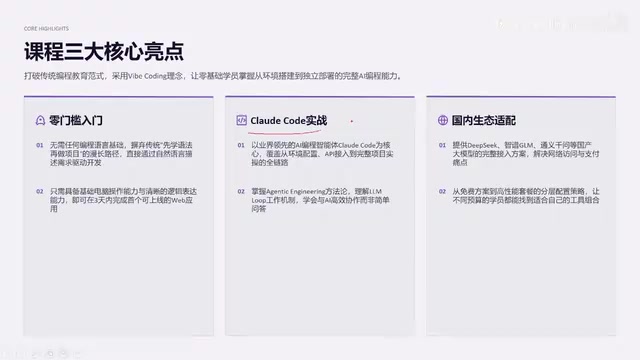
Vibe Coding is transforming traditional software development. According to a zero-to-hero AI Coding course by Bilibili creator Meng Ge, the core philosophy of Vibe Coding is: "You no longer need to worry about how to write code — instead, you fully immerse yourself in the productivity gains that AI tools deliver."
Unlike traditional programming courses that walk you through syntax line by line, Vibe Coding emphasizes describing your needs in natural language and letting an AI agent handle the entire requirements-driven development process. This dramatically lowers the barrier to entry — no programming background required, no lengthy learning curve. According to the course, anyone with basic computer skills and the ability to express ideas clearly can "build and launch a simple web app in just three days of learning."
This paradigm shift is driven by the exponential evolution of AI Coding tools. As AI agents grow more capable, the human developer's role shifts from "code writer" to "requirements describer" and "collaborative director."
The Core Toolchain: Claude Code as the Hub, Multiple Models for Flexibility
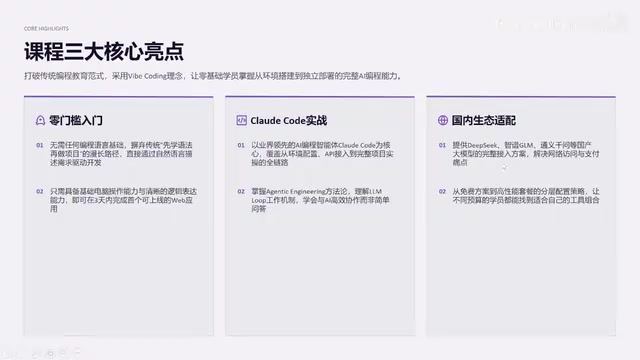
The course centers on Claude Code as the primary programming tool, positioning it as the industry-leading AI coding agent. The learning path covers everything from environment setup and API integration to full end-to-end project work.
One particularly noteworthy focus is the model selection strategy around cost and compliance. The course points out that many people have tried Claude Code but didn't follow the official recommended setup steps — resulting in low cache hit rates on the underlying model, leading to poor results and high costs. This is a critical detail that's easy to overlook in practice: cache hit rate directly impacts both user experience and spending.
Here's the cost comparison the course provides:
- Claude Code (Sonnet 4.6): Recommended monthly subscription, ranging from $20 to $100/month
- GPT: Also recommended as a monthly subscription
- Zhipu GLM 5.1: Monthly subscription at ¥49/month, with discounts for quarterly/annual plans
- Qwen 3.7 Max: Monthly subscription around ¥100–200, with discounts available
- DeepSeekAd V4 Pro: Pay-as-you-go API, averaging ~¥3/day — best value for money
The course particularly emphasizes that DeepSeek V4 Pro, when properly configured, can achieve cache hit rates of 98–99%, making it the primary model powering most of the hands-on course content. That said, if configured incorrectly and cache hit rates are low, "it can actually get quite expensive."
Cache Hit Rate refers to the proportion of API requests where the AI model can reuse a previously cached context (prompt prefix) rather than recomputing it. When a user makes repeated API calls, if the system prompt or historical context remains consistent across requests, the model provider can read directly from cache instead of processing everything from scratch — dramatically reducing token costs. Anthropic prices Claude's cache reads at roughly 10% of normal input costs. The higher the cache hit rate, the lower the API cost for equivalent work. Factors affecting hit rate include: whether the request headers remain stable and consistent, whether Prompt Caching is properly enabled, and how sessions are structured. DeepSeek and other models support similar KV Cache mechanisms — proper configuration can yield significant savings on pay-as-you-go usage.
Domestic Model Options for Users in China
For users in China who have difficulty accessing GPT, Claude, and other overseas models, the course provides a localized alternative path with support for DeepSeek, Zhipu GLM, Qwen, and other domestic large language models.
This is practically significant. For product managers, operations staff, and other business-side professionals in China — as well as developers who can't reliably access overseas services — domestic model options lower the barrier to adopting AI Coding even further. The course also segments plans by budget: from GLM's ~¥49/month subscription to DeepSeek's pay-as-you-go pricing, catering to learners across different financial situations.
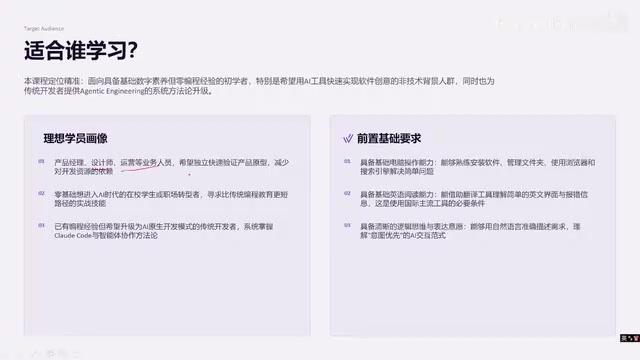
Three Ideal Learner Profiles: Who Is Vibe Coding For?
The course identifies three ideal learner profiles:
Business Professionals Without a Coding Background
Product managers, designers, operations staff, and others who already understand the full business logic but lack coding skills. With AI Coding, they can reduce reliance on engineering resources and describe requirements directly to an AI to bring projects to life.
Students or Career-Changers Starting from Zero
Undergraduates or professionals pivoting careers who want to enter the AI era — they don't need to start with traditional line-by-line coding, but can instead leverage AI for assisted development from day one.
Developers Already in the Industry Who Are Unfamiliar with AI Coding
Experienced developers can use this course to systematically learn Claude Code and agent collaboration methodologies, keeping pace with the rapid evolution of tooling.
Collaborating Effectively with AI: Don't Be Combative
One counterintuitive but spot-on insight from the course: your attitude toward AI directly affects the quality of your output.
The course bluntly states: don't argue with the AI like a troll on the internet — "it serves no purpose other than wasting your tokens and your money." Instead, "the more humble you are, the more trust you show in the conversation, the more you ask for confirmation at each step, the better the results."
This actually gets at the heart of the AI Coding methodology. The course introduces the concept of LLM-Loop and Agent Engineering — two frameworks for effective collaboration. High-quality output doesn't come from simple back-and-forth exchanges; it comes from expressing requirements clearly, confirming incrementally, and iterating to guide the agent toward the desired result.
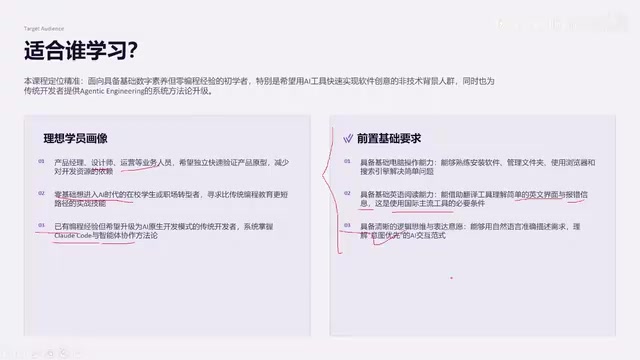
Prerequisites: Lower Than You'd Think
The course's prerequisites are refreshingly minimal: being able to turn a computer on and off, install common software like QQ or WeChat, find files in folders, and use a browser; basic English reading ability (being able to understand simple interfaces and error messages with the help of a translation tool is sufficient); and most importantly — clear logical thinking.
LLM-Loop (Large Language Model Loop) refers to embedding an AI model within a continuously iterating feedback cycle: user states a requirement → AI generates output → user validates and gives feedback → AI revises and outputs again — repeating until the goal is reached. This is fundamentally different from simple "one question, one answer" interaction; it emphasizes using multi-turn dialogue to progressively converge on the right result. Agent Engineering is the next level up — equipping the LLM with tool-use capabilities (such as executing terminal commands, reading and writing files, calling external APIs), enabling it to autonomously decompose complex tasks and execute them step by step, rather than merely returning text. Claude Code is a classic implementation of a Coding Agent: it can directly operate on local codebases, run tests, fix errors, and form an autonomous "plan → execute → verify" loop. Understanding these two concepts helps learners graduate from "how to ask good questions" to "how to design task workflows."
What You'll Walk Away With
According to the course roadmap, learners will ultimately gain three types of capability:
- Conceptual understanding: Being able to clearly explain what Vibe Coding is, what agent-paradigm programming means, and what SaaS paradigms look like and when to use them
- Engineering skills: Mastering the full workflow of Claude Code — environment setup, model integration, project development, debugging, and deployment
- Hands-on capability: Using and customizing Skills, independently building and deploying complete web applications, writing PRD requirement documents, conducting code reviews, and managing production deployments
Final Thoughts
This course reflects a trend that's already underway: AI Coding is evolving from a "developer-exclusive tool" into a "universal productivity tool." The course's opening line — "It's never AI that makes you obsolete; it's another person who knows how to use AI" — may be marketing language, but it captures the essence of what's at stake when a powerful tool becomes widely accessible.
For readers hoping to get started with AI-assisted development, the real value this kind of course offers lies in toolchain design thinking (Claude Code as the core, with multi-model flexibility), cost optimization insights (cache hit rate optimization), and collaboration methodology (LLM-Loop, Agent Engineering). One caveat worth noting: as a promotional course, claims like "ship a web app in three days" lean optimistic. Real-world results will depend on your logical thinking ability and consistent practice.
Related articles

Random Pruning of the DPO Computation Graph: 1.4x Training Speedup and Lower Peak Memory
DPO training too slow and memory-hungry? This paper proposes a random pruning framework for the DPO computation graph, sampling independently across position, sequence, and branch dimensions; branch pruning achieves a 1.426x step-time speedup and cuts training time by about 30%, with in-depth attribution of memory and time gains.

Why Does JEPA Underperform MLM in Longitudinal EHR Representation Learning?
New study compares JEPA and MLM for longitudinal EHR representation learning on MIMIC-IV: three JEPA variants train stably without collapse but underperform MLM; target size, not heterogeneity, drives prediction error.

Transfer Learning + Visible Light Communication: A New Approach to Energy-Efficient Indoor Positioning
A study proposes a transfer learning-based visible light communication indoor positioning method, achieving 47% accuracy improvement on the BOSCH factory dataset, 67.5% model efficiency under high noise, and introducing the ME composite metric for energy-efficient positioning in energy-constrained industrial IoT scenarios.