Vibe Coding for Beginners: Directing AI to Write Code and Building a One-Person Company

A practical course on using AI to build complete products solo — the one-person company playbook for the AI era.
This Vibe Coding course by Bilibili creator 分镜影院 argues that AI has evolved from an assistive tool into a new form of productivity, shifting developers from writing code to directing AI to write it. True AI development goes beyond workflow orchestration tools like Coze or Dify — it requires an AI + code + agents + engineering stack. The course covers the full product lifecycle from UI design and frontend/backend development to testing, deployment, and AI-driven marketing, using tools like Claude Code, MCP, Stitch, Figma, and UniApp. The goal: equip learners with the end-to-end capability to build and ship products as a one-person company.
From Tool to Productivity: AI Is Reshaping Software Development
A Vibe Coding beginner's practical course by Bilibili creator "分镜影院" puts forward a striking idea: AI is no longer just an assistive tool — it's becoming an entirely new form of productivity. Building a product used to require coordinated effort from product managers, designers, frontend and backend developers, testers, and marketing teams. Now, AI is rapidly lowering the barrier across all these roles, and in theory, "one person is enough."
The course is built on the creator's read of industry trends — that the way software is developed is being fundamentally restructured by AI. In the old model, people adapted to code: developers had to master design, frontend, backend, databases, servers, and even operations. Many people weren't short on ideas; they were short on the ability to bring those ideas to life. AI changes that by turning code into a medium that understands human language.
What Is Vibe Coding
The author defines Vibe Coding in a single sentence: it's no longer about people writing code, but about people directing AI to write code.
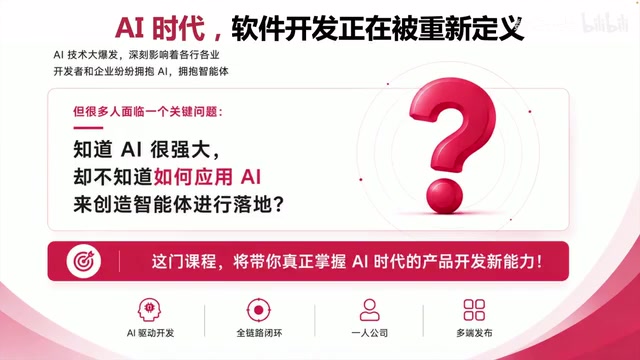
In other words, you simply tell the AI what page you want to build, what it should look like, and how it should work — and the AI generates the page, writes the code, connects to the database, runs automated tests, fixes bugs, produces documentation, and can even generate marketing copy and short-form video scripts. This shifts the focus of development from "how to implement" to "how to express what you need."
The author also flags a common misconception: many people equate workflow orchestration tools like Coze, Dify, and n8n — connecting a few nodes to run a few processes — with "knowing AI development." In his view, these are only surface-level approaches. The real path to industrial-grade, complex-system development is the AI + code + agents + engineering stack.
The concept of "Vibe Coding" was introduced by OpenAI co-founder Andrej Karpathy in early 2025 to describe a development paradigm where natural language is the primary interface and AI handles the actual code generation. Developers no longer write code line by line; instead, they drive the entire development process by describing intent, giving feedback, and iterating on requirements. This is fundamentally different from traditional "AI-assisted programming" (such as code completion in GitHub Copilot): in that model, humans lead and AI assists; in Vibe Coding, AI leads while humans review and guide. The rise of Vibe Coding is backed by rapid advances in large language models' ability to understand and generate code — models like GPT-4 and Claude can now handle relatively complex engineering tasks, not just snippet completion.
AI-Native Applications Are Where the Real Value Lies
The course emphasizes that the truly valuable products of the future won't be simple chatbots, but AI-native applications — such as AI-powered e-commerce platforms, digital humans, automation systems, and enterprise AI platforms. All of these ultimately come down to a competition in engineering capability.
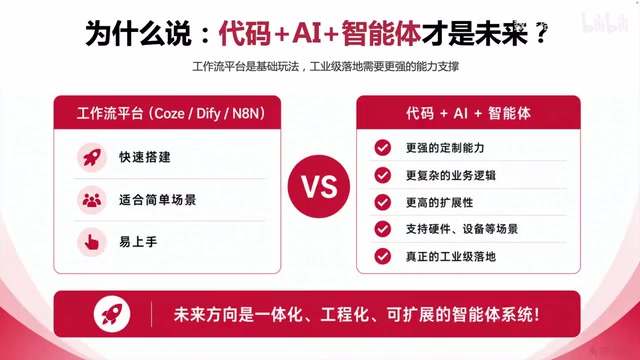
The author sets two goals for the course: first, to help students genuinely master AI engineering and product delivery skills — not just learn how to use a few AI tools; and second, to help them "make money." He predicts that a wave of AI companies, AI entrepreneurs, and "super individuals" is coming, and that many people's career paths will shift from finding a job to building products with AI. Viewed this way, this is less a tool tutorial and more a practical course for the one-person company of the AI era.
The author's distinction between "workflow orchestration" and "AI engineering" has real significance in the industry. Tools like Coze, Dify, and n8n operate on the logic of "node connection" — visually linking existing AI APIs, database operations, and HTTP requests into lightweight automated pipelines. They're great for quick prototyping but fall short when dealing with complex business logic, state management, error handling, and system scalability. "AI engineering," by contrast, requires developers to have genuine control at the code level — able to build maintainable, extensible software systems with AI capabilities embedded as modules. The two paths aren't mutually exclusive, but they differ significantly in terms of product complexity and commercial value, which is why the author frames the former as "basic-level" work.
Full-Stack Closed-Loop Development: More Than Just Writing Code
The course's biggest differentiator is its "full-stack closed-loop" approach. The author emphasizes that a real product isn't just handwritten code — it requires linking together requirements analysis, UI design, page development, backend logic, databases, testing, deployment, and marketing.
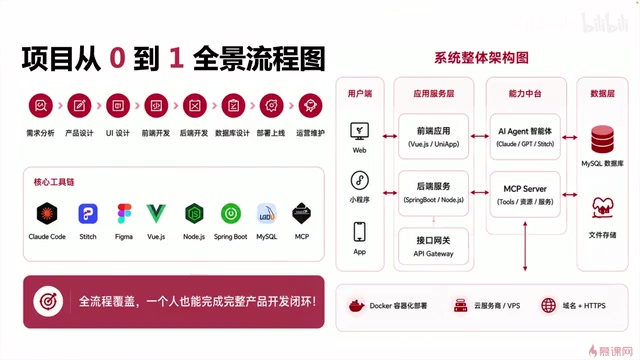
On the technical side, the author covers the collaboration between tools like Claude Code, Stitch, MCP, Skills, and Figma. His view: the future of software development isn't about any single capability — it's about "AI collaborative development," where AI genuinely participates in design, development, testing, optimization, and operations, not just chat.
To address the traditional pain point of multi-platform development (a separate codebase for Web, a separate one for mobile apps, another for mini-programs), the course covers a solution combining UniApp with AI code generation, using component reuse to achieve "write once, run everywhere" — further lowering the bar for independent developers.
A few tools mentioned in the course are worth explaining individually. Claude Code is Anthropic's terminal-based AI programming assistant that can directly manipulate local files, execute commands, and understand project context — one of the most widely used tools in Vibe Coding practice today. MCP (Model Context Protocol) is an open protocol from Anthropic that allows AI models to interact with external tools, databases, and APIs in a standardized way — essentially giving the AI "hands" so it can actively call external services rather than just generating text. Stitch is a Google AI UI design tool that generates interface prototypes from text descriptions and exports code directly. UniApp is a cross-platform development framework by DCloud built on Vue.js; a single codebase compiles to iOS, Android, H5, and all major mini-program platforms, making it the go-to choice for independent developers in China looking to minimize multi-platform adaptation costs.
AI Enters the Marketing and Operations Layer
Many people think the job is done once the product is built — but the real challenge is often distribution. The author points out that AI has now moved into the operations domain.
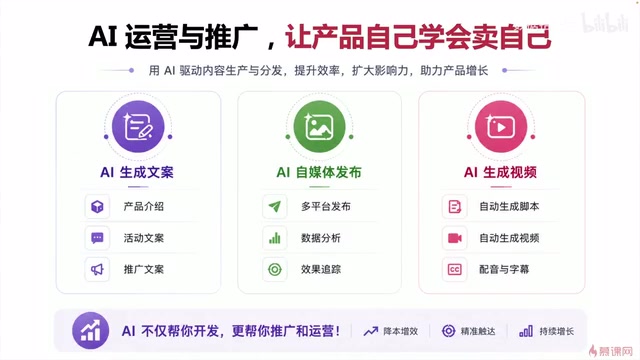
From auto-generating WeChat public account articles, promotional copy, and video scripts, to producing product demo videos — AI can help a product "market itself." The author believes the truly formidable individuals of the future will be those who combine both development and AI-powered operations capabilities.
What You'll Be Able to Do After the Course
According to the course roadmap, students who complete the program will develop the following capabilities:
- The ability to independently develop products
- AI full-stack collaboration skills
- AI engineering capabilities
- Multi-platform development skills
- AI-driven automated operations skills
The ultimate goal is to possess the comprehensive ability to "build a product solo." The author's conclusion carries a clear generational bet: AI will eliminate a large amount of repetitive labor, but it will also give rise to a wave of super individuals and one-person companies. The opportunity belongs to those who prepare ahead of time.
Conclusion
The value proposition of this course is less about teaching you how to use a specific tool, and more about providing a methodology for the independent creator in the AI era. Its core argument — moving from workflow orchestration to engineering systems, and from point-solution development to AI full-stack collaboration — genuinely identifies the critical inflection point in AI development right now. For developers and entrepreneurs who want to level up from "knowing how to use AI tools" to "building complete products with AI," this kind of systematic course offers a clear path forward. Of course, the actual effectiveness of Vibe Coding ultimately depends on how deeply the learner understands requirements articulation, engineering planning, and product refinement.
Related articles

Chain of Thought Isn't Just for AI: How Humans Can Use CoT to Improve Thinking Quality
Chain of Thought isn't just a prompt trick for large models. Starting from a Hacker News discussion, this article analyzes why CoT works for human thinking too, breaks down actionable ways to transfer it, and highlights the key differences between human CoT and machine CoT.
Cloudflare Teams Up with OpenAI: Closi…
Cloudflare Teams Up with OpenAI: Closing the Loop from Vulnerability Discovery to Defense with AI
Cloudflare uses OpenAI Daybreak to investigate security vulnerabilities and generate reviewable remediation plans, while developers use Codex to boost coding efficiency and quality.

Orca Multi-Agent Orchestration in Practice: A Guide to Parallel Collaboration with Claude and Codex
Orca is Stable AI's free open-source agent workbench supporting 34 agents like Claude Code and Codex in parallel. Learn its Git worktree isolation, multi-model orchestration, and mobile management.