Vibe Coding for Beginners: How Ordinary People Can Command AI to Code — and Do the Work of an Entire Team

Vibe Coding lets anyone direct AI to build software using plain language — no coding skills required.
Naval Ravikant claims he rebuilt an app solo using Vibe Coding that once took 8 engineers a year. This article breaks down what Vibe Coding really is, why its instant feedback loop makes it addictive, and how beginners can get started using a China-accessible toolchain (VS Code + Qwen) through three 15-minute hands-on projects.
Naval's New Prediction: One Person Replacing an 8-Engineer Team
Naval Ravikant, author of The Almanack of Naval Ravikant, made waves again in a recent podcast, sparking widespread discussion across the tech world. He boldly predicted Apple's decline, the fracturing of society — and declared that the window for pure software startups has closed, because AI is pushing the barrier to coding to an all-time low.
Background: Who is Naval? Naval Ravikant is one of Silicon Valley's most influential angel investors and co-founder of AngelList. He was an early investor in Twitter, Uber, Notion, and dozens of other unicorns. The Almanack of Naval Ravikant wasn't written by him directly — Eric Jorgenson compiled it from years of Naval's podcasts, tweets, and interviews. The core theme is "how to build wealth and find happiness through specific knowledge and leverage." Naval has long argued that code and media are the most important leverage tools of the 21st century, because they work for you while you sleep. His latest take on AI-powered coding is a natural extension of that framework — technological leverage is being democratized by AI, and the collapse of barriers will redefine who gets to build wealth.
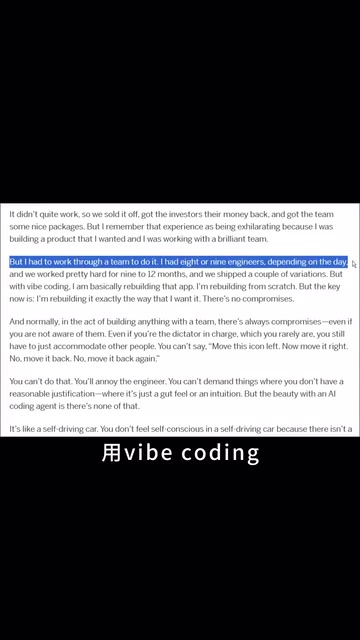
The most striking claim he made: using "Vibe Coding," he alone rebuilt an app that once required 8 engineers working for an entire year. This isn't a marketing slogan — it's his genuine, lived experience with AI-assisted development. When one person's output can match a full team's annual work, the entire logic of value distribution in the software industry is being rewritten.
Also worth noting is his advice on education: he says we should take phones away from kids who are scrolling and gaming, and replace that time with Vibe Coding. In his view, it's "more addictive than games, and more meaningful" — it delivers the same hit of instant gratification, but builds real creative capacity in the process.
The Essence of Vibe Coding: Not Writing Code — Directing AI Through Conversation
The core insight of Vibe Coding is precisely that it isn't about writing code. Traditional programming demands mastery of syntax, debugging, architecture, and a whole stack of hard skills — the barrier is enormous. Vibe Coding, by contrast, is fundamentally about using natural language conversation to direct AI to do the coding for you.
The Technical Origins of Vibe Coding: The term "Vibe Coding" was formally coined and popularized by OpenAI co-founder Andrej Karpathy in early 2025. He described it as "fully giving in to the vibes, forgetting that the code even exists — just seeing, saying, running, and pasting." The technical foundation is the breakthrough performance of large language models (LLMs) in code generation — models like GPT-4, Claude 3.5, and Gemini can now solve over 90% of problems on coding benchmarks like HumanEval. This is powered by the Transformer architecture's deep learning from billions of lines of open-source code on GitHub, enabling models to understand natural language intent and generate corresponding executable code. Unlike traditional IDE autocomplete, Vibe Coding supports multi-turn conversational iteration: the user describes a need → AI generates code → user gives feedback → AI revises, forming a continuous human-AI collaboration loop.
This means the human role shifts from "code writer" to "intent expresser." You simply need to clearly describe what you want — a particle effect, an AI character with a distinct personality, a small game — and AI translates those vague "vibes" into runnable code.
The significance of this shift is that it transforms programming from the exclusive domain of specialists into a general-purpose skill that ordinary people can use. As Naval puts it, "anyone can learn it." When expressing intent becomes the core skill, the value of creativity itself far outweighs the technical barrier to executing it.
Why Instant Feedback Is the Key Driver
What makes Vibe Coding so addictive is its instant feedback loop. Type a description, and within minutes you can see real, running results. That feeling of "holy sh*t, I actually made this" creates a powerful positive cycle that keeps pulling you deeper.
There's solid neuroscience behind this: the brain's dopamine reward circuit activates when anticipated rewards are realized, and immediacy is the key variable — the shorter the delay between action and reward, the stronger the motivational reinforcement. This is the core of the "game loop" theory in game design: by compressing the time between action and feedback, players stay in a state of flow. The frustration of traditional programming comes precisely from a feedback chain that's too long: learn syntax → write code → get errors → read docs → debug — beginners give up before they ever see results. Vibe Coding compresses that cycle from hours to minutes, fundamentally rewiring the learning experience at the neurological level. This is exactly why Naval compares it to games and short-form video — the same dopamine drive, but pointed toward creation rather than consumption.
From Zero to One: A Practical Vibe Coding Path for Beginners
In response to this trend, systematic beginner tutorials have already appeared, helping zero-experience users complete an entire AI-assisted development workflow. The approach is refreshingly pragmatic: skip the theory, and just get things running through three 15-minute mini-projects.

Typical starter projects include:
- An interactive particle universe: Build a visual effect in 15 minutes and feel the satisfaction of "code creating visuals" firsthand.
- An AI character with personality: Design a conversational AI with a distinct persona, and learn how to shape behavior through prompts.
- A playable mini-game: Go from idea to a game you can actually play — the complete creative loop, start to finish.
The logic behind this three-step design is to use instant feedback to dissolve learning anxiety. When beginners see results in the first 15 minutes, motivation activates naturally.
Tools That Actually Work in China
A lot of people worry about not being able to access foreign software — and that's a real obstacle to adopting Vibe Coding locally. These tutorials offer a solution: a fully accessible domestic toolchain — VS Code + JRM + Qwen (Tongyi Qianwen).

Toolchain Background: Alibaba Cloud's Qwen series is one of the most capable open-source LLMs currently available in China. The Qwen2.5-Coder series is specifically optimized for coding tasks and has reached internationally competitive performance on multiple code generation benchmarks. VS Code (Visual Studio Code) is a free, open-source code editor built by Microsoft with over 15 million monthly active users worldwide. Its rich plugin ecosystem makes it the go-to platform for AI coding tools — GitHub Copilot, Cursor, and other leading AI coding assistants are all deeply integrated with it. The core barrier for Chinese developers is access to top-tier models like Claude and GPT-4. The "VS Code + domestic LLM" combination provides a compliant, accessible alternative path. As Chinese models rapidly close the capability gap, this local toolchain now delivers a user experience that's meaningfully comparable to international options for everyday development tasks.
This combination connects a development environment (VS Code), helper tooling (JRM), and a domestic large language model (Qwen) into a complete AI programming workflow. The tutorials come with ready-to-use code and prompt templates for every step, making the whole experience feel like "having a senior architect debugging alongside you in real time." For zero-experience users, templated prompts are the most critical scaffolding — they preemptively solve the biggest psychological barrier: not knowing how to talk to the AI.
What Vibe Coding Actually Means
Returning to Naval's assessment: Vibe Coding isn't just an efficiency upgrade — it's a restructuring of the production relationship. When "one person matching a full team" becomes the norm, the moat in software entrepreneurship will no longer be technical execution ability, but creativity, taste, and deep insight into user needs.
For ordinary people, this is a rare window of opportunity. All those wild ideas that were buried because you couldn't write code now have a real path to becoming reality. You don't need to become an engineer — you just need to learn how to clearly express your intent and skillfully direct AI.
That said, keeping a level head matters too. When Naval says "one person redoing a year of work by 8 engineers," the AI is mostly handling repetitive, pattern-based coding tasks. Genuinely complex system architecture, security, and performance optimization still require professional judgment.
The Technical Gap Between "It Runs" and "Production-Grade": AI currently excels at "recombining known patterns": CRUD applications, API integrations, UI components, algorithm implementations — tasks with clear, established paradigms. But industrial-grade software complexity hides in several critical dimensions: concurrency and performance (race conditions and memory leaks in high-concurrency scenarios require deep systems knowledge), security (SQL injection, XSS, and permission bypasses are vulnerabilities AI often unintentionally introduces in generated code), maintainability (AI-generated code often lacks consistent architectural design, leading to high long-term maintenance costs), and edge case handling (real user behavior is far more complex than any spec description). This is why Vibe Coding is currently best suited for "prototype validation" and "personal projects," rather than direct use in production systems in sectors like finance or healthcare where reliability requirements are extreme.
Vibe Coding lowers the barrier from "0 to 1" — but there's still a long road from "it runs" to "production-grade reliable." For ordinary people who want to rapidly validate ideas and build product prototypes with AI, however, right now is undoubtedly the best time to get started.
Key Takeaways
Related articles

Felix Rieseberg Personal Homepage
Felix Rieseberg's personal homepage sparks attention on Hacker News. This article covers the Slack engineer's technical background, the rise and fall of nativefier, and the value of a developer homepage as a tech calling card.

@ai-sdk/vue 3.0.306 Patch Release Syncs with [email protected] Update
@ai-sdk/vue 3.0.306 released, synced with [email protected]. A routine patch release for the Vercel AI SDK ecosystem with no public API changes; the Vue adapter layer stays version-aligned with the core package.

Gemini 4 Argon API Launches: The Era of Million-Token Output Begins
Google launches Gemini 4 Argon with sparse MoE architecture, up to 1M output tokens, and a 68.90% Vals Index score, available across API, AI Studio, and the Gemini app.