Vibe Coding: Full-Chain Development in Practice for One-Person Companies in the AI Era
Bilibili tutorial breaks down Vibe Coding: how ordinary people can use AI to complete the full product loop of a one-person company from 0 to 1.
The article introduces the Bilibili creator "分镜影院"'s course "Vibe Coding: Zero Basis Introduction to Practical Combat." Its core is the shift in development paradigm: humans no longer write code line by line but describe intent to AI, which handles coding, integration, testing, and fixes. The course emphasizes that building nodes in Coze or Dify is only basic play; industrial-grade deployment requires an "AI + code + agents + engineering" system. A real product must connect the full chain of requirements analysis, UI design, development, backend and databases, testing and deployment, and operations and promotion—this is the origin of the "one-person company." The course also introduces UniApp for develop-once-run-multiple-platforms and uses AI to generate copy, scripts, and promotional videos for automated promotion. The author also reminds: AI lowers the threshold but does not replace judgment; requirements, architecture, and operations strategy are still led by humans, and the future belongs to those with dual capabilities in "development + AI operations."
What Is Vibe Coding? From "Humans Writing Code" to "Humans Directing AI"
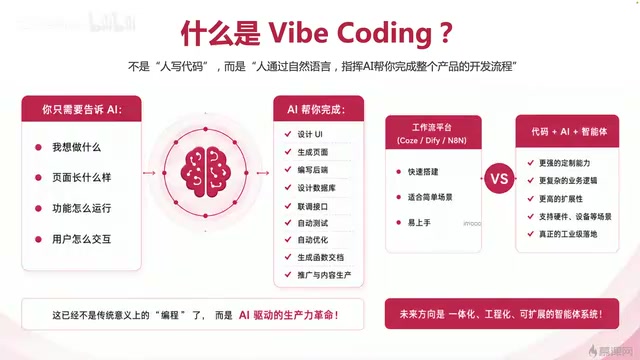
The core definition of Vibe Coding is simple: humans no longer write code line by line. Instead, they describe their intent to AI—what the page should look like, how features should work—and AI generates the pages, writes the code, connects to databases, runs automated tests, fixes bugs, and even produces documentation and promotional content.
This model means the developer's role shifts from "implementer" to "director." At the start of the course, the creator emphasizes that AI is now understanding human language, and humans no longer need to adapt to the syntactic details of code. For people who have ideas but lack technical skills, this is indeed a democratization of capability.
But the course also points out a common misconception: many people think that building a few nodes and running a few workflows in Coze, Dify, or n8n means they have mastered AI development. The creator states clearly that these are merely "basic AI playstyles." The direction that can truly achieve industrial-grade deployment and build complex systems is the system of "AI + code + agents + engineering."
The Boundary Between Vibe Coding and Natural Language Programming
Vibe Coding was proposed by OpenAI co-founder Andrej Karpathy in early 2025. It refers to a development approach where developers describe requirements in natural language and fully trust AI to generate code and run the results. The "vibe" emphasizes directing by feel rather than line-by-line review. Its key difference from traditional "AI-assisted programming" (Copilot-style completion) lies in the transfer of control: the latter is human-led with AI suggestions, while the former is human-described intent with AI-led implementation. This also brings new risks—when developers do not read the generated code line by line, potential security vulnerabilities, dependency conflicts, and performance issues may be hidden. Therefore, industrial-grade scenarios usually require layering code review, automated testing, and version control on top of Vibe Coding—what the article repeatedly emphasizes as "engineering."
The Full-Chain Closed Loop of a One-Person Company: More Than Just Writing Code
The course repeatedly emphasizes one point: a real product is far more than handwritten code. From requirements analysis, UI design, and page development to backend logic, databases, testing, deployment, and operations and promotion, all links need to be connected.
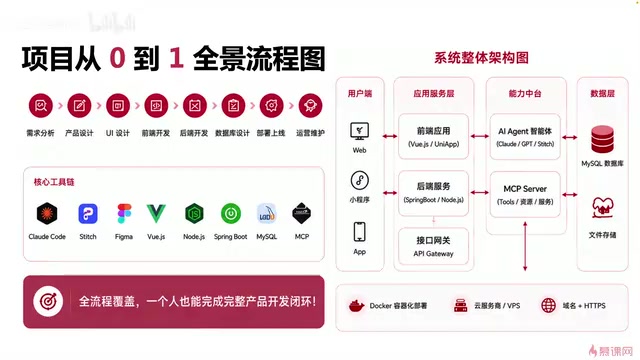
"We are not building a simple demo; we are truly guiding everyone to build a complete product." In the course, the creator presents the complete flow chart of the project from zero to one and points out that the biggest feature of this course is the full-chain closed loop. This exactly corresponds to the concept of a "one-person company"—tasks that previously required collaboration among product managers, designers, frontend, backend, testing, and operations can now all be covered by one person with the help of AI.
In terms of technical architecture, the course mentions that tools such as Claude Code, Stitch, MCP, Skills, and Figma will collaborate with one another. AI is no longer just a conversation in a chat window; it participates in every link of design, development, testing, optimization, and operations. This kind of multi-tool collaborative engineering capability is the core competitiveness of future AI development.
The Role of MCP and Skills
MCP (Model Context Protocol) is a standardized protocol open-sourced by Anthropic at the end of 2024. It is used to let large models connect to external tools, data sources, and services (such as databases, Figma, GitHub, and local file systems) in a unified way. You can think of it as the "USB interface of the AI world": previously, every tool had to have a separate adapter layer written for large models, but MCP abstracts this layer into a universal protocol, enabling agents such as Claude Code to plug and play—reading and writing project files, querying databases, and calling design mockups. Skills are encapsulated reusable capability modules (such as "generate a CRUD API with authentication"), allowing agents to stably invoke established processes for specific tasks rather than re-reasoning each time. The combination of the two is precisely the technical prerequisite for "AI moving from the chat window into all aspects of design, development, and testing" mentioned in the article.
Multi-Platform Development and AI Operations: Completing the Last Two Pieces of the One-Person Company
Multi-platform development used to be a nightmare for independent developers—one set for the web, one for the app, and another for the mini program. The course introduces UniApp combined with AI code generation and component reuse to achieve "develop once, run on multiple platforms." The creator believes this is an important technical foundation that makes the "one-person company" possible.
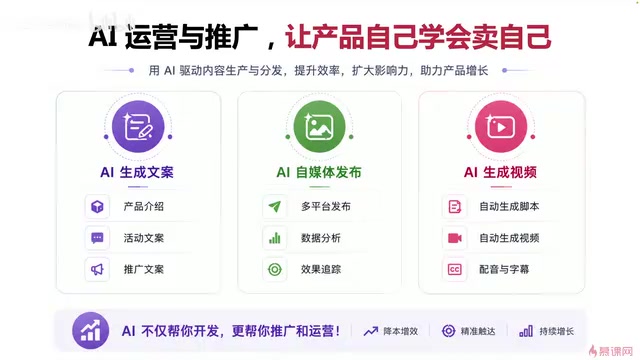
Another often overlooked link is promotion. Many people think product development is the end, but the real difficulty is making the product seen. The course demonstrates AI applications in operations: automatically generating WeChat official account articles, promotional copy, video scripts, and even automatically generating product promotional videos. The creator calls this "letting the product promote itself."
This also leads to the course's judgment about the future: truly capable people will definitely be those with dual capabilities in "development + AI operations." Those who only know how to write code or only know how to do operations may both be redefined in the AI era.
UniApp's Cross-Platform Principle
UniApp is a cross-platform development framework based on Vue syntax. Developers write one set of code, which after compilation can be output separately as applications for WeChat mini programs, H5 web pages, iOS/Android apps (through native rendering or webview containers), and platforms such as HarmonyOS. Its core is to abstract platform differences into conditional compilation and unified component APIs, with developers using directives such as #ifdef to handle platform-specific capabilities. For independent developers, UniApp solves the cost problem of "implementing the same business logic three times"; AI code generation further lowers the threshold for writing this cross-platform code—after describing page structure and interactions, AI produces component code that conforms to UniApp specifications. Only the combination of the two makes "one person covering multiple platforms" feasible in terms of time.
Course Goals and Target Audience
The creator admits that the course has two purposes: first, to help learners truly master the ability to land AI engineering products, rather than stopping at being able to use a few AI tools; second, to make money—because in the future there will be a large number of one-person companies, AI entrepreneurs, and super individuals. Many people may no longer choose to look for jobs but instead use AI to build products.
After completing the course, learners should possess the ability to independently develop products, full-chain AI collaboration capability, AI engineering capability, multi-platform development capability, and AI automated operations capability. The course is positioned not as a simple tool course but as a "practical course for one-person companies in the AI era."
A Rational View: Opportunities and Misconceptions Coexist
Vibe Coding lowers the development threshold, but it does not mean everyone can easily build good products. The creator repeatedly emphasizes the importance of engineering in the course, which in fact reminds learners: AI can help you write code, but requirements judgment, architecture design, product thinking, and operations strategy still need to be led by humans. The more powerful the tools, the higher the demand for the "director's" judgment.
For zero-basis learners, this course provides a complete path from cognition to practice; for experienced developers, its ideas about multi-tool collaboration and AI operations are also worth referencing. AI will eliminate a large amount of repetitive labor while also giving birth to a large number of super individuals—opportunities belong to those who prepare in advance.
One-line Summary
A Bilibili tutorial breaks down Vibe Coding: how ordinary people can use AI to complete the full product loop of a one-person company from 0 to 1.
Paragraph Summary
The article introduces the Bilibili creator "分镜影院"'s course "Vibe Coding: Zero Basis Introduction to Practical Combat." Its core is the shift in development paradigm: humans no longer write code line by line but describe intent to AI, which handles coding, integration, testing, and fixes. The course emphasizes that building nodes in Coze or Dify is only basic play; industrial-grade deployment requires an "AI + code + agents + engineering" system. A real product must connect the full chain of requirements analysis, UI design, development, backend and databases, testing and deployment, and operations and promotion—this is the origin of the "one-person company." The course also introduces UniApp for develop-once-run-multiple-platforms and uses AI to generate copy, scripts, and promotional videos for automated promotion. The author also reminds: AI lowers the threshold but does not replace judgment; requirements, architecture, and operations strategy are still led by humans, and the future belongs to those with dual capabilities in "development + AI operations."
Related articles

A 19-Year-Old's Rental Horror Story: Ceiling Collapse, Bug Infestation, and the Lessons It Taught Me
At 19, my first off-campus rental brought bug infestations, no heat, a collapsed ceiling, and a ruined laptop with no renter's insurance. Here are the hard-won lessons for first-time student renters.

Veda Nurse's Cranial Nerve Exam: Why ASMR Role-Play Is Going Viral
Bilibili creator Veda's cranial nerve exam ASMR video goes viral, blending humor and sensory triggers through nurse role-play. This article analyzes its unique appeal and the audience psychology behind ASMR role-play.

LG Cinebeam AI Review: 120-Inch Giant Screen + 3000 Lumens, a New Choice for the Living Room Theater
LG Cinebeam AI projector review: 3000 ANSI lumens, 4K, 100 inches from about 8 cm and 120 inches from about 18 cm. Built-in webOS, AI Concierge voice recommendations, AI Sound Pro 11.1.2 virtual surround, and Game Optimizer—positioned for fixed living room installation, complementing the portable Cinebeam S.