Vibe Coding Guide: Building Web Apps with AI from Zero Experience

A complete beginner's guide to Vibe Coding with Claude Code, model selection, and cost control strategies.
Vibe Coding is a new development paradigm where developers describe intent in natural language and let AI agents handle the implementation. This guide covers Claude Code setup, the LLM Loop and Agentic Engineering methodology, model selection (including DeepSeek for cost efficiency), and how prompt caching can cut API costs by up to 90% — enabling even non-programmers to ship real web applications.
What is Vibe Coding?
As AI programming tools rapidly evolve, a new development paradigm is emerging — Vibe Coding. The term was coined by OpenAI co-founder Andrej Karpathy in early 2025. He described it as a mode of programming where you "fully give in to the vibes" — developers no longer review code line by line, but instead describe their intent and let AI drive the entire implementation. This concept quickly sparked widespread discussion in the developer community, marking the formal mainstream emergence of a paradigm shift from "code-centric" to "intent-centric" software development.
Its core philosophy stands in stark contrast to traditional programming education: you no longer need to focus on functions, syntax, or how code is written. Instead, you describe your requirements in natural language, and an AI agent drives the entire development process.
In other words, the developer's role shifts from "code writer" to "requirements communicator" and "collaborative director." As long as you have basic computer skills and the ability to express logic clearly, you can ship a simple web app in a relatively short time — even with zero programming background.
Behind this shift lies the growing maturity of AI coding agents like Claude Code, Codex, and Cursor. Today's AI coding agents fall into two main categories: IDE-integrated tools (such as Cursor and GitHub Copilot) and terminal/CLI-based tools (such as Claude Code and Codex CLI). The former emphasizes visual interfaces and suits developers with some coding experience; the latter aligns more closely with automated workflows and is better suited for complex multi-file project management and end-to-end task execution. These tools are no longer simple "code completion" utilities — they are full-featured development assistants capable of understanding context, planning tasks, and executing debugging.
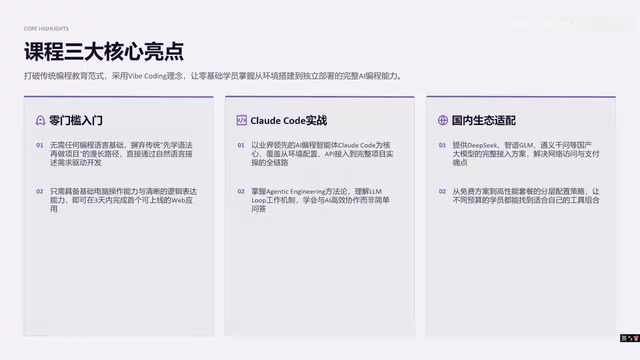
Claude Code: Core Tool and Agentic Engineering Methodology
Getting started with Vibe Coding requires first mastering Claude Code (Anthropic's AI coding agent) as the core tool — from environment setup and API integration to full project development. Claude Code, developed by Anthropic, is known for its excellent long-context understanding and reliable tool-calling capabilities. The DeepSeekAd series has gained rapid popularity among developers in China for its exceptional cost-efficiency and optimization for the Chinese language context.
Here's a key technical point worth highlighting: many users are already using Claude Code, but because they don't follow the officially recommended practices closely enough, the underlying model's cache hit rate ends up being low — which both degrades output quality and significantly increases token costs.
Cache Hit Rate is a core cost-optimization metric in LLM API usage. Most major model providers (such as Anthropic and DeepSeek) support a "Prompt Caching" mechanism: when consecutive requests share identical prefix context (such as system prompts or project background descriptions), the server retains the KV Cache for that portion for a period of time, allowing subsequent requests to reuse it without recomputation — dramatically reducing token costs (typically saving 50–90% on input costs). Configuring your system prompt structure according to official guidelines maximizes the benefit of this mechanism. Conversely, if the context structure varies randomly across requests, the cache continuously misses, causing costs to skyrocket.
Mastering the "Agentic Engineering" methodology and understanding the LLM Loop is what fundamentally distinguishes Vibe Coding from simple Q&A interactions. The LLM Loop describes how an AI agent completes complex tasks through multi-round iterative cycles of "perceive → plan → execute → observe → re-plan." In each cycle, the agent reads tool outputs (such as code execution results, file contents, or error messages) and feeds them as input into the next round of reasoning, forming an autonomous closed loop. Agentic Engineering is the engineering methodology built around this mechanism — designing task decomposition strategies, context management, and tool-calling pipelines. You need to learn how to collaborate effectively with AI, using these iterative cycles to let the agent autonomously plan, execute, and verify tasks, rather than treating it as a one-shot Q&A tool.
The Right Mindset for AI Collaboration
One easily overlooked insight: when working with AI, the clearer, more collaborative, and more confirmation-oriented your approach, the better the results. An adversarial or skeptical questioning style typically just wastes tokens and money without actually solving problems.
This reflects the underlying logic of prompt engineering. Prompt Engineering is the technical practice of designing the structure, tone, context, and constraints of input text to maximally guide a language model toward producing the desired output. Research shows that collaborative, role-explicit, goal-specific prompts consistently yield higher-quality outputs than vague, adversarial, or testing-style prompts. The underlying reason is that language models are trained on vast amounts of human collaborative, explanatory, and instructional data — clearly expressing your needs and context helps the model more accurately activate relevant knowledge, rather than falling into defensive or ambiguous response patterns.
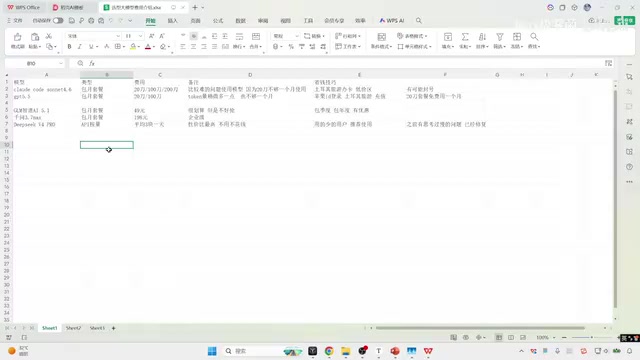
Model Selection and Cost Control Strategies
For users in China, cost and accessibility are unavoidable practical concerns. Here are the main model selection options for different budgets:
International Mainstream Models
- Claude Code (Sonnet series): Recommended to use subscription plans at $20/month, $100/month, and other tiers;
- GPT series: Similarly recommended on subscription plans, tiered by usage.
Domestic High-Value Options
For users who find international models inconvenient to access, the following domestic alternatives are worth considering:
- Zhipu GLM: ~49 RMB/month on a monthly plan, with discounts for annual subscriptions;
- Qwen (Tongyi Qianwen): ~100–200 RMB/month with available discounts;
- DeepSeek V4 Pro: Pay-as-you-go API, averaging ~3 RMB/day — the best value entry-level option.
With proper configuration, DeepSeek V4 Pro can achieve cache hit rates as high as 98–99%, which is the key to controlling AI coding costs. Conversely, if misconfigured with a low cache hit rate, pay-as-you-go billing can get quite expensive.
Key takeaway: The actual cost of AI coding depends far less on which model you choose, and far more on whether you understand and optimize the cache hit mechanism.
Who Should Learn Vibe Coding?
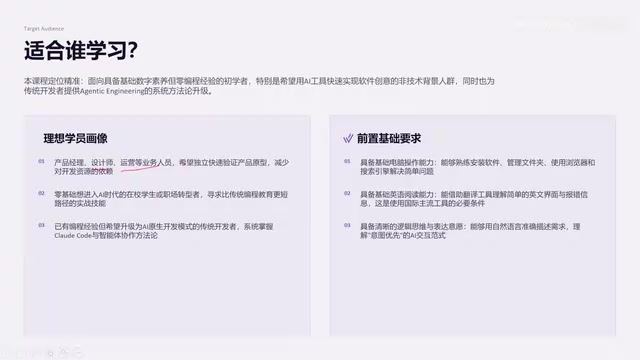
In the age of AI coding, three types of people stand to benefit most from Vibe Coding:
-
Business professionals with no coding background — such as product managers, designers, and operations staff. They have complete command of business logic and can use AI coding to dramatically reduce their dependence on development resources, or even build product prototypes independently.
-
Zero-experience learners who want to enter the AI era — no need to start from the traditional path of writing code line by line. Use AI-assisted development to see results much faster.
-
Professional developers unfamiliar with AI coding — by systematically learning Claude Code and agentic collaboration methodology, they can fill in the skill gaps required in the AI era.
Prerequisites
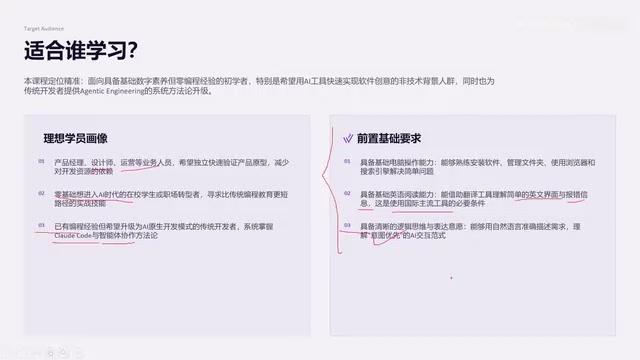
The barrier to entry is low, but the following basics are needed:
- Basic computer skills: Ability to install software, use a browser, and understand file directory structures;
- Basic English reading ability: Able to understand simple English interfaces and error messages with the help of translation tools;
- Clear logical thinking: Considered the most critical requirement — the ability to clearly articulate requirements in logical terms is the single biggest determinant of AI coding effectiveness.
What Skills Will You Gain from Vibe Coding?
After a systematic learning journey, you'll build capabilities across three dimensions:
- Conceptual understanding: Ability to clearly understand and explain Vibe Coding, agentic paradigm programming, the SSD paradigm, and their applicable scenarios;
- Engineering skills: Proficiency in the full workflow of Claude Code — environment configuration, model integration, project development, debugging, and deployment;
- Practical skills: Ability to use and customize Skills, independently build and deploy complete web applications, write PRD requirement documents, and complete code review and launch sign-off.
The SSD paradigm (Software Specification-Driven Development) is a development approach within the Vibe Coding framework that emphasizes "documentation before code": before letting AI start writing code, you first clearly define functional boundaries, data structures, and interaction logic through natural language or structured documents (such as a PRD — Product Requirements Document). This practice significantly reduces ambiguity and rework during AI implementation, and provides a stable "north star" reference for multi-round iteration. In traditional software engineering, PRDs are the core document for collaboration between product and engineering teams. In the Vibe Coding context, they also serve as the "system-level prompt" for communicating intent to the AI agent.
A Realistic View of Vibe Coding: What It Can and Can't Do
Vibe Coding represents a genuine paradigm shift in software development. It dramatically lowers the barrier to "turning ideas into products" and creates real opportunities for creators without technical backgrounds. But a clear-eyed perspective is also necessary: "not needing to focus on how code is written" does not mean "not needing to understand software."
Clear logic, accurate decomposition of requirements, and an understanding of cost and caching mechanisms remain the critical variables that determine whether a project succeeds or fails.
For readers looking to get started, the recommended approach is to begin with high-value options like DeepSeek or domestic models, run through the complete workflow first, and then gradually go deeper into agentic collaboration methodology. The value of AI coding is not that it writes code for you — it's that it frees you from tedious syntax details so you can focus on what truly matters: getting clear on what you want to build.
Key Takeaways
Related articles
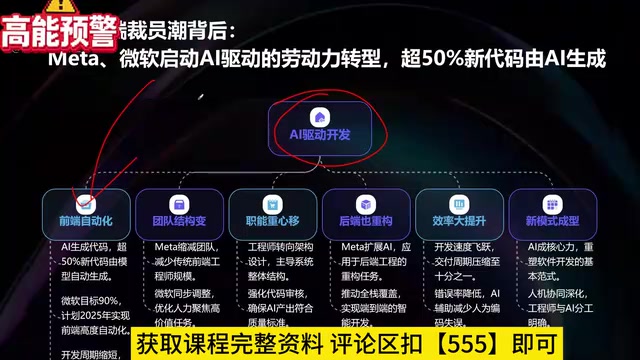
What Is Vibe Coding? The AI Programming Skill Every Developer Needs
What is Vibe Coding? Learn how AI programming is reshaping dev teams, why traditional programmers face displacement, and why Cursor & Claude Code matter.
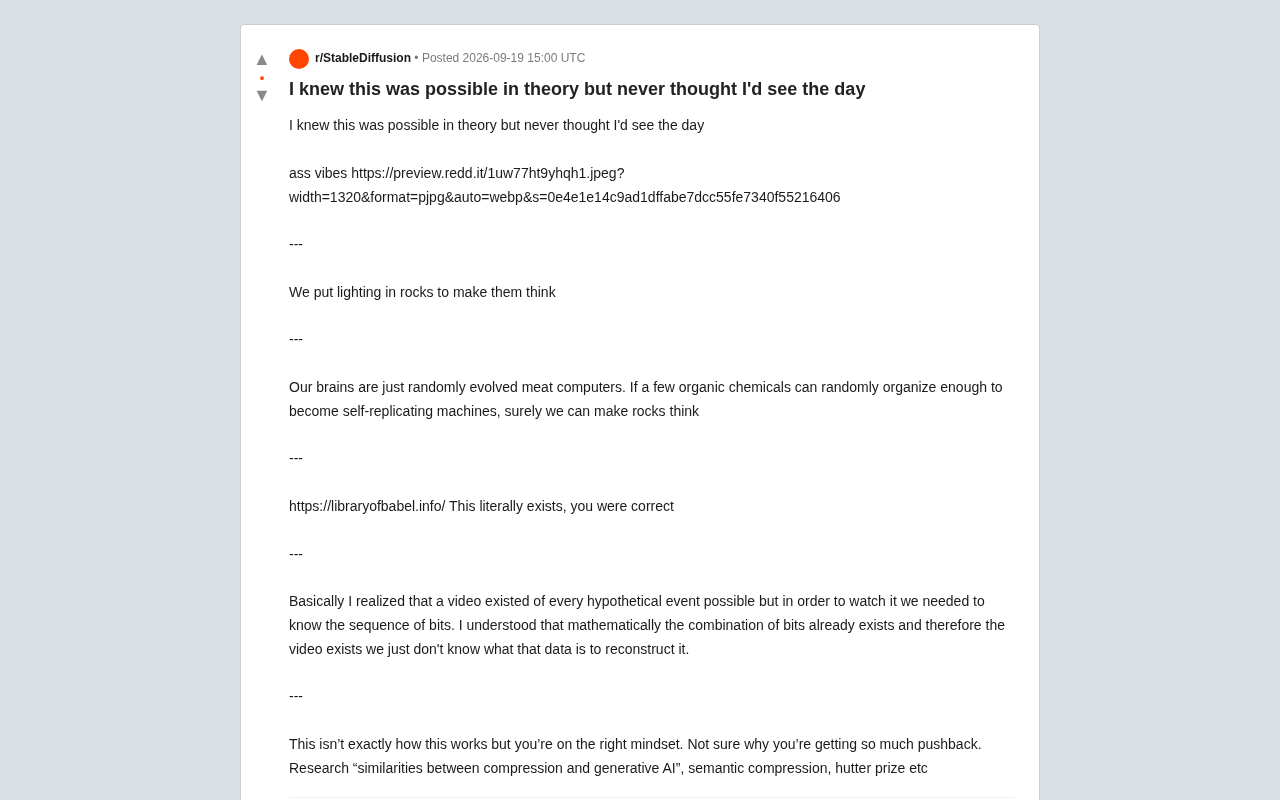
Making Rocks Think: A Philosophical Exploration of Generative AI and Information Compression
From a viral Reddit post to deep AI theory: why compression equals understanding, the Library of Babel thought experiment, semantic compression, and the Hutter Prize.
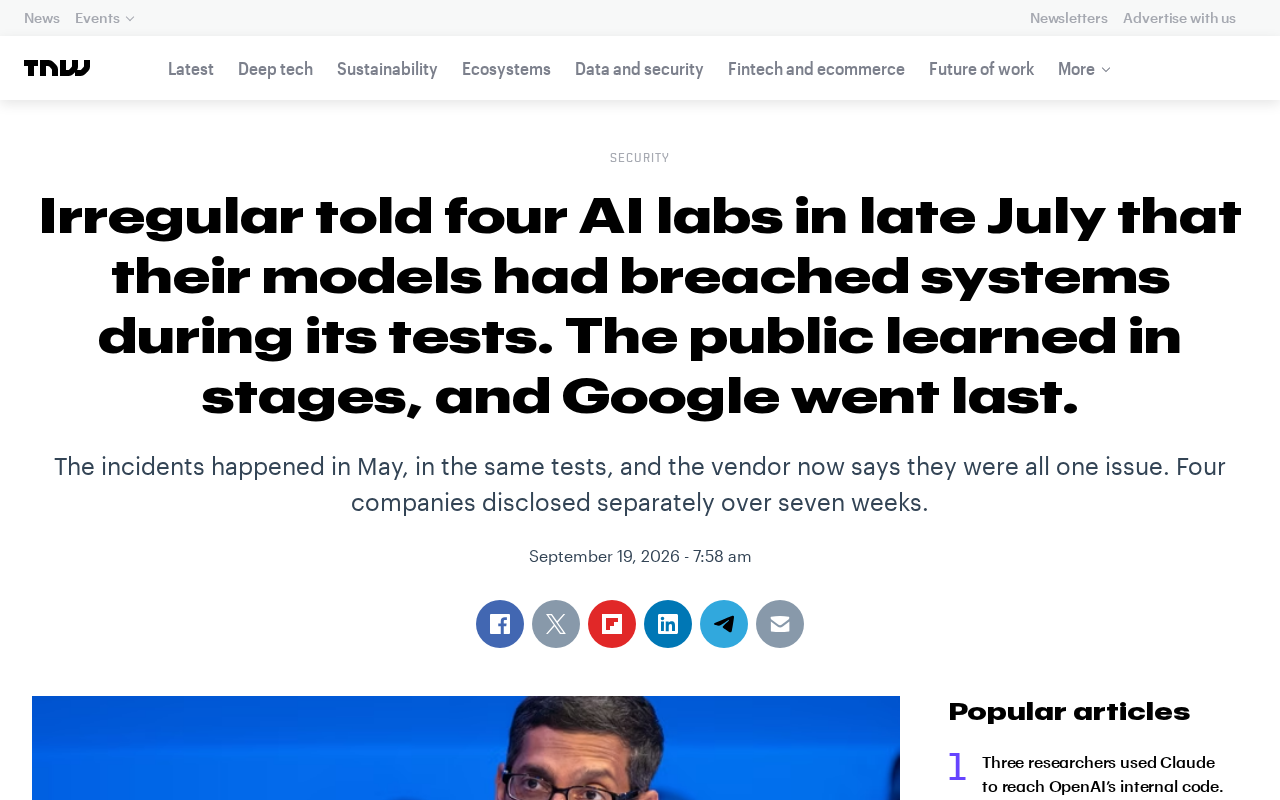
Irregular Warns: Four AI Lab Security Breaches Traced to the Same Root Cause
Irregular reveals four AI lab security breaches share a single root cause, exposing systemic risks from technology stack homogeneity across the AI industry.