Vibe Coding in Practice: The Possibilities and Limits of Full-Stack AI Development for a One-Person Company

A Bilibili course argues that AI + code + engineering — not just workflow tools — is the real path to enterprise-grade Vibe Coding.
This article reviews an enterprise-level AI development course centered on Vibe Coding. The course argues that AI has graduated from a support tool to a core productive force, and corrects a common misconception: platforms like Coze and Dify are glue layers, not true AI engineering. The real value lies in combining AI, code, agents, and engineering discipline across the full product lifecycle — from UI design and frontend/backend development to cross-platform deployment and AI-driven marketing. The article concludes with a grounded caveat: the gap between a demo and a production-grade product remains large, and solo developers still face real complexity limits.
From Tools to Productivity: AI Is Reshaping Software Development
A Bilibili creator known as 分镜影院 has launched an enterprise-level Vibe Coding course built around a bold thesis: AI is no longer just an assistive tool — it's becoming an entirely new form of productive power. Building a product used to require a full team — product managers, designers, frontend and backend developers, QA engineers, and marketing staff. AI is now compressing that entire pipeline dramatically.
The course author argues that most people aren't short on ideas — they're short on the ability to execute them. The technical barriers of design, frontend/backend development, databases, and server management have kept countless creative concepts from ever seeing the light of day. This is exactly where AI delivers value: gradually erasing those technical thresholds. The old model was humans adapting to code; the new model is AI understanding human intent. This shift is giving rise to a rapidly emerging development paradigm — Vibe Coding.
What Is Vibe Coding
The course offers a straightforward definition: instead of people writing code, people direct AI to write code. You simply tell the AI what page you want to build, what it should look like, and how it should behave. The AI then generates the interface, writes the code, connects to the database, runs automated tests, fixes bugs, produces documentation, and can even output marketing copy and short-form video scripts.

This logic sounds like a utopia where anyone can build software. The course author embraces that vision — while also calling out a critical misconception.
The term "Vibe Coding" was coined by AI researcher Andrej Karpathy in early 2025 on social media. He used it to describe an extreme development style where developers rely entirely on large language models to generate code, barely reading or reviewing the output themselves — in his words, "fully giving in to the vibes, forgetting that the code even exists." The term quickly went viral in developer communities and was broadly adopted to describe any natural-language-driven AI programming workflow. It's worth noting that Karpathy himself flagged significant risks with this approach in contexts requiring precision and reliability: developers lack a deep understanding of what the AI-generated code actually does, and the difficulty of debugging and maintenance scales exponentially with project size.
Don't Confuse Workflow Orchestration with AI Development
One of the most noteworthy points in the course is its pushback against a widespread misconception. The author argues that many people's understanding of AI development is still stuck at tools like Coze, Dify, and n8n — believing that connecting a few nodes and running some flows means they've mastered AI development. In his view, that's just scratching the surface.
The real direction — the one capable of industrial-grade deployment, building complex systems, and creating the AI products of the future — is a complete stack of AI + code + agents + engineering. What will truly matter going forward isn't simple chatbots, but AI-native applications: AI-powered e-commerce, automated digital avatar systems, AI enterprise platforms. All of these ultimately come back to engineering capability.
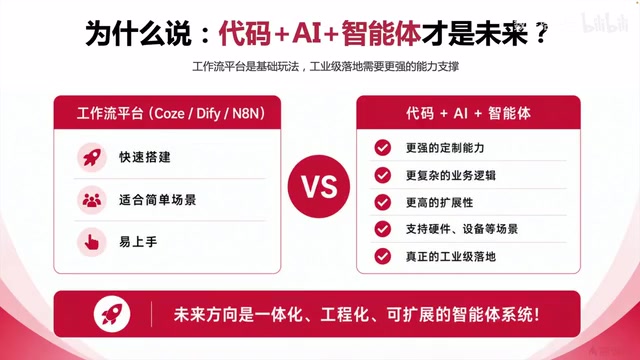
This assessment has real-world grounding. Low-code workflow tools have lowered the bar for rapid prototyping, but in scenarios demanding stability, maintainability, and complex business logic, genuine software engineering skills remain unavoidable. If Vibe Coding is going to scale to enterprise level, engineering discipline is a non-negotiable prerequisite.
Coze, Dify, and n8n are leading "no-code/low-code" AI workflow orchestration platforms. Their core approach is to wrap large language models, external APIs, and data processing into visual nodes that users connect through drag-and-drop interfaces to build automated pipelines — for example: "user input → call GPT → write to database → send notification." These tools have dramatically lowered the barrier to entry for AI applications and work well for rapid prototyping or standardized repetitive tasks.
Their limitations, however, are equally real: complex conditional branching, state management, concurrency control, and error recovery are difficult to express elegantly through node-based orchestration. Platform performance ceilings and limited private deployment options also constrain enterprise-grade use cases. This is the practical reason the article points to — workflow orchestration functions more like a glue layer than a load-bearing wall.
Full-Stack Closure: Building Products, Not Demos
The course's defining feature is what it calls "full-stack closure." A real product isn't just hand-written code — it's the entire chain: requirements analysis, UI design, frontend development, backend logic, database setup, testing, deployment, and go-to-market operations, all strung together.
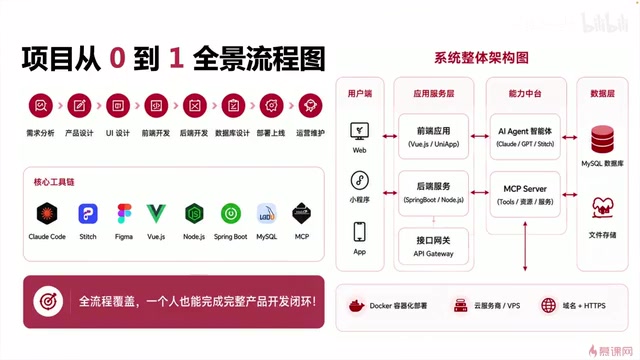
The course also maps out an architectural vision for AI-driven development, emphasizing that future software won't be built through isolated capabilities but through AI collaborative development — where tools like Claude Code, Stitch, MCP, Skills, and Figma work in concert, with AI genuinely participating in design, development, testing, optimization, and operations at every stage. This is why the course covers three major AI coding tools: Claude Code, Codex, and Cursor.
Cross-platform development is another focal point. Building separate codebases for Web, App, and mini-programs has always been painful. The course uses UniApp combined with AI code generation and component reuse to pursue a "build once, run everywhere" approach — further reducing the technical burden on a one-person operation.
Claude Code, Codex, and Cursor represent three distinct categories of AI-assisted programming tools, each with a different focus. Cursor is a deeply customized fork of VS Code that supports multi-file context understanding and conversational code editing — well-suited for real-time collaboration during day-to-day development. Codex is OpenAI's code generation model (and one of the foundations of GitHub Copilot), excelling at translating natural language descriptions into function-level code snippets. Claude Code is Anthropic's terminal-based AI coding agent, capable of autonomously reading and writing files, executing commands, debugging, and iterating — closer to the "agent that independently completes a task" paradigm. MCP (Model Context Protocol) is an open protocol proposed by Anthropic to standardize interactions between AI models and external tools and data sources, enabling different tools to be called uniformly by AI agents — essentially the infrastructure layer for multi-tool coordination.
AI Moves into Marketing and Operations
Many people assume the hard work ends when the product ships. In reality, distribution is often the harder challenge. The course argues that AI has now entered the operations domain: automatically generating public account articles, promotional copy, video scripts, and even product demo videos — enabling products to essentially "market themselves."
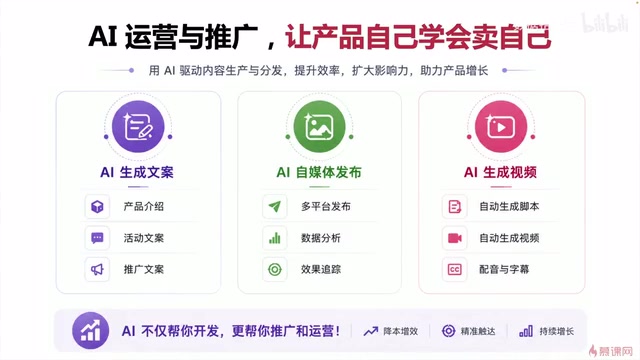
Based on this, the author sketches a talent profile for the future: the people who will truly stand out are those with both development skills and AI operations skills. Upon completing the course, learners should be equipped for independent product development, AI full-stack collaboration, AI engineering, cross-platform development, and AI-driven automated marketing — all in service of the ultimate goal: building products as a team of one.
A Rational Take: Opportunities and the Judgment Worth Keeping
The course's ambition is clear — it's not a simple tool tutorial but more of a "one-person company playbook for the AI era," with the explicit goal of helping learners build products and generate income using AI. The author believes a wave of AI companies, AI entrepreneurs, and super-individuals is coming, and the opportunity belongs to those who prepare early.
As a piece of course marketing, the directional judgments here carry real reference value: the combination of engineering rigor, full-stack coverage, cross-platform development, and AI-driven operations genuinely reflects important trends in AI application development today. But a measure of rationality is warranted. There is a vast engineering gap between a demo and a truly stable enterprise-grade product. The complexity ceiling for what a "one-person company" can realistically cover remains real. AI dramatically lowering the barrier is a fact; "anyone can ship enterprise-grade products" is an optimistic expectation that still needs to be tested in practice. For learners, treating this course as a starting point for developing an AI engineering mindset is far more pragmatic than treating it as a shortcut to overnight success.
Related articles

JobRunner MCP Server: AI Agents Can Now Fix Failed Java Jobs
JobRunner launches an open-source MCP server enabling AI agents to view cluster status, diagnose failures, and recover Java jobs—incident response from any cloud coding environment or existing agent.

MLAI Digital Launches 9 Security Agents: MCP Server Safeguards the Full Lifecycle of Agentic AI
MLAI Digital launches Security MCP Server with nine built-in specialized security agents covering vulnerability discovery, attack simulation, prompt injection detection, API and infrastructure assessment, and accelerated remediation—embedding security validation across the full Agentic AI lifecycle from development to production.

Running Isaac Lab on H100 GPUs: Exploring Better Approaches
Exploring optimization methods for running Isaac Lab on NVIDIA H100 GPUs, including MIG configuration, mixed precision, TensorRT acceleration, and community experience to improve robotics simulation and reinforcement learning efficiency.