Vibe Coding Is Disrupting the Music Hardware World

AI-assisted development tool vibe coding is fueling explosive growth in custom firmware for music hardware.
The article observes a surge in custom firmware development for hardware devices in the synth community, almost entirely thanks to mature AI-assisted tools like vibe coding. These tools let non-professional programmers describe requirements in natural language and generate code, greatly lowering the embedded development barrier and expanding firmware modding from a few geeks to ordinary music enthusiasts. r/synthesizers and YouTube creators are the main channels, and the community bypasses manufacturers' ambiguity through reverse engineering and AI-generated code. But AI-generated firmware poses stability and safety risks in real-time audio, with bricked-device cases already reported.
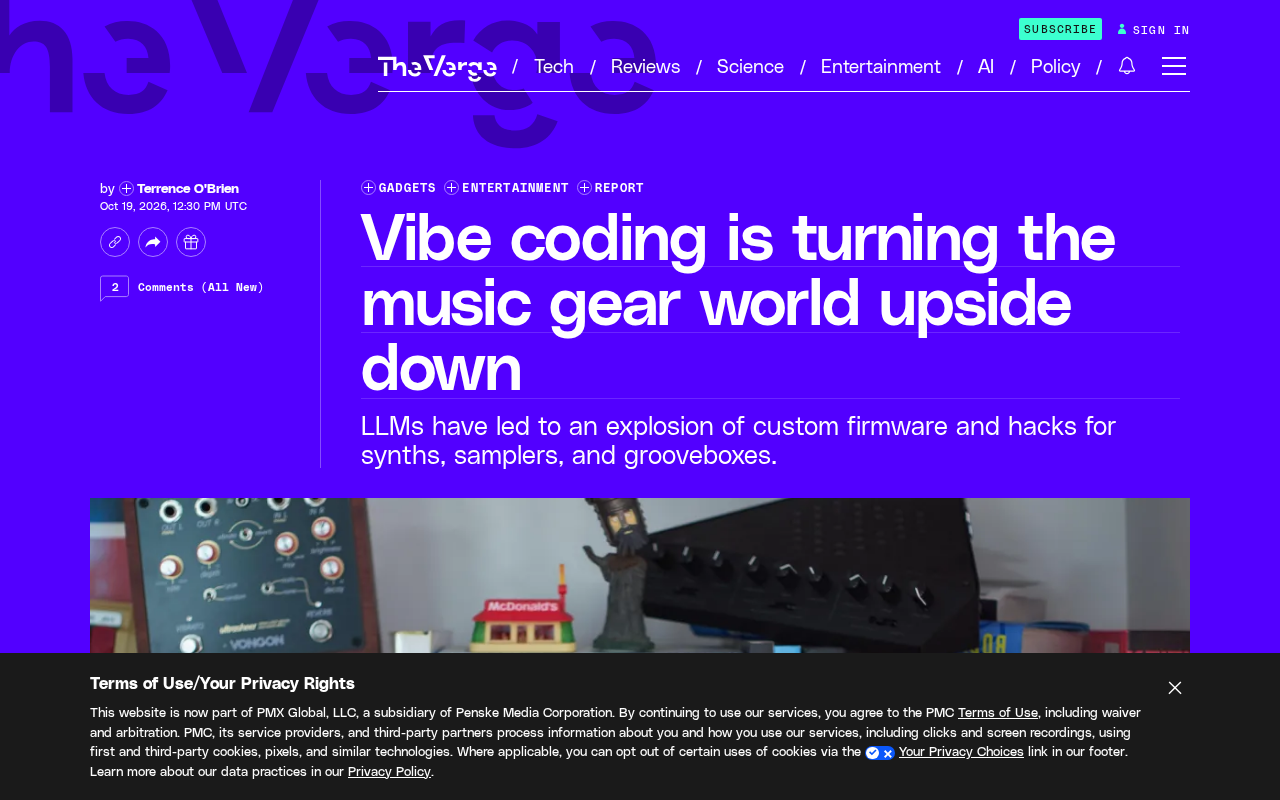
In the synth community and the hardware music gear scene, a new development wave is quietly emerging: more and more musicians and developers are writing custom firmware for hardware synthesizers, samplers, and grooveboxes. According to observations from the r/synthesizers community and synth content creators on YouTube, this surge is almost entirely thanks to increasingly mature vibe coding tools—AI-assisted development environments that let non-professional programmers generate code by describing what they want in natural language.
From "Don't Even Think About It" to "Just Write It": The Democratization of Firmware Development
In the past, writing custom firmware for hardware devices was an extremely high-barrier endeavor. Developers needed a deep understanding of the target device's chip architecture, real-time operating system, audio DSP pipeline, and low-level hardware abstraction layer. Even experienced embedded engineers, faced with a closed synthesizer, often needed weeks or even months just to get a simple feature running. This high barrier kept hardware community firmware modding confined to a tiny handful of geeks for a long time, while ordinary users could only wait for official updates from manufacturers.
Vibe coding changed all of that. The core capability of these tools is this: users describe requirements in natural language, AI generates a usable code framework, and users then iterate and debug through repeated conversation. For music hardware enthusiasts, this means they can directly say "I want this sampler's envelope curve to be exponential, and add an adjustable feedback parameter," without having to grind through chip manuals from scratch.
Real-Time Operating System (RTOS) and audio DSP pipeline: In hardware synthesizers, firmware typically runs on top of a real-time operating system, such as FreeRTOS or a manufacturer's in-house scheduling kernel. Unlike general-purpose operating systems, an RTOS requires tasks to complete within strict timing constraints—the audio processing thread must fill the buffer every few milliseconds, or you get clicks or dropouts. The audio DSP pipeline is a series of signal processing modules executed in a fixed order, such as oscillators, filters, envelope generators, and effects, where the latency and computational cost of each module must be precisely controlled. Understanding these underlying mechanisms is the key prerequisite for judging whether AI-generated code can run stably on real devices.
A Community-Driven Firmware Ecosystem Is Taking Shape
The cases emerging on r/synthesizers reveal a clear pattern: users are no longer satisfied with the fixed features manufacturers provide—they want to mod devices to match their own playing habits and tonal aesthetics. Some have added modern sequencer features to old grooveboxes, some have ported new filter algorithms to samplers, and others have simply turned a long-discontinued synthesizer into a modern device with MIDI 2.0 support.
The reason these projects can appear in large numbers in such a short time owes much to vibe coding tools. They shorten the path from "idea" to "runnable prototype" by orders of magnitude. Synth content creators on YouTube have also begun frequently showcasing this kind of modding process, further driving community spread.
MIDI 2.0: MIDI 2.0 is the next-generation music device communication protocol officially released in 2020. Compared with MIDI 1.0, which has been in use for decades, it offers higher resolution (e.g., 16-bit velocity instead of 7-bit), bidirectional capability negotiation, and richer expressiveness. For old synthesizers, supporting MIDI 2.0 means rewriting the device's communication firmware layer, involving protocol parsing, buffer management, and backward-compatibility design. This is exactly a typical scenario for community firmware projects: manufacturers no longer provide updates for discontinued devices, and enthusiasts use AI-assisted tools to complete the porting of the protocol stack.
Manufacturer Silence and the Open-Source Community's Response
A tension worth noting is this: hardware manufacturers are generally ambiguous about custom firmware. An open firmware ecosystem could boost device sales, but it also means manufacturers must bear additional technical support pressure and even face the risk of stability issues after devices are "modded." At present, most manufacturers choose not to take a public stance, and the community has bypassed this obstacle in its own way—through reverse engineering and vibe coding-assisted code generation, gradually building a firmware development workflow independent of official support.
Concerns: Uneven Quality and Security Boundaries
Behind this boom there are also problems that cannot be ignored. Code generated by vibe coding is not necessarily reliable enough in embedded real-time audio environments—memory allocation in audio threads, interrupt latency, and floating-point precision can all become hidden hazards. Cases of devices being bricked due to unstable firmware have already appeared in the community. In addition, non-professional developers' insufficient awareness of hardware safety boundaries may also lead to issues such as device overheating or abnormal battery management.
Still, the trend is irreversible. The music hardware world is undergoing a democratization movement driven by AI-assisted development tools, and vibe coding is the catalyst for this movement. For manufacturers, rather than avoiding it, it is better to think about how to form a healthier collaborative relationship with the community; for users, while enjoying the fun of freely modding, they also need to maintain clear judgment about firmware quality.
Common hidden hazards in embedded real-time audio: In embedded audio environments, three types of problems are most likely to cause firmware instability. The first is dynamic memory allocation in audio threads—malloc/free can cause unpredictable latency jitter, and real-time audio programming usually requires pre-allocated memory pools. The second is interrupt latency—if the audio DMA interrupt is blocked by other high-priority tasks, it will directly cause buffer underruns. The third is floating-point precision and performance—some low-end MCUs lack a hardware floating-point unit, and relying on software floating point significantly increases CPU load. AI-generated code often ignores these constraints, so developers need basic real-time systems knowledge to review and correct it.
One-line Summary
AI-assisted development tool vibe coding is driving explosive growth in custom firmware for music hardware.
Paragraph Summary
The article observes that the synth community is seeing a surge of custom firmware development for hardware devices, almost entirely thanks to the maturity of AI-assisted development tools such as vibe coding. These tools let non-professional programmers describe requirements in natural language and generate code, greatly lowering the barrier to embedded development and expanding firmware modding from a tiny number of geeks to ordinary music enthusiasts. r/synthesizers and YouTube creators have become the main channels for spread, and the community, through reverse engineering and AI-generated code, has bypassed manufacturers' ambiguous attitudes and built a development workflow independent of official support. But the article also points out that AI-generated firmware poses stability and safety risks in real-time audio environments, with cases of bricked devices already occurring, and calls for manufacturers and the community to explore a healthier collaborative relationship.
Related articles
DeepSeek's Open-Source Inference Framework Leads This Week's Five Major Tech Highlights
Tech weekly: DeepSeek open-sources production inference framework DeepInfo, DuckDB 2.0 moves to the server side, Rust-based TypeScript compiler TSRS is 8x faster, Android apps run directly on Mac, and open-source publishing tool DesignCraft and TV launcher Ariel debut.
Three Releases in 18 Hours: Strata Runs DeepSeek V4.1 Flash on a 12GB GPU
Strata shipped three releases in 18 hours (0.2.3, 0.2.3.1, 0.2.4), using RAM as VRAM, skipping redundant compute, and speculative decoding to run DeepSeek V4.1 Flash on a 12GB GPU plus 46GB RAM.
DeepSeek Open-Sources Inference Engine: 80% Gross Margin Crushes Silicon Valley, but Copycats Find the Assembly Line Missing
DeepSeek open-sources its inference engine DeepInfer and Rust gateway DeepSeek Recipe, revealing 155T tokens/day at 80% gross margin. A breakdown of causal encoder-decoder architecture, wide expert parallelism, EPLB, dSpark, bounded replay, and Ascend 950 support—plus the three closed-source barriers that remain.