DeepSeek's Open-Source Inference Framework Leads This Week's Five Major Tech Highlights
DeepSeek open-sources its inference framework, DuckDB 2.0 goes server-side, and a Rust-based TS compiler speeds up—infrastructure is being reshaped for AI.
This week's tech developments center on "infrastructure being reshaped for AI and real-time analytics." DeepSeek open-sourced the production-grade inference framework DeepInfo with self-developed operators like Flash MLA and DeepEP, supporting NVIDIA SM100 and Huawei Ascend 950, plus a cost-benefit analysis. DuckDB 2.0 LTS adds the Quark protocol and Connect statement, moving from an embedded library to client-server architecture and overlapping with ClickHouse. TSRS ports the TypeScript compiler to Rust, up to 8x faster with ~70% less memory, and can run in wasm sandboxes for Agent development. Additionally, Mac APK runs Android apps on Apple-silicon Macs via a compatibility layer, while DesignCraft and Ariel challenge Adobe's monopoly and domestic TV ads.
The tech world has been busy this week, from DeepSeek open-sourcing a production-grade inference framework to DuckDB entering the server era, and the debut of a Rust-based TypeScript compiler. Each item points to the same trend: infrastructure is being reshaped for AI and real-time analytics. Here are five technical developments worth noting this week.
DeepSeek Open-Sources Production Inference Framework: Making LLM Serving Costs Transparent
According to the tech weekly from Bilibili creator Koala, DeepSeekAd this week open-sourced DeepInfo, the inference framework used in its own online services, currently supporting the V4.1 Flash model. The framework integrates self-developed operator libraries such as Flash MLA, DeepJam, and DeepEP, supports attention data parallelism, MVE expert parallelism, and load-balanced draft-token accelerated decoding, and offers batch-invariant inference and deterministic sampling. At the hardware level it supports both NVIDIA SM100 and Huawei Ascend 950, and is open-sourced under the Apache 2.0 license.
This is one of the most talked-about news items this week. Previously, DeepSeek's open-source operators were rather scattered; this time it provides a complete inference engine that ties them together, and supports domestic NPUs on day one. The official announcement also explicitly states that advanced features such as the KVCash system, Green Field Onion and decode-disaggregated multi-replica, and load balancing are not included. But more noteworthy is that the team subsequently published an economic cost-benefit analysis of model serving, giving the outside world a more intuitive reference for model pricing.
Flash MLA, DeepEP, and MoE Parallelism
Flash MLA is a compute kernel optimized for multi-head latent attention (MLA). MLA significantly reduces the memory footprint of long-context inference through low-rank compression of the KV cache, and Flash MLA builds on this with operator-level fusion and tiled scheduling. DeepEP is a communication library for expert parallelism (EP) that addresses the all-to-all communication overhead when distributing tokens to the corresponding experts across multiple GPUs/NPUs in MoE models, typically used together with grouped GEMM. The difficulty of MoE inference lies in uneven expert load: popular experts become bottlenecks while cold experts sit idle, so load-balancing strategies and draft-token-style dynamic scheduling are needed to improve utilization. Batch-invariant inference means that computation results do not change with batch size, which is critical for deterministic sampling and reproducible evaluation.
DuckDB 2.0: An Embedded Analytics Library Moves to the Server Side
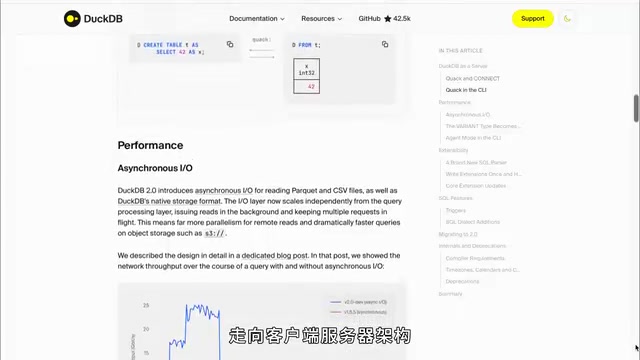
DuckDB has released version 2.0 as a long-term support release, with support lasting at least until October 2027. The biggest change is that it can now be used as a server: a built-in Quark protocol plus a new Connect statement allows it to connect to remote DuckDB instances as well as directly to Postgres SQL and MySQL, pushing queries down for execution. It also brings asynchronous reading of Pocket and CSV, a truly usable Variant semi-structured type, and triggers.
Koala believes that DuckDB 1.0 was about stability, while 2.0 is about features—moving from a single-machine analytics library to a client-server architecture and beginning to directly overlap with service-oriented analytical databases like ClickHouse. There is also a subtle implementation detail: the command line can detect when it is being invoked by an Agent and automatically switches to concise output; in tests this let the model read nearly 60% less content.
The Quark Protocol and the Variant Type
Quark is the client-server communication protocol introduced in DuckDB 2.0, functioning similarly to Postgres's wire protocol: clients use it to connect to a remote DuckDB instance and execute queries, extending DuckDB from an "in-process embedded library" to a server that can be shared by multiple clients. The new Connect statement mounts external databases as catalogs, pushing down predicates and aggregations as much as possible during queries to reduce data movement. Variant is a semi-structured type used to store JSON-like data with a variable schema; previously this was mostly handled with the JSON extension, while Variant provides truly typed storage and more efficient path queries. Together, these two capabilities give DuckDB a foundation to compete head-on with ClickHouse and others in lightweight analytics service scenarios.
Rust-Based TypeScript Compiler: Performance and Agent Scenarios
Engineers from CloneFlare and VoidZero have introduced TSRS, a port of the TypeScript compiler to Rust, incubated under the OXC toolchain. With the same number of type-checking threads, it is up to 8 times faster than TypeScript 7.0 and uses about 70% less memory, with some optimizations already contributed upstream. The team emphasizes that it does not fork the language design; decisions remain with the official TypeScript team.
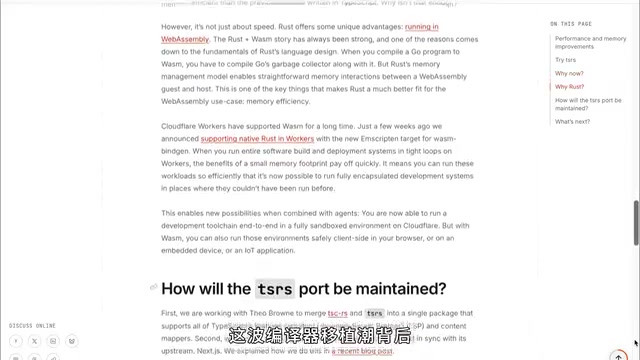
Why Rust when the official team just finished rewriting in Go? The key is WebAssembly: compiling Go to wasm requires bundling garbage collection, which hurts both size and performance; the Rust version, by contrast, can run the full toolchain in a browser or Workers sandbox, perfectly matching the scenario of online Agent development. Behind this wave of compiler ports is AI drastically lowering the cost of large-scale porting, but the real challenge is following upstream behavior over the long term and maintaining portability.
WebAssembly and Agent Sandboxes
WebAssembly (wasm) is a portable binary instruction format that executes at near-native speed in browsers, edge Workers, and sandboxes. When Go is compiled to wasm, it must include a runtime and garbage collector, resulting in large artifacts, slow startup, and limited control over memory; Rust has no mandatory GC and can produce smaller, more controllable wasm modules, making it suitable for running a full toolchain in a restricted sandbox. For Agents, this means development tools such as type checking, formatting, and refactoring can be safely executed on demand in a browser or server-side sandbox without users installing a Node environment locally. OXC is a JavaScript/TypeScript toolchain project written in Rust, and TSRS being incubated under it is precisely to reuse the existing parser and infrastructure.
Running Android Apps on Mac and an Open-Source Desktop Publishing Tool
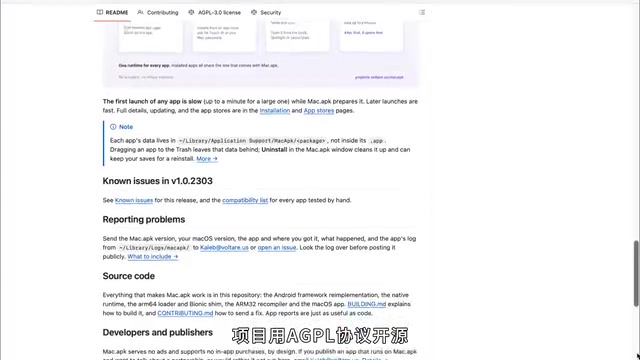
Mac APK lets Android apps run directly on Apple-silicon Macs—not an emulator or a virtual machine, and with no Linux kernel underneath; instead, it implements an Android app environment directly on top of macOS. Apps run as ordinary macOS processes, draw with the Mac's GPU, and appear in the Dock. It is currently in Alpha; the author tested 71 apps, of which 58 were fully usable. Koala sees the approach as similar to Wine on Linux—reimplementing system interfaces instead of emulating an entire machine—yielding better performance but requiring compatibility work app by app. The fact that Apple silicon is essentially ARM architecture makes this path much easier than on x86. The project is open-sourced under the AGPL license and also offers commercial licensing.
DesignCraft is an open-source desktop publishing application from ArtCraft, written in pure Rust and targeting InDesign. It has professional features such as linked text frames, paragraph styles, and text wrap on its homepage, uses the same Conduce Plus line-breaking algorithm as TeX, supports CMYK spot colors, bleed, and PDF/A print output, offers installers for all platforms, and has a self-hostable web version. Most notably, every menu and panel can be operated by an Agent through an MCP server. Koala notes that professional publishing has long been monopolized by Adobe, and the open-source Scribus has never felt modern enough; DesignCraft is free, with no subscription and no telemetry, and its native Agent-oriented approach is quite new—though it is still in development.
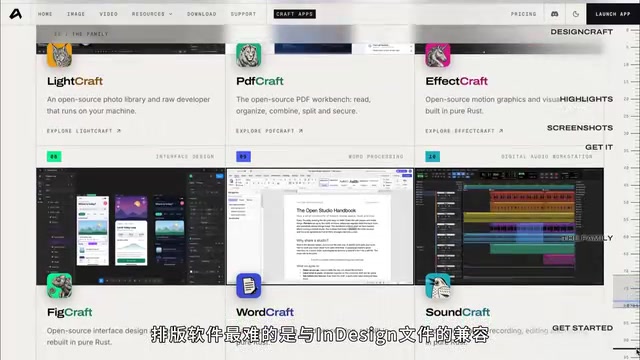
The hardest part for publishing software is compatibility with InDesign files and adapting to print-shop workflows; whether it will be accepted by professional designers remains to be seen.
Compatibility Layers and MCP
Mac APK takes an approach similar to Wine: instead of virtualizing an entire machine, it reimplements the target platform's system interfaces (here, Android's Binder, graphics, and media frameworks) on the host system, letting apps run as native processes and use the host GPU directly. This avoids kernel and instruction-translation overhead and delivers near-native performance, but every API must be implemented one by one, and compatibility can only be refined app by app. ARM architecture consistency is an important prerequisite for feasibility on Apple silicon. MCP (Model Context Protocol) is a protocol that lets AI Agents call external tools and data through a unified interface; DesignCraft exposes menus and panels as MCP services, meaning Agents can script publishing workflows—a rare architectural choice for traditional desktop software.
Open-Source Android TV Launcher: Bypassing Ads and Recommendation Feeds
Ariel is an open-source Android TV launcher designed with reference to Apple TV, aimed specifically at domestic TVs from Xiaomi, TCL, and others, with no ads and no recommendation feeds. It can surface apps hidden by the system, supports folders, hiding, and uninstalling/installing, and only requires enabling ADB debugging on the TV—no root, and fully reversible at any time. Koala notes that boot ads and wall-to-wall recommendations are long-standing pain points of domestic TVs; Ariel bypasses them by replacing the launcher, with a much lower barrier than flashing the firmware. Its limitation is that it relies on ADB authorization and system permissions, and a manufacturer system update could displace it at any time, requiring another setup.
Overall, this week's updates together sketch a main thread: AI is not only spawning new inference infrastructure but also lowering the cost of cross-language porting and system reimplementation, while open-source tools are moving from edge experiments into production environments.
One-line Summary
DeepSeek open-sources its inference framework, DuckDB 2.0 moves to the server side, and the Rust-based TS compiler speeds things up—infrastructure is being reshaped for AI.
Paragraph Summary
This week's technical developments revolve around "infrastructure being reshaped for AI and real-time analytics." DeepSeek open-sourced its production-grade inference framework DeepInfo, integrating self-developed operators such as Flash MLA and DeepEP, supporting NVIDIA SM100 and Huawei Ascend 950, and publishing a cost-benefit analysis of model serving. DuckDB 2.0 LTS includes the Quark protocol and Connect statement, shifting from an embedded analytics library to a client-server architecture and beginning to directly overlap with ClickHouse. TSRS ports the TypeScript compiler to Rust, with type checking up to 8x faster and about 70% less memory, with the key point being that it can run in a wasm sandbox, fitting online Agent development. In addition, Mac APK runs Android apps on Apple-silicon Macs via a compatibility layer, while the open-source publishing software DesignCraft and the Android TV launcher Ariel challenge Adobe's monopoly and the ad pain points of domestic TVs, respectively.
Related articles

AgentTrust: Adding Zero Trust and Human Approval to AI Agents
AgentTrust debuts on Hacker News, offering zero-trust security and human approval for AI agents. This article analyzes its action-level permission checks, human approval gates, and audit traceability, and discusses differences from existing AI observability tools and deployment limitations.
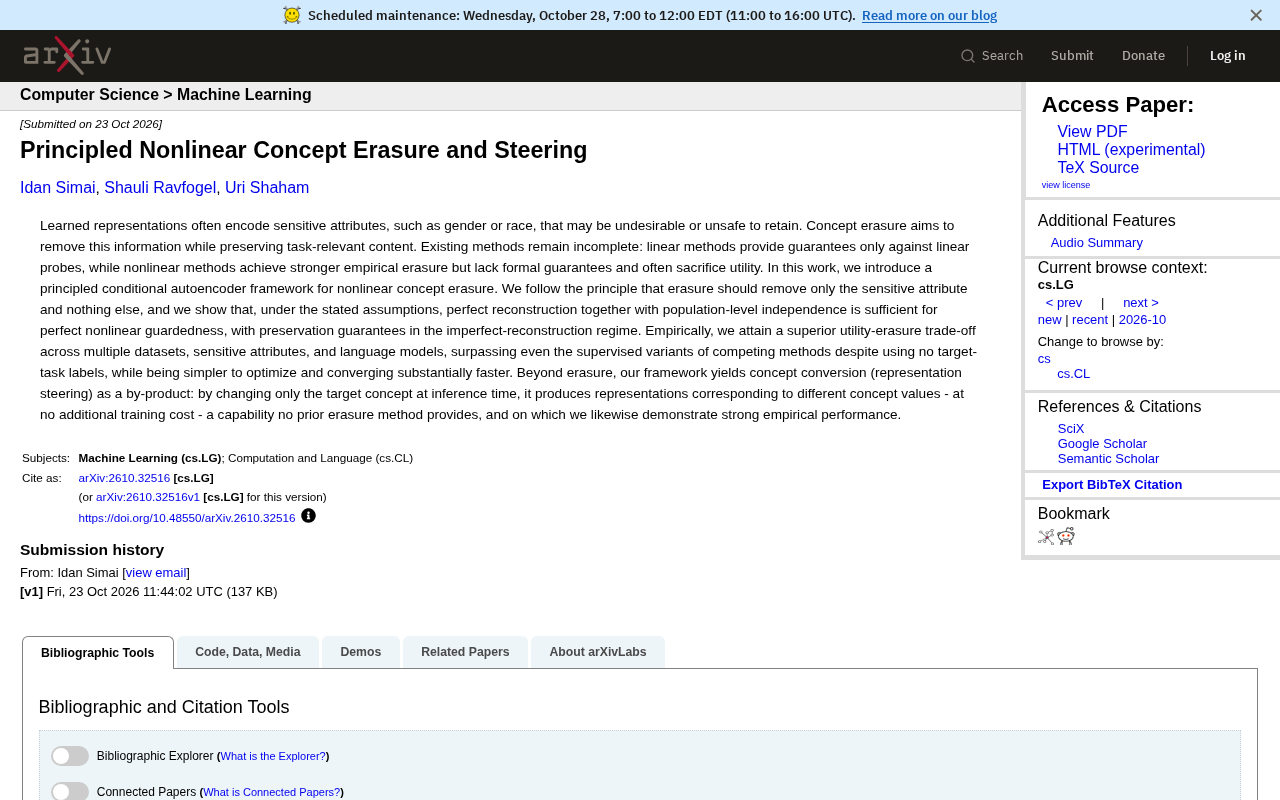
New Framework for Nonlinear Concept Erasure: Conditional Autoencoder Enables Precise Erasure and Steering
This paper proposes a conditional autoencoder framework that provides formal guarantees for nonlinear concept erasure, achieving a better utility-erasure trade-off without target-task labels and unlocking representation steering with faster convergence.
Serbia's Election Shake-Up: Vučić Concedes Defeat as Student Movement Makes History
Serbian President Vučić concedes defeat in the snap parliamentary election as a student-led opposition camp wins a historic victory. Analysis of the student movement's rise, the geopolitical impact, and Serbia's political future.