Vibe Coding Practical Guide: AI Development Makes the One-Person Company a Reality

Vibe Coding lets one person use AI to handle the entire product development lifecycle.
This guide explores Vibe Coding — a new AI-driven development paradigm where developers direct AI tools like Claude Code, Codex, and Cursor to build complete products. It covers the full chain from requirements analysis and UI design to deployment and automated marketing, showing how AI is collapsing traditional team barriers and enabling one-person companies to ship real products.
From Team Collaboration to a One-Person Army
In the past, developing a product typically required a full team: a product manager to sort out requirements, a designer to create interfaces, front-end and back-end engineers to write code, QA to ensure quality, and operations staff to handle promotion. Each step was a hurdle — and the reason many great ideas never made it to launch. Most people don't lack ideas; they lack the ability to turn ideas into products.
Today, AI is fundamentally reshaping this landscape. This zero-to-one Vibe Coding practical course is built on a core philosophy: by leveraging AI tools like Claude Code, Codex, and Cursor, a single person can cover the work that once required an entire team. Claude Code is Anthropic's command-line AI programming tool that understands project context directly in the terminal and handles code writing, refactoring, and debugging. OpenAI's Codex is a code generation system based on GPT models that converts natural language descriptions into code across multiple programming languages. Cursor is an AI-native code editor with integrated LLM capabilities, supporting code completion, cross-file editing, and conversational development. Together, these three represent the major paradigms of AI-assisted programming: command-line interaction, API integration, and IDE embedding. AI is systematically lowering the technical barriers across design, front-end, back-end, databases, DevOps, and even operations.
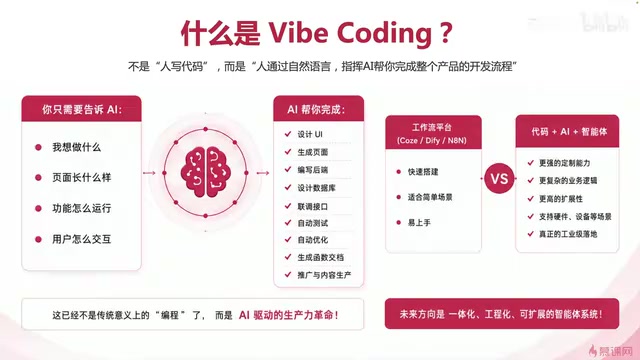
What Is Vibe Coding: A New Paradigm Where Humans Direct AI to Write Code
In one sentence: You no longer write code yourself — you direct AI to write it for you.
Vibe Coding is a rapidly emerging development methodology. The term was first coined by OpenAI co-founder Andrej Karpathy in early 2025, describing a completely new way of programming: developers fully immerse themselves in the "vibe," using natural language conversations with AI to build software — without even needing to read the AI-generated code. The concept quickly sparked heated discussion in the tech community because it represents a fundamental shift from "manual coding" to "intent-driven development."
Developers simply need to clearly tell the AI "what page I want, what it should look like, and how the features should work," and the AI handles the rest:
- Generating pages and writing code
- Connecting to databases
- Automated testing and bug fixing
- Generating technical documentation
- Even producing marketing copy and short video scripts
The essence of this approach is a fundamental shift in the development paradigm. In the past, it was "humans adapting to code" — developers had to learn the syntax and rules of programming languages. Now it's "code adapting to humans" — AI understands human natural language intent and translates it into runnable software. This is precisely why even complete beginners can enter the AI development era.
Breaking Free from the "Workflow Orchestration" Misconception
There's a widespread misconception today: many people's understanding of AI development is still stuck at workflow orchestration tools like Coze and n8n, believing that connecting a few nodes and running a few processes equals mastering AI development.
Let's clarify what these tools actually are: Coze is ByteDance's AI application development platform that allows users to build AI Bots and automated workflows through a visual interface. n8n is an open-source workflow automation tool similar to Zapier, where users can connect different APIs and services by dragging and dropping nodes. The core value of these tools lies in lowering the entry barrier for automation, but their limitations are obvious: when product logic becomes complex, when custom UI is needed, when handling high concurrency, or when implementing fine-grained data management, pure workflow orchestration often falls short, and you must return to code-level engineering.
But this is only the basics of AI development. The true direction capable of industrial-grade deployment, building complex systems, and creating future AI products is a complete system of "AI + Code + Agents + Engineering."
What will truly be valuable in the future isn't simple chatbots, but AI-native application forms — AI e-commerce, digital humans, automation systems, AI enterprise platforms, and more. An AI-Native Application is a product built with AI capabilities at its core from the very beginning of architecture design, rather than simply "bolting on" a layer of AI to a traditional product. For example, AI e-commerce isn't just adding a recommendation algorithm to the search bar — the entire shopping experience, from product discovery and personalized displays to intelligent customer service and dynamic pricing, is AI-driven. Digital human products integrate multiple AI technologies including LLMs, speech synthesis, and computer vision to create interactive virtual personas. All these systems ultimately require solid engineering capabilities. In other words, AI lowers the barrier, but it doesn't eliminate the need for systematic thinking and engineering skills.
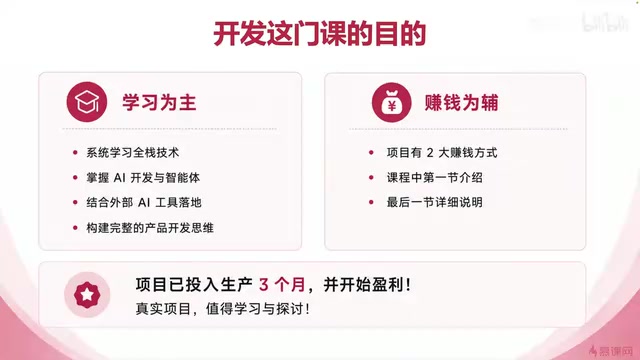
Full-Chain Closed Loop: The Complete Path from Idea to Product
The defining feature of this course is its emphasis on a full-chain closed loop, rather than stopping at building a simple demo. A real product requires connecting all of the following stages:
- Requirements Analysis — Defining the problem the product solves
- UI Design — Generating interfaces with tools like Figma
- Page Development — Front-end component generation and reuse
- Back-end Logic & Database — Data storage and business processing
- Testing — Automated testing and bug fixing
- Deployment — Shipping the product
- Marketing & Operations — Getting the product in front of users
This workflow comprehensively covers the entire journey from idea to launch to growth, helping learners build a systematic understanding of product development rather than just knowing how to use a few isolated tools.
The Architecture of AI Collaborative Development
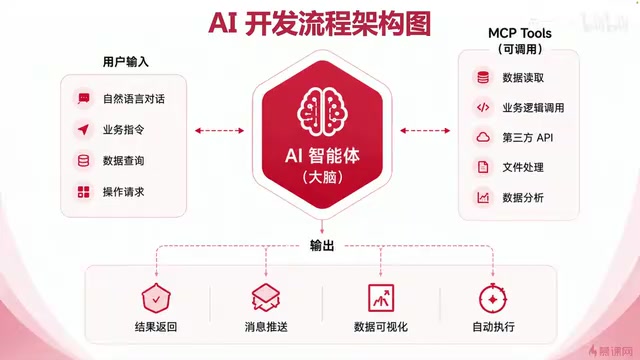
The future of software development no longer relies on individual capabilities but on AI collaborative development. Tools like Claude Code, Stitch, MCP, Skills, and Figma form a collaborative ecosystem.
A few key concepts need explanation here: MCP (Model Context Protocol) is an open standard protocol released by Anthropic in late 2024, designed to establish a unified communication interface between AI models and external tools and data sources. It's like the "USB port" of the AI world — enabling different AI tools and services to work together in a plug-and-play fashion. Stitch is an AI-driven design-to-code conversion tool that transforms design mockups directly into usable front-end components. Skills refer to reusable capability modules for AI Agents, giving AI professional expertise in specific tasks. The collaboration of these tools forms a complete AI development ecosystem.
AI is no longer just a passive chat assistant — it's a genuine participant in every stage: design, development, testing, optimization, and operations. This is the direction of AI engineering.
The Collapse of Multi-Platform Development Barriers
Building multi-platform products used to be extremely painful: one codebase for Web, another for App, and yet another for mini-programs. Traditional multi-platform development meant teams needed to master different tech stacks — Swift (iOS), Kotlin (Android), JavaScript (Web), WXML (WeChat mini-programs) — resulting in enormous personnel costs.
Now AI is dramatically lowering these barriers. UniApp is a cross-platform development framework by DCloud, based on Vue.js syntax, that allows developers to write one codebase and compile it to over ten platforms including iOS, Android, Web, WeChat mini-programs, and Alipay mini-programs. By combining UniApp with AI code generation and component reuse, you can achieve "write once, run everywhere." When AI code generation is paired with UniApp, developers don't even need to deeply understand platform differences — AI automatically handles compatibility issues. This is what truly makes the "one-person company" possible — a single person can maintain products across multiple platforms simultaneously.
AI-Powered Automated Operations: Let Your Product Promote Itself
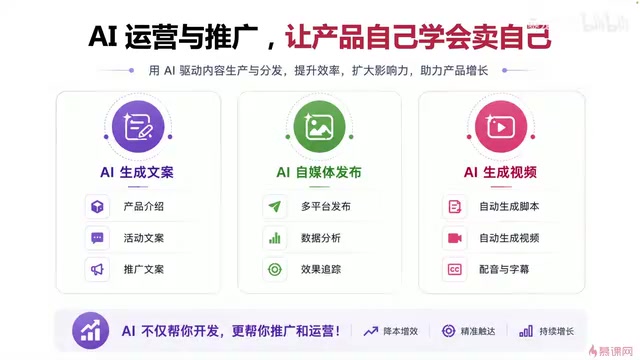
Many people think the job is done once the product is built, but the real challenge often lies in promotion. Today, AI has deeply penetrated the operations domain and can:
- Automatically generate blog and newsletter articles
- Automatically generate marketing copy
- Automatically generate video scripts
- Even automatically generate product promotional videos
In other words, AI can help a product "promote itself." This relies on the content generation capabilities of LLMs, the visual creation power of AI video generation tools (such as Sora, Kling, etc.), and the integration of automated publishing toolchains. The maturation of these technologies is driving the marginal cost of content marketing toward zero. The truly formidable individuals of the future will be hybrid talents who possess both development skills and AI operations capabilities.
The Era of Opportunity for Super Individuals
After mastering full-chain Vibe Coding development, you'll possess six core competencies: the ability to independently develop products, AI full-chain collaboration skills, AI engineering capabilities, multi-platform development skills, AI automated operations abilities, and most critically — the ability to build products as a one-person team.
Over the next few years, AI will inevitably eliminate a massive amount of repetitive work, but it will simultaneously give rise to a wave of super individuals, one-person companies, and AI entrepreneurs. The concept of a "super individual" refers to a new type of creator who leverages AI and other technological multipliers to single-handedly accomplish what previously required an entire team. Since 2024, a large number of one-person companies generating over a million dollars in annual revenue have emerged globally, with the vast majority deeply relying on AI tools for product development and business operations. For many people, the future may no longer be about finding a job, but about using AI to build their own products.
This course, therefore, isn't merely a tool tutorial — it's more like a practical course on building a one-person company in the AI era. Its two objectives — mastering AI-engineered development and using AI to create value and generate income — directly address the most pressing needs of our time.
Opportunity always belongs to those who prepare in advance. As AI continues to lower technical barriers, whether you can seize this wave of opportunity depends on whether you're willing to step into the AI development era right now.
Key Takeaways
Related articles

Claude Autonomously Designs Proteins with 35% Success Rate, Far Exceeding Human Expert Performance
Anthropic's Claude achieves 35% wet-lab success rate in autonomous protein design, far surpassing the 10-15% human expert average, signaling AI's move toward real scientific productivity.

Perplexity Discover's Multilingual Support Suddenly Disappears — Why Are International Users Upset?
Perplexity Discover's multilingual news feature suddenly dropped non-English support, frustrating international users. We analyze possible causes and the broader challenges of AI product internationalization.

GitHub Daily · August 20: Mojo Tops the Charts & The Local-First Open Source Rebellion
GitHub Trending Aug 20: Mojo tops charts for AI compute stack ambitions, OpenLogi surges 1225 stars with local-first philosophy, and privacy rebellion dominates.