Vibe Coding Shakes Up the Synth World: Will Open Source Become the New Normal?

AI coding agents lower the barrier to synth firmware reverse engineering, sparking upheaval and polarized manufacturer strategies.
The emergence of AI coding agents and tools like Reverse Engineer Anything has significantly lowered the barrier to reverse engineering and modding firmware for music devices such as synthesizers and drum machines, causing upheaval in the hardware world. Firmware modification that once required professional embedded engineers can now be rapidly produced by AI agents from natural language descriptions. Manufacturer responses have diverged: Roland remains silent, while some actively embrace the modding community. The core question is whether vibe coding will make open source the new normal for synthesizers. Tool democratization is forcing manufacturers to reassess firmware openness, but business models, safety responsibilities, and after-sales systems remain real concerns—whether the outcome is openness or tightening remains to be seen.
A Hardware Industry Upheaval Sparked by AI Coding Agents
When powerful vibe-coding agents and a tool called Reverse Engineer Anything emerged, the music equipment world was thrown into disarray. According to an RSS source report, manufacturers are scrambling to figure out how to respond to this wave of disruption.
Vibe coding refers to a development approach where intent is described in natural language and AI agents directly produce runnable code. It lowers the barrier to firmware modification—previously something only professional embedded engineers could touch—to the level of "being able to clearly explain what you want." Synthesizers, drum machines, and similar devices have long been known for closed firmware, but their binaries are no longer an insurmountable wall in the face of AI tools.
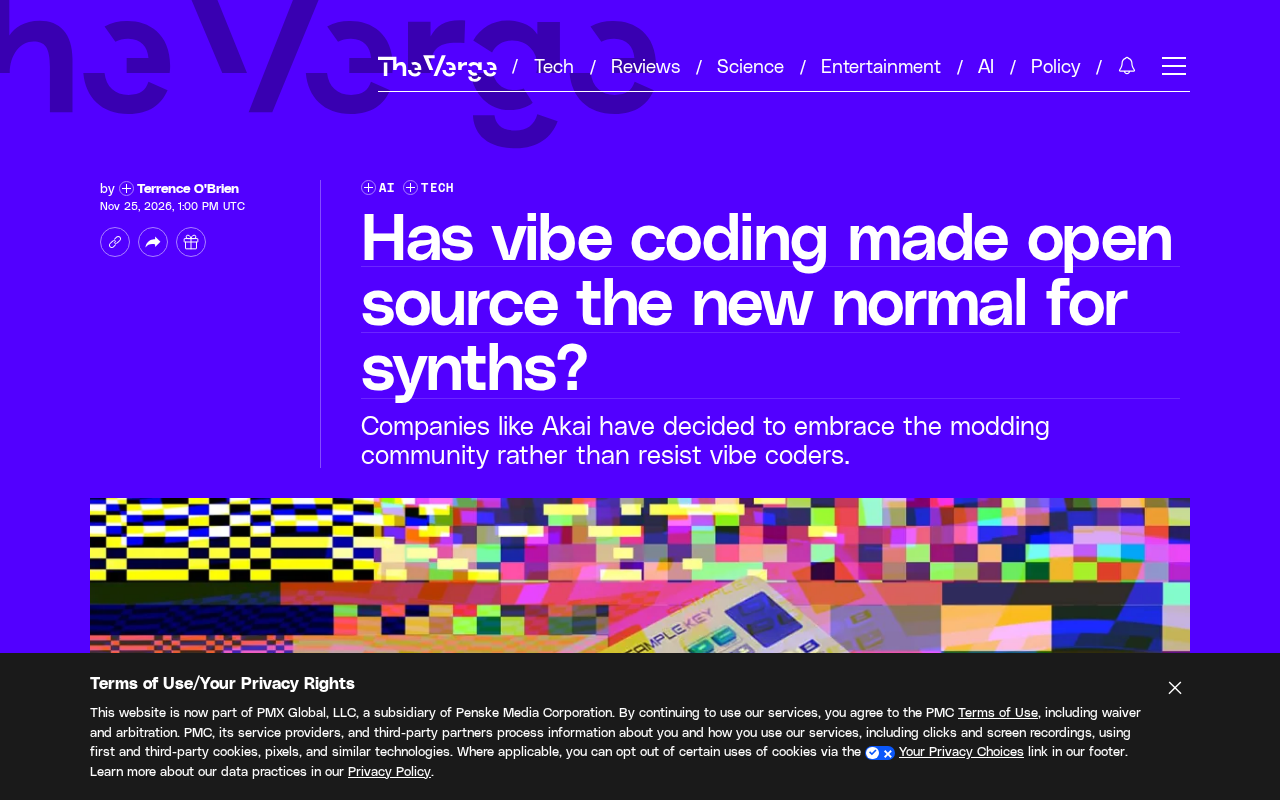
Firmware is the low-level software embedded in hardware devices, typically stored on read-only memory or flash chips, responsible for directly controlling the hardware's behavior and functions. For music devices such as synthesizers and drum machines, firmware determines the sound synthesis algorithms, sequencer logic, MIDI response behavior, and panel control mappings. Manufacturers have long treated firmware as a core asset, often not disclosing source code and rarely providing official modification interfaces. For this reason, when the community wants to change device behavior, it has historically had to rely on reverse engineering—inferring logic and data structures from binary files. What makes AI tools disruptive is that they turn this process from manual work requiring deep assembly and embedded expertise into a workflow that can be guided by natural language and rapidly iterated, significantly weakening firmware's barrier as a "black box."
Manufacturers' Responses Are Polarized
Faced with this wave, hardware manufacturers' attitudes have diverged markedly. The report notes that Roland is currently staying silent and has not yet made a public statement, while other manufacturers have chosen to embrace the modding community and actively move toward modding culture.
This split is not hard to understand. The silent camp worries about warranty and liability issues if firmware is reverse-engineered and rewritten; the embracing camp sees the value of community creativity—modding enthusiasts often uncover use cases that official product teams never anticipated, extending device lifespans. Tools like Reverse Engineer Anything make manufacturers nervous precisely because they turn "reverse engineering" from a craft of a few geeks into a process that can be replicated at scale.
Reverse engineering refers to the process of understanding how a system works by analyzing binaries, protocols, or hardware behavior without source code. In the music equipment field, classic reverse engineering includes unpacking firmware images, identifying processor architecture, locating timbre parameter tables and validation logic, and inferring the format of MIDI system-exclusive messages. Traditionally this has been a highly specialized skill that is time-consuming and experience-dependent. The value of tools like Reverse Engineer Anything lies in automating part of the analysis: they can assist in identifying file structures, locating key functions, or generating readable pseudocode, enabling non-specialist developers to get up to speed relatively quickly. This does not mean reverse engineering has become barrier-free, but it does make "modding at scale" possible and challenges manufacturers' assumptions about firmware protection.
Will Open Source Become the New Normal for Synthesizers?
The core question raised by the original report is: Does vibe coding make open source the new normal for synthesizers? Based on the information currently available, the answer is still taking shape.
On one hand, tool democratization is indeed forcing manufacturers to reconsider how open their firmware should be. When the community can rapidly produce mods with AI agents, a fully closed strategy will become increasingly difficult to sustain, and embracing the community may instead become a differentiating competitive advantage. On the other hand, the business models, safety responsibilities, and after-sales systems of hardware products will not disappear just because the programming approach has changed—manufacturers' concerns have a real basis.
What is certain is that the music equipment world is undergoing a lowering of barriers driven by AI tools, and manufacturers' response strategies will determine whether this change ultimately moves toward openness or tightening.
Note: This article is based on a brief report from a single RSS source. The original material did not provide specific manufacturer case details, tool technical specifications, or community data; the relevant judgments are analysis based on the available information.
Modding culture has existed for a long time in hardware and gaming communities, referring to users spontaneously modifying device hardware or software to extend functionality, change appearance, or fix defects. In the synth world, modding may take the form of replacing panel components, flashing third-party firmware, adding MIDI control capabilities, or developing unofficial patch editors. A healthy modding community can extend product lifecycles, create tutorial and tool ecosystems, and even influence the design of official subsequent versions. But modding also raises issues such as warranty boundaries, device safety, and intellectual property ownership. When manufacturers choose to "embrace" the modding community, it usually means making concessions on documentation, interfaces, or licensing policies in exchange for the added value brought by community innovation; choosing silence or tightening is a conservative balance between commercial control and liability risk.
One-line Summary
AI coding agents lower the barrier to synth firmware reverse engineering, sparking upheaval in the music equipment world and polarized manufacturer strategies.
Paragraph Summary
The emergence of AI coding agents and tools like Reverse Engineer Anything has significantly lowered the barrier to reverse engineering and modding firmware for music devices such as synthesizers and drum machines, causing upheaval in the hardware world. Firmware modification that once required professional embedded engineers can now be rapidly produced as runnable code by AI agents guided by natural language descriptions. Manufacturer responses have diverged: Roland remains silent, while some manufacturers actively embrace the modding community in exchange for community creativity and extended product lifecycles. The core question is whether vibe coding will make open source the new normal for synthesizers. Tool democratization is indeed forcing manufacturers to reassess firmware openness strategies, but hardware business models, safety responsibilities, and after-sales systems remain real concerns—whether the outcome is openness or tightening remains to be seen.
Related articles

A 19-Year-Old's Rental Horror Story: Ceiling Collapse, Bug Infestation, and the Lessons It Taught Me
At 19, my first off-campus rental brought bug infestations, no heat, a collapsed ceiling, and a ruined laptop with no renter's insurance. Here are the hard-won lessons for first-time student renters.

Veda Nurse's Cranial Nerve Exam: Why ASMR Role-Play Is Going Viral
Bilibili creator Veda's cranial nerve exam ASMR video goes viral, blending humor and sensory triggers through nurse role-play. This article analyzes its unique appeal and the audience psychology behind ASMR role-play.

LG Cinebeam AI Review: 120-Inch Giant Screen + 3000 Lumens, a New Choice for the Living Room Theater
LG Cinebeam AI projector review: 3000 ANSI lumens, 4K, 100 inches from about 8 cm and 120 inches from about 18 cm. Built-in webOS, AI Concierge voice recommendations, AI Sound Pro 11.1.2 virtual surround, and Game Optimizer—positioned for fixed living room installation, complementing the portable Cinebeam S.