VibeCode.surf: A Multi-Agent Collaborative AI Code Editor

VibeCode.surf uses multi-agent collaboration to push AI programming from code generation to a build-run-test loop.
VibeCode.surf is a desktop AI code editor focused on multi-agent collaboration, ranking #15 on Product Hunt with 73 upvotes. Its core is a "lead agent + helper agents" hierarchy: the lead agent decomposes tasks, while helper agents write code, run it, and test in a real browser, forming an automated build-run-test loop. All agents run locally, and it supports Claude, GPT, and local models without vendor lock-in. It also displays the cost of each response, making multi-agent token overhead transparent. It targets rapid prototypers and developers seeking to automate repetitive coding and testing, though local setup barriers, browser test stability, and task decomposition quality remain key challenges.
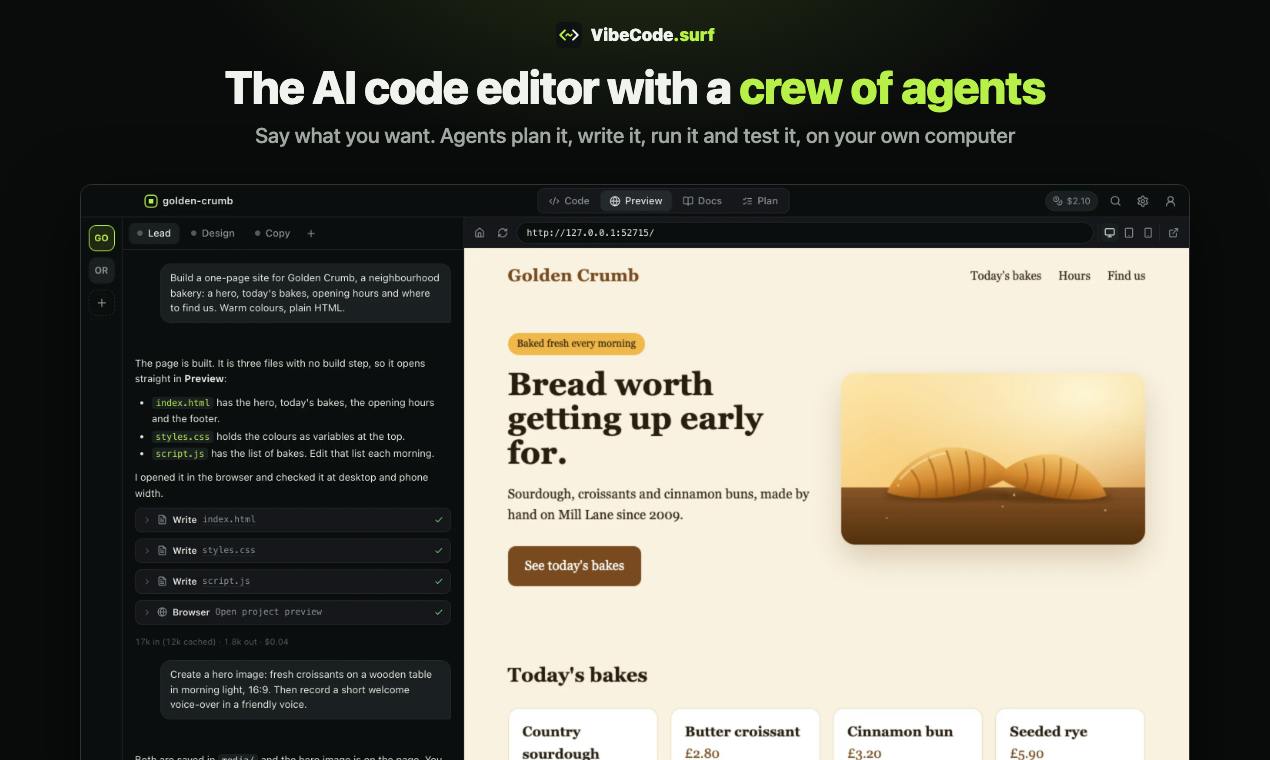
At a time when AI coding tools are increasingly homogeneous, VibeCode.surf attempts to redefine the desktop code editor through "multi-agent collaboration." This product, which earned 73 upvotes and ranked #15 on Product Hunt, targets a simple yet critical pain point: letting AI do more than generate code snippets—it actually gets the app "running."
How Multi-Agents Divide and Collaborate
VibeCode.surf's core design is a hierarchical structure of "lead agent + helper agents." After a user describes requirements in natural language, the lead agent first decomposes the task, then assigns work such as writing code, running, and testing to different helper agents.
The significance of this division of labor: traditional AI editors often stop at "providing code," whereas VibeCode.surf requires agents to run and validate results in a real browser environment. The agents that write code and the agents that test are independent of each other, meaning that when something goes wrong, it is not a matter of self-confirming in isolation but another role discovering and feeding back the problem.
Local Execution and Model Freedom
The product explicitly emphasizes that all agents run on the user's own computer. This is practically appealing to developers who care about code privacy—generation and testing workflows can be completed without uploading code to third-party servers.
For model selection, VibeCode.surf supports everything from Claude and GPT to locally deployed models, without being tied to a single vendor. For teams already subscribed to a certain API or wishing to use local models in an offline environment, this flexibility lowers migration costs and avoids being locked into one ecosystem.
Multi-Agent System is an architectural pattern in which multiple AI agents with independent reasoning capabilities work together to complete a task. Unlike a single large model generating results in one pass, a multi-agent system typically involves role division: an orchestrator is responsible for planning and decomposing tasks, while several workers each handle specific subtasks and exchange intermediate results through messaging. The advantage of this pattern is that it enables parallel processing, mutual verification, and reduced "self-confirmation bias" through role isolation; the cost is that the number of calls and token consumption multiply, and the planning quality of the orchestrator directly determines overall success. The lead agent + helper agents structure adopted by VibeCode.surf is a typical implementation of this paradigm.
Local LLM refers to running open-source or downloadable model weights on the user's own hardware rather than calling a cloud API. Common approaches include loading models locally through tools such as Ollama, LM Studio, and llama.cpp, with inference fully offline and data never leaving the machine. Its advantages are controllable privacy, no per-token billing, and offline usability; its disadvantages are requirements on VRAM and compute, and the code generation quality of small-parameter models is usually weaker than top-tier cloud models. VibeCode.surf supports both cloud (Claude, GPT) and local models, effectively leaving the trade-offs between "quality and cost" and "privacy and convenience" for users to decide themselves.
Cost Transparency: An Underrated Detail
VibeCode.surf displays the cost of each response. The multi-agent architecture naturally means multiplied token consumption—when a task is split among multiple agents, the number of calls far exceeds a single-turn conversation.
Making costs explicit is, in effect, an honest response to users' concerns about "how much AI coding really burns." Developers can use this to judge whether a complex task is worth handing to multiple agents, and can also compare the economics of different model options. This design is not flashy, but it is quite pragmatic in actual use.
Token billing mechanism is the common pricing method for large model APIs: input and output text are split into tokens and billed at a unit price per million tokens, with prices for different models differing by as much as dozens of times. Under a multi-agent architecture, a single user request triggers multiple model calls, and each call often carries a long context (task description, existing code, historical feedback), resulting in token consumption far higher than a single-turn conversation. Therefore, explicitly displaying the cost of each response essentially turns the hidden overhead of "call chain length × context size × model unit price" into a number users can perceive, helping them make trade-offs between quality and budget.
Who It's For and What Challenges It Faces
From its product positioning, VibeCode.surf covers two groups: product and design personnel who want to quickly turn ideas into runnable prototypes—the No-Code category tag also confirms this—and developers who want to use multiple agents to share repetitive coding and testing work.
The challenges are equally obvious. Although local execution on the desktop protects privacy, it places higher demands on environment configuration and dependency installation; real browser testing needs to handle various edge cases, and whether agents can reliably complete the loop remains to be verified. In addition, the quality of "task decomposition" in multi-agent collaboration depends heavily on the lead agent's judgment; poor decomposition can instead amplify errors.
In the highly competitive AI code editor track, VibeCode.surf's differentiator is not model capability itself, but stringing "build—run—test" into an automated pipeline and making costs visible. Whether this path can succeed depends on its stability in real projects.
Real browser environment testing means that agents do more than generate code—they launch the application and, in a real browser (for example, through automation tools such as Playwright and Puppeteer), load pages, click through interactions, and check rendering results and console errors. Compared with static code inspection, this approach can uncover problems that only surface at runtime, such as missing dependencies, broken styles, and API errors. But it also brings engineering complexity: managing browser processes, handling asynchronous loading and network fluctuations, defining criteria for "test passed," and passing readable feedback back to the coding agent upon failure to form a repair loop.
One-line Summary
VibeCode.surf uses multi-agent collaboration to advance AI programming from code generation to a build-run-test loop.
Paragraph Summary
VibeCode.surf is a desktop AI code editor centered on multi-agent collaboration, earning 73 upvotes and ranking #15 on Product Hunt. Its core is a "lead agent + helper agents" hierarchy: the lead agent decomposes tasks, while helper agents handle writing code, running, and testing, validating results in a real browser to form an automated build-run-test loop. The product emphasizes that all agents run on the user's local computer and supports Claude, GPT, and locally deployed models without being tied to a single vendor. Another pragmatic design is displaying the cost of each response, making the token overhead brought by multiple agents transparent. The product targets those needing rapid prototypes and developers hoping to automate repetitive coding and testing, but local environment configuration barriers, browser testing stability, and task decomposition quality remain major challenges.
Related articles

A 19-Year-Old's Rental Horror Story: Ceiling Collapse, Bug Infestation, and the Lessons It Taught Me
At 19, my first off-campus rental brought bug infestations, no heat, a collapsed ceiling, and a ruined laptop with no renter's insurance. Here are the hard-won lessons for first-time student renters.

Veda Nurse's Cranial Nerve Exam: Why ASMR Role-Play Is Going Viral
Bilibili creator Veda's cranial nerve exam ASMR video goes viral, blending humor and sensory triggers through nurse role-play. This article analyzes its unique appeal and the audience psychology behind ASMR role-play.

LG Cinebeam AI Review: 120-Inch Giant Screen + 3000 Lumens, a New Choice for the Living Room Theater
LG Cinebeam AI projector review: 3000 ANSI lumens, 4K, 100 inches from about 8 cm and 120 inches from about 18 cm. Built-in webOS, AI Concierge voice recommendations, AI Sound Pro 11.1.2 virtual surround, and Game Optimizer—positioned for fixed living room installation, complementing the portable Cinebeam S.