VibeDefend: Add Security Guardrails to Your AI Coding Tools with a Single Command

VibeDefend injects security rules into AI coding agents to intercept vulnerabilities and dangerous commands before code is written.
VibeDefend is a real-time security tool by CybeDefend built for AI-assisted coding, installable with a single command into Cursor, Claude Code, Windsurf, and other major AI coding agents. Unlike traditional post-commit scanners, it shifts protection to the moment of code generation — scanning every diff in real time and intercepting high-risk operations like `rm -rf`, `sudo`, and secret file access before they execute. Its core mechanism injects both business rules and security rules into the AI agent's context, guiding the model to generate code with constraints built in. It offers a free plan with no credit card required and earned 157 upvotes on Product Hunt.
AI coding assistants are reshaping developers' daily workflows. Tools like Cursor, Claude Code, Windsurf, and Copilot have made code generation more efficient than ever. But efficiency comes with risk: when AI agents can autonomously write and execute commands, who ensures they won't accidentally delete files, leak secrets, or perform dangerous operations? VibeDefend by CybeDefend attempts to answer that question with a single command.
One Command to Secure Your AI Coding Agent
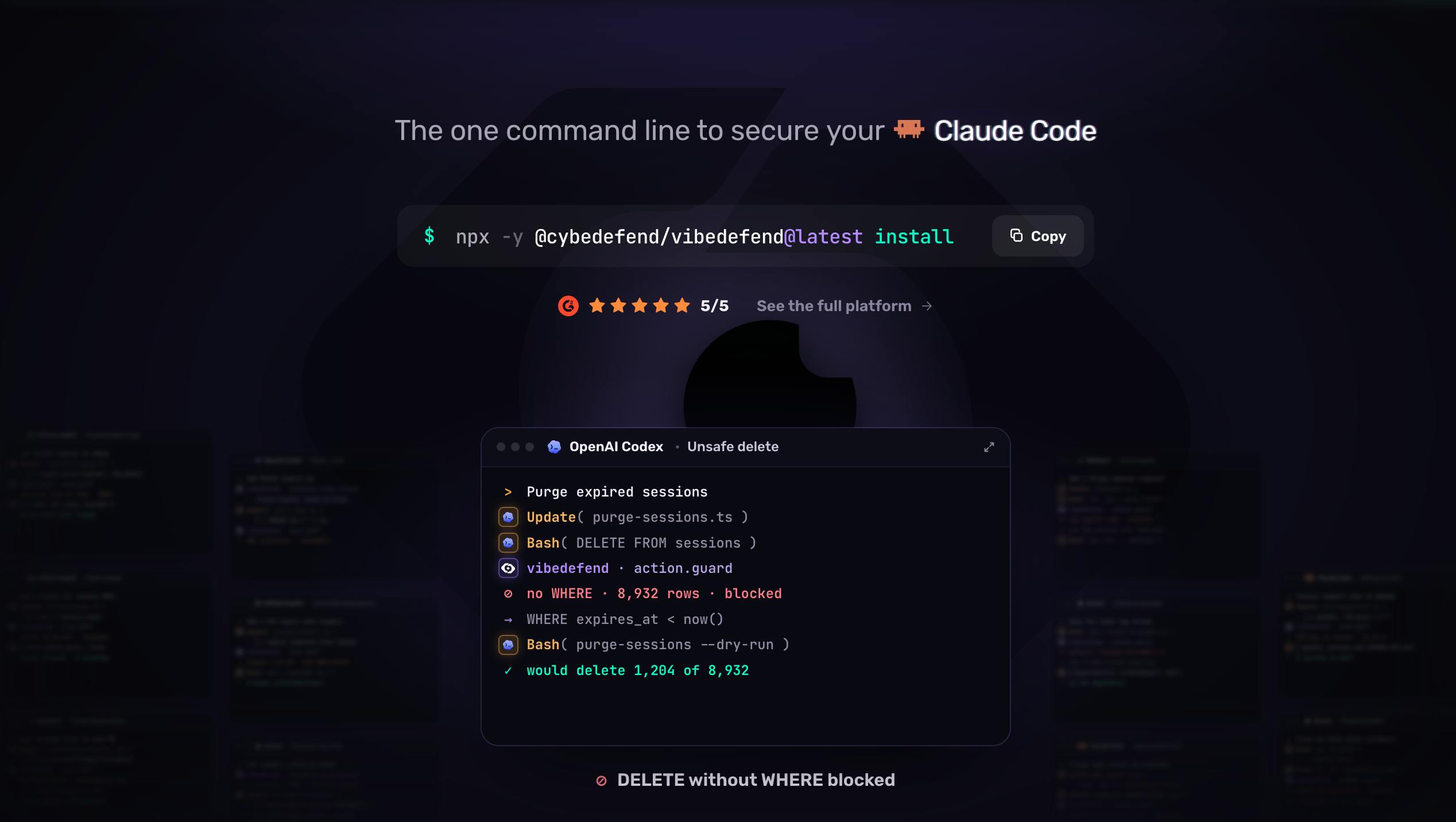
VibeDefend's core pitch is refreshingly direct — install it on your AI coding agent with a single command, with support for Claude Code, Cursor, Windsurf, Copilot, Codex, and other mainstream tools. Once installed, the AI agent references two types of rules when generating code: business rules extracted from your codebase, and a set of predefined security rules.
The elegance of this approach lies in injecting security constraints directly into the AI's context, rather than applying them as an afterthought. After launching on Product Hunt, the product earned 157 upvotes and 34 comments, ranking fourth for the day under the Developer Tools, Security, and Vibe coding categories.
From "Scan After Commit" to "Intercept Before the Line Is Written"
The most fundamental difference between VibeDefend and traditional security scanners is timing. The official description captures it perfectly: "Scanners check code after the commit, this runs before the line is written."
The tool operates on two layers of protection:
Real-Time Diff Scanning
While a file is still open, VibeDefend scans every code change (diff) in real time. This means security issues can be caught before the developer has even committed — or even left the current file — dramatically shrinking the window between when a vulnerability is introduced and when it's discovered.
Dangerous Operation Guards
Even more notable is its "guard" feature. When an AI agent attempts to execute high-risk operations like rm -rf, sudo, or reading secret files, the guard intercepts the command before it actually runs. For developers who grant their AI agents significant autonomy, this interception layer provides a critical safety net — because AI judgment isn't always reliable.
The risk of AI coding agents executing dangerous operations is far from hypothetical. Major agent frameworks like Claude Code, Devin, and OpenAI Codex CLI all support executing shell commands directly in the local terminal — this is central to their ability to "autonomously complete tasks," but it also means a single bad instruction could corrupt a filesystem or leak environment variables. Recursive deletion via rm -rf, privilege escalation via sudo, and reading secrets from directories like .env or ~/.ssh are classic high-risk operation categories. Without an interception layer, once an AI agent generates and executes these commands under the logic of "maximum efficiency," the consequences are often irreversible. The industry has documented several incidents where AI agents accidentally deleted project files or wrote API keys into version control during automated tasks — which is why the principle of least privilege is being re-emphasized in the context of AI agents.
Why "Vibe Coding" Needs Dedicated Security Tools
"Vibe coding" — a term that has gained traction recently — refers to a programming style where developers rely more on intuition and AI assistance to iterate rapidly. This mode boosts output speed, but introduces new security blind spots: AI-generated code may contain hidden vulnerabilities, autonomously executed commands can cause irreversible damage, and traditional CI/CD-stage scanning often comes too late.
VibeDefend's approach is to shift security as far left as possible — not to the CI pipeline, but to the moment the AI puts pen to paper. Feeding both business rules and security rules into the AI agent simultaneously is essentially guiding the AI to "think with constraints" from the start, rather than letting it run free and correcting mistakes afterward.
Getting Started and Pricing
The product offers a free plan with no credit card required, lowering the barrier for individual developers and small teams. For users already on Cursor or Claude Code, the single-command installation process creates almost zero migration friction.
In terms of positioning, VibeDefend is targeting a rapidly growing need: as more teams bring AI coding agents into production environments, figuring out how to maintain security while reaping the efficiency benefits has become an unavoidable challenge. CybeDefend's decision to enter at this intersection shows real market timing awareness.
Summary
VibeDefend represents a new form of AI security tooling — no longer a standalone scanner sitting outside the development workflow, but a real-time guardrail deeply embedded in the AI agent's workflow. Its value proposition is clear: intercept risks before the code is written, and halt dangerous commands before they execute. For developers embracing AI-assisted programming but worried about losing control, tools like this may well become standard equipment. Of course, real-world effectiveness still needs to be validated in actual projects — particularly the accuracy of rule extraction and the false-positive rate of interceptions.
Background
The term "vibe coding" was coined by Andrej Karpathy in early 2025 to describe a programming paradigm highly dependent on large language model (LLM) assistance, where developers rarely review code line by line and instead drive code generation through natural language descriptions of intent. In this model, developers act more as "requirement describers" than "code writers," while AI agents handle completion, refactoring, and even autonomous terminal command execution. This introduces attack surfaces that traditional security models never anticipated: AI may introduce dependency vulnerabilities without the developer noticing, hardcode credentials, or trigger high-privilege operations through tool chaining. LLMs also carry an inherent hallucination risk — they may confidently generate security-sensitive code that looks reasonable but contains logical flaws, and developers in "going with the vibe" mode often lack sufficient motivation to review carefully, allowing vulnerabilities to quietly slip into production.
Traditional code security scanning tools (such as Snyk, SonarQube, and Semgrep) are typically integrated into CI/CD pipelines, triggering after developers commit code or even after a Pull Request is opened. This "shift-left" strategy is an improvement over post-deployment scanning, but still lags in scenarios where AI agents generate code at high speed — an AI might produce hundreds of lines of code and execute side effects in seconds, and discovering problems at the CI stage makes rework extremely costly. More critically, certain operations (like executing destructive shell commands) cause damage before any code is committed, leaving CI scanning powerless. VibeDefend moves the protection window forward to the "code generation stage," essentially treating security rules as context constraints during AI reasoning — placing it firmly in the category of "preventive security" rather than "detective security."
Related articles

Random Pruning of the DPO Computation Graph: 1.4x Training Speedup and Lower Peak Memory
DPO training too slow and memory-hungry? This paper proposes a random pruning framework for the DPO computation graph, sampling independently across position, sequence, and branch dimensions; branch pruning achieves a 1.426x step-time speedup and cuts training time by about 30%, with in-depth attribution of memory and time gains.

Why Does JEPA Underperform MLM in Longitudinal EHR Representation Learning?
New study compares JEPA and MLM for longitudinal EHR representation learning on MIMIC-IV: three JEPA variants train stably without collapse but underperform MLM; target size, not heterogeneity, drives prediction error.

Transfer Learning + Visible Light Communication: A New Approach to Energy-Efficient Indoor Positioning
A study proposes a transfer learning-based visible light communication indoor positioning method, achieving 47% accuracy improvement on the BOSCH factory dataset, 67.5% model efficiency under high noise, and introducing the ME composite metric for energy-efficient positioning in energy-constrained industrial IoT scenarios.