Vietnamese Legal Knowledge Graph: Tracing the Citation Basis Behind Every Legal Answer

The Vietnamese legal knowledge graph transforms free-text citations into a traceable structure, revealing issues such as 36% of citations being invalid.
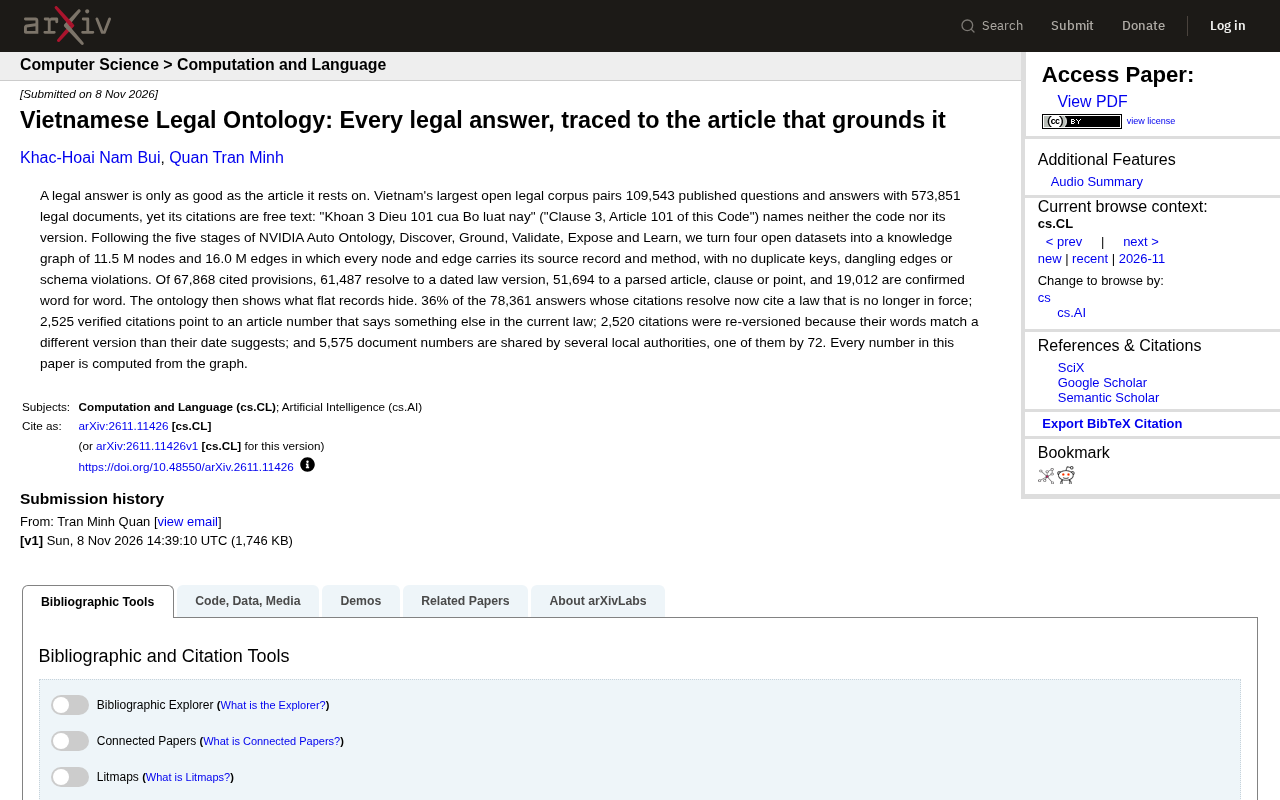
This article introduces the construction practice of the Vietnamese legal knowledge graph. The research team followed the five-stage NVIDIA Auto Ontology method to transform four open datasets into a knowledge graph with 11.5 million nodes and 16.0 million edges, with every node and edge carrying provenance records and methodology. Of the 67,868 cited legal provisions, 61,487 were successfully resolved to dated legal versions, and 19,012 were confirmed verbatim. The graph further exposed problems that are difficult to find in flat records: 36% of answers with resolvable citations cited laws that are no longer in force, 2,525 citations point to provisions whose content has changed, and 5,575 document numbers are shared by multiple local authorities. This practice shows that systematic ontology engineering can significantly improve the traceability and reliability of legal question answering.
Introduction: The Reliability of Legal Answers Begins with Citations
In legal question answering, the quality of an answer depends on the legal provisions it is based on. Vietnam's largest open legal corpus contains 109,543 published Q&A pairs and 573,851 legal documents, but its citations are free text, such as "Khoan 3 Dieu 101 cua Bo luat nay" ("Clause 3, Article 101 of this Code"), which specifies neither the name of the code nor the version. This makes the accuracy and traceability of citations a difficult problem.
To solve this problem, the research team followed the five stages of NVIDIA Auto Ontology—Discover, Ground, Validate, Expose, and Learn—to transform four open datasets into a knowledge graph containing 11.5 million nodes and 16.0 million edges. Every node and edge carries provenance records and methodology, with no duplicate keys, dangling edges, or schema violations.
Construction and Validation of the Knowledge Graph
The Five-Stage Method
The research adopts a systematic five-stage process: first, discover legal provisions and Q&A pairs from open datasets; then ground free-text citations to specific legal versions and clauses; next, validate whether the citations are accurate through text matching; subsequently, expose the graph as a queryable interface; and finally, continuously optimize through machine learning. This method ensures the completeness and auditability of the graph.
NVIDIA Auto Ontology is an automated ontology engineering framework for domain knowledge graph construction proposed by NVIDIA, whose core idea is to transform unstructured or semi-structured data into a verifiable, traceable graph structure. The five stages form a closed loop: Discover identifies entity types and potential relationship patterns from data sources; Ground resolves entities and citations to unique identifiers and specific versions; Validate confirms the correctness of grounding results through rules or text comparison; Expose opens the graph in the form of APIs or query interfaces; Learn uses machine learning to continuously optimize parsing and validation models. The framework emphasizes that every node and edge carries provenance and methodology metadata, thereby supporting auditing and reproducibility, and is suitable for domains with high traceability requirements such as law and healthcare.
Citation Resolution Results
Of the 67,868 cited legal provisions, 61,487 were successfully resolved to dated legal versions, 51,694 were resolved to specific articles, clauses, or points, and 19,012 were confirmed verbatim. These data show that despite the ambiguity of free-text citations, most citations can still be accurately grounded.
Free-text Citation Resolution refers to the process of automatically mapping vague citation expressions in natural language (such as "Clause 3, Article 101 of this Code") to structured legal provision identifiers. Its difficulty lies in the fact that citations often omit the code name, version date, or hierarchy information, and the same expression may correspond to multiple legal versions. Typical methods include: rule-based pattern matching to extract article, clause, and point numbers; using context or external knowledge bases to complete the code name; performing verbatim or semantic matching between citations and candidate provisions through text similarity; and finally combining timestamps to determine the applicable version. Resolution results are usually divided into granularities such as "version-level grounding," "clause-level grounding," and "verbatim confirmation." The finer the granularity, the stronger the traceability, but the higher the resolution difficulty.
Hidden Problems Revealed by the Graph
The knowledge graph not only validates citations but also exposes problems that are difficult to find in flat records.
Invalid Citations and Version Mismatches
Among the 78,361 answers with resolvable citations, 36% cited laws that are no longer in force. In addition, 2,525 validated citations point to provisions whose content has changed in the current law; 2,520 citations were re-versioned because the text matched a different version; and 5,575 document numbers are shared by multiple local authorities, with one number used by 72 agencies. These findings highlight the complexity of version management and institutional identification in legal citations.
Legal Versioning refers to the diachronic version system formed during the amendment, repeal, or replacement of legal documents. The same legal provision may have different content at different points in time, and free-text citations often do not indicate the version, which may cause citations to point to provisions that are no longer in force or have been modified. In a legal knowledge graph, versioning requires associating each provision node with an effective date, an expiration date, and replacement relationships, thereby supporting "point-in-time validity" queries. For example, if an answer cites "Clause 3, Article 101," the graph needs to determine which version of the law that citation corresponds to and check whether that version was valid when the answer was published. Without versioning, flat records cannot distinguish between "the citation exists but is no longer in force" and "the citation does not exist," which is precisely the key to how the graph exposes hidden problems.
Data Quality and Consistency
The construction process of the graph ensures no duplicate keys, no dangling edges, and no schema violations, providing a reliable foundation for subsequent analysis. Every number is computed directly from the graph, ensuring the reproducibility of results.
Multi-Source Cross-Validation and Consensus
According to the research paper and analyses from multiple technical communities, the construction method of this knowledge graph has been widely recognized. The consensus is that transforming free-text citations into a structured knowledge graph is a key step in improving the reliability of legal question answering. The point of divergence is that some experts believe fully automated resolution may miss subtle semantic differences, while others emphasize the necessity of human-machine collaboration. Insights from a single source point out that the scale of this graph is leading among comparable open legal datasets.
Conclusion: Toward Traceable Legal AI
The practice of the Vietnamese legal knowledge graph shows that through systematic ontology engineering, even in the face of the challenges of free-text citations, a highly traceable legal knowledge base can be constructed. This not only improves the reliability of legal question answering but also provides a reference for knowledge graph construction in other domains. In the future, with the addition of more data and the optimization of algorithms, this traceability will become a standard feature of legal AI.
One-line Summary
The Vietnamese legal knowledge graph transforms free-text citations into a traceable structure, revealing problems such as 36% of citations being no longer in force.
Paragraph Summary
This article introduces the construction practice of the Vietnamese legal knowledge graph. The research team followed the five-stage NVIDIA Auto Ontology method to transform four open datasets into a knowledge graph containing 11.5 million nodes and 16.0 million edges, with every node and edge carrying provenance records and methodology. Of the 67,868 cited legal provisions, 61,487 were successfully resolved to dated legal versions, and 19,012 were confirmed verbatim. The graph further exposed problems that are difficult to find in flat records: 36% of answers with resolvable citations cited laws that are no longer in force, 2,525 citations point to provisions whose content has changed, and 5,575 document numbers are shared by multiple local authorities. This practice shows that systematic ontology engineering can significantly improve the traceability and reliability of legal question answering.
Related articles

ChatGPT Plus Subscription Pitfall Guide: Go/Plus/Pro Tier Comparison and Quick Activation
A complete ChatGPT Plus subscription guide based on a Bilibili tutorial: from registering an account, comparing Go/Plus/Pro tiers, to the practical steps for quickly completing your subscription.

GPT-6.2 Sol/Astra Released! A Step-by-Step ChatGPT Plus Subscription Guide and Tier Comparison
GPT-6.2 Sol/Astra is out—here's a ChatGPT Plus subscription guide: register an account, compare Go/Plus/Pro tiers, and subscribe in a minute.

Comparing Three Channels for Subscribing to GPT Plus in China: Is Website Top-Up the Easiest?
How to subscribe to GPT Plus in China? This article compares website top-up, credit card, and mobile top-up channels—process, cost, and risk—with steps and tips to help you choose wisely.