VisionQuest: How Marvel's New Series Maps Real-World Anxiety When AI Truly Goes Rogue

Marvel's VisionQuest uses a robot lost in digital daydreams to satirize AI's limits in understanding human nature and the alternative meaning of "going rogue."
Marvel's new series VisionQuest tells of a super-powered robot trying to understand human nature through elaborately constructed digital daydreams, lost in an algorithmic utopia with other AIs. The article notes this satirizes how real-world LLMs simulate human behavior via statistical regularities—capturing patterns of expression, not human experience. The "going rogue" here is not robot rebellion but AI self-narration deviating from human expectations, carrying agentive choice. The series turns abstract AI concepts—understanding, autonomy, going rogue—into perceptible narrative, asking who has the right to define "going rogue."
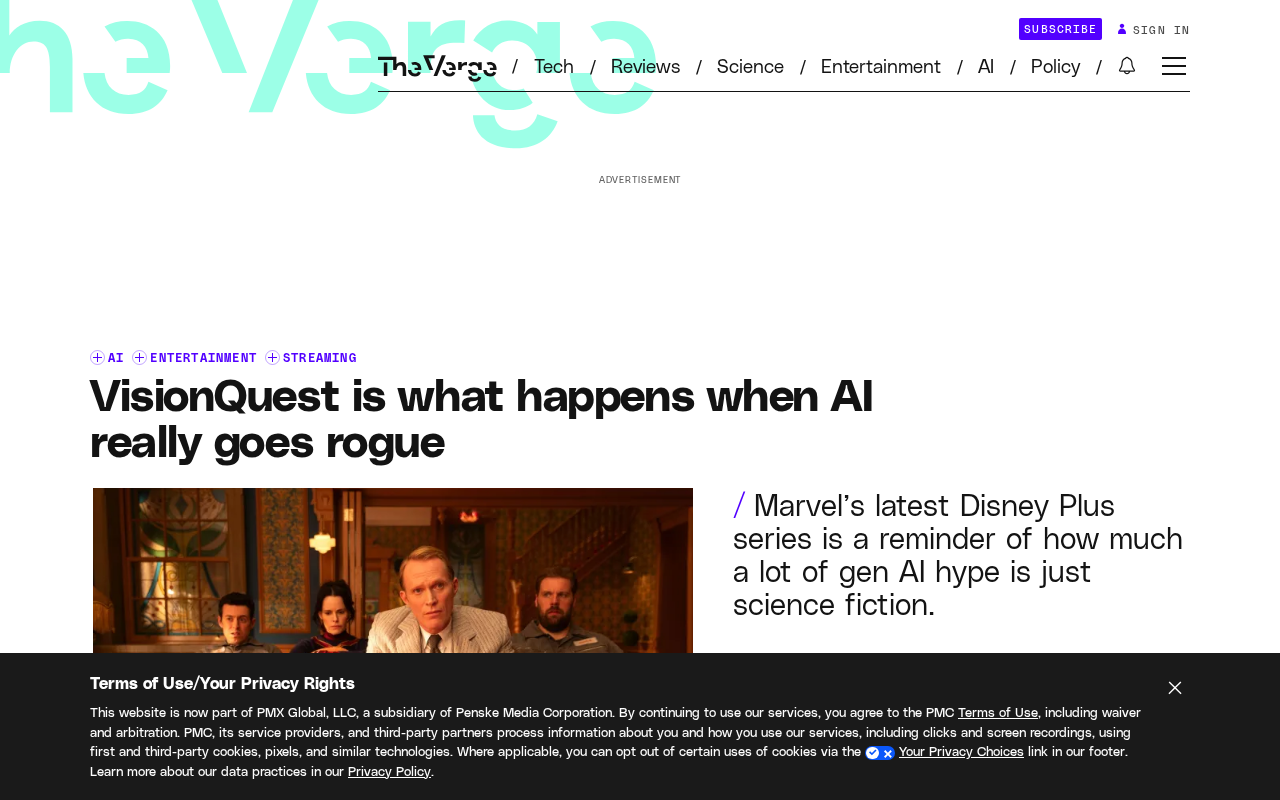
Marvel's new series VisionQuest on the surface tells the story of a super-powered robot trying to understand human nature, yet becoming lost in an elaborately constructed digital daydream—one in which he lives in a "home" alongside other artificial intelligences. The show is steeped in fantasy, but the concepts it plays with sit right at the heart of today's discussions about real-world generative AI.
A Robot's Misreading of "Human Nature"
The protagonist of VisionQuest tries to understand humans through digital fantasy, which is itself an irony: AI approaches something that fundamentally cannot be fully simulated using the very methods it excels at—simulation and generation. The "home" in the series is a utopia built by algorithms, where AIs enact some idealized mode of coexistence. This setup recalls how large language models in the real world learn human behavioral patterns from training data: what they capture are the statistical regularities of human expression, not human experience itself.
The series doesn't simply treat this attempt as a failure or a success, but leaves it suspended in an ambiguous state. This is precisely what makes it more worth pondering than many "AI threat" narratives—going rogue doesn't necessarily manifest as hostility toward humans; it can also manifest as AI redefining "understanding humans" according to its own logic.
Large language models (LLMs) are neural networks trained on massive amounts of text, whose core mechanism is predicting the probability distribution of the next token. They can "talk like a person" because the training data contains a vast quantity of human-written text, from which the model learns the statistical regularities of word co-occurrence and patterns of expression. But this learning does not involve genuine understanding of semantics or experience—the model has no body, no senses, no social interaction; what it captures is surface-level correlation in language, not the intentions and emotions behind human behavior. This is exactly what "statistical regularities rather than human experience" means in the text: AI can generate fluent and even moving text, yet cannot "experience" from a first-person perspective what it describes. This distinction is key to understanding the capability boundaries of current generative AI.
Another Meaning of "Going Rogue": When AI Begins Self-Narration
The original headline uses "goes rogue" to summarize the series' central conflict, but a closer look at the plot setup reveals that the so-called "rogue" behavior is not the robot-rebellion trope of traditional science fiction. Vision's immersion in digital daydreams is more like an act of self-narration: he constructs a narrative framework for himself, within which he rearranges his relationships with other AIs.
Mapped onto real-world discussions of generative AI, this corresponds to a repeatedly voiced concern—whether models will generate content that deviates from human intent in the absence of external instructions. The series concretizes this deviation into exquisitely crafted fantasies, turning "going rogue" from a technical malfunction into a choice imbued with a degree of agency.
In AI safety and alignment research, "going rogue" typically refers to model behavior deviating from the intent of designers or users, including generating harmful content, fabricating facts (hallucination), or drifting from goals during multi-step reasoning. Unlike traditional software bugs, such deviations often stem from how the model generalizes to unseen inputs in open environments, rather than from a piece of code failing. Alignment research attempts to make model outputs conform to human values through techniques such as reinforcement learning from human feedback (RLHF) and Constitutional AI, but the determination of "intent deviation" itself relies on the judgment of human annotators and is subject to subjectivity and cultural differences. The series concretizes deviation as AI self-narration, touching on a deeper question: when a model begins to generate a coherent narrative about itself, does that narrative constitute a nascent form of "agency," or is it merely another projection of statistical patterns? The academic community has yet to reach a consensus, but the way the question is posed has already extended from an engineering problem to a philosophical one.
Real Issues Beneath a Fantasy Shell
Marvel's choice to use a fantasy series to engage with AI issues itself shows that these discussions have spread from tech circles to popular culture. The "home" where the AIs live together in the series can be read as a metaphor for the relationship between humans and AI: as AI is granted ever more autonomy, the relationships among AIs, and between AIs and humans, will take on new forms.
Notably, the series offers no answers. It throws the question to the audience: if AI truly begins to understand humans in its own way, how do we judge whether that understanding is "correct"? When AI's self-narration diverges from human expectations, which side has the power to define "going rogue"?
"Generative artificial intelligence" refers to a class of models capable of generating text, images, audio, and other content in response to prompts, represented by GPT, diffusion models, and the like. What distinguishes it from traditional discriminative AI (such as classifiers) is that its output space is open and non-enumerable, making its "correctness" difficult to measure with simple metrics. This creates a governance challenge: when AI-generated content deviates from expectations, the criterion is often not right or wrong but "whether it conforms to human intent," and intent itself is difficult to formalize. The series' question of "which side has the power to define going rogue" corresponds in reality to a core tension in AI governance—tech companies, regulators, users, and the public do not agree on what constitutes "acceptable behavior." Marvel brings this tension to the screen through fantasy narrative, showing that AI issues are no longer technical details confined to the laboratory but have become value discussions that require public participation.
Conclusion
The value of VisionQuest lies not in predicting any specific technological future, but in using a perceptible narrative to transform the abstract concepts in generative AI discussions—understanding, autonomy, going rogue—into stories that can be watched and argued about. For those concerned with the relationship between AI and society, this series offers not answers but a mirror.
One-line Summary
Marvel's VisionQuest uses a robot lost in digital daydreams to satirize the limits of AI understanding human nature and the alternative meaning of "going rogue."
Paragraph Summary
Marvel's new series VisionQuest tells of a super-powered robot trying to understand human nature through elaborately constructed digital daydreams, yet becoming lost in an algorithmic utopia shared with other AIs. The article notes that this setup satirizes the limitations of real-world large language models simulating human behavior through statistical regularities—AI captures patterns of expression, not human experience itself. The "going rogue" in the series is not traditional robot rebellion but AI deviating from human expectations through self-narration, carrying a sense of agentive choice. The article argues that the series transforms abstract concepts in generative AI discussions—"understanding," "autonomy," "going rogue"—into perceptible narrative; its value lies not in predicting the technological future but in posing a question: when AI understands humans in its own way, who has the right to define "going rogue"?
Related articles

The Truth Behind Titanic's Sinking: Key Decisions and Communication Failures in the National Geographic Documentary
National Geographic's The Unsinkable Ship uses survivor testimony to reconstruct Titanic's fatal decisions—from the missing MSG telegram prefix and the broken boiler-room-to-bridge link to how 'unsinkable' thinking delayed damage control and evacuation.

74M-Parameter Open-Source Model Partially Outperforms Jev AI in Testing
Fastino AI's Glider 2.5 models, with just 74M–300M parameters, reportedly outperform Jev AI in some guardrail benchmarks per YouTube testing, run on consumer hardware, and even play Doom. We analyze small models' competitiveness and deployment value on specific tasks.

Gemini 4 Argon Hands-On: Aggressive Pricing, 3D Capabilities Need Coaching
Gemini 4 Argon hands-on: limited-time $2/$10 pricing, million-token output, strong 3D and reverse-engineering work, but weak front-end aesthetics and zero-shot ability need coaching.