Vitalik on Digital Minimalism: Subtracting from Information Intake

Vitalik discusses digital minimalism, sparking debate over individual discipline vs. platform responsibility.
Ethereum founder Vitalik Buterin published 'Digital minimalism,' sparking heated discussion on Hacker News. The article approaches from personal information intake strategy, advocating resetting admission thresholds and choosing actively rather than filtering passively. After cutting intake, one must consciously increase deep activities or minimalism becomes posturing. The comment section splits between personal and platform responsibility. Amid AI content at scale, information overload has shifted from a quantitative to a qualitative problem—filtering matters more than acquisition.
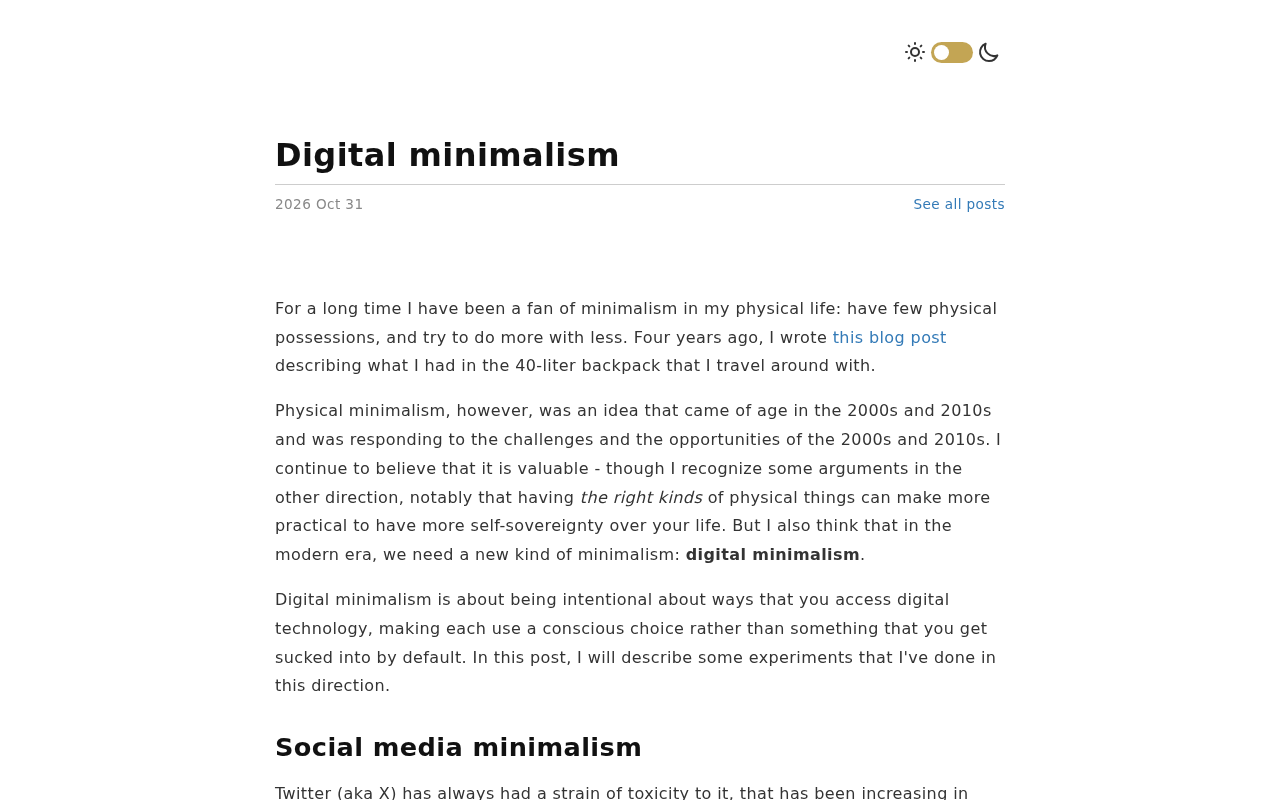
Ethereum founder Vitalik Buterin published an article titled "Digital minimalism" on his personal blog, which quickly sparked widespread discussion on Hacker News—the post garnered 232 points and 170 comments. A technical leader known for high-intensity output talking about "less" creates a certain interesting tension: when information supply far exceeds digestion capacity, reduction isn't passive retreat but a necessary means of maintaining judgment.
Why Digital Minimalism Is Returning to the Center of Discussion
"Digital minimalism" isn't a new concept, but it's being revisited now under different circumstances. In the past, it targeted social media's attention hijacking; today it faces AI-generated content at scale, continuously reinforced push mechanisms, and nearly zero-cost content production. Information is no longer scarce—attention and filtering ability are.
Vitalik's starting point is personal-level information intake strategy, not product design or social critique. Judging from the discussion heat on Hacker News, this "individually actionable" perspective is exactly what readers need—the comment section has both those who agree and share their own subtraction practices, and skeptics who believe personal discipline can't counter platform mechanisms. The two lines of thought aren't in conflict: structural problems don't disappear through individual effort, but individuals can indeed change what information environment they're exposed to.
The concept of Digital Minimalism was systematically proposed by computer science professor Cal Newport in his 2019 book of the same name, preceded by his 2016 article "Quit Social Media. Your Career May Depend on It." Newport's argument isn't simple abstinence but "intentional use of technology": first clarify what values you truly cherish, then decide in reverse which digital tools are worth keeping. This differs fundamentally from traditional "digital detox"—the latter is a periodic pause, the former is long-term structural filtering. Understanding this lineage helps grasp Vitalik's position: he's talking about sustained intake strategy, not short-term detox.
The Subtraction Logic of Information Intake
From "Can I Look at It" to "Is It Worth Looking At"
The core of digital minimalism isn't rejecting technology but resetting the admission threshold. By default, people's information intake is determined by recommendation algorithms; minimalism demands taking back that decision, first asking "can this information change my judgment or action." Information that can't—even if interesting—belongs to entertainment consumption rather than learning input.
This distinction seems simple but is hard to execute because platform design precisely blurs the boundary between the two. Vitalik emphasizes active choice rather than passive filtering—not blocking through tools but through one's own judgment criteria, so low-value content can't get in at the source.
The Output Problem After Subtraction
Cutting intake inevitably brings a secondary question: what to do with the freed-up time. If it's just filled with another form of diversion, minimalism degenerates into posturing. Comments in the discussion point out that the real difficulty lies in "consciously adding after reducing"—redirecting attention to activities like deep reading, writing, and coding that require continuous time blocks.
This is especially real for technical professionals. AI-assisted tools are compressing the time cost of many tasks; if freed time has no clear destination, it's easily swallowed by new information streams. Digital minimalism here is closer to a resource allocation strategy than a lifestyle slogan.
"Deep Work" is also a concept proposed by Newport, referring to high-cognitive-intensity activities conducted in an undisturbed state that can create new value and are hard to replicate. It forms two sides of the same coin with digital minimalism: the purpose of cutting low-value intake is precisely to free up continuous time blocks for deep work. Note that the opposite of deep work isn't rest but "shallow work"—those low-cognitive-demand, transactional tasks that can be completed while distracted. Technical professionals often mistake busyness for productivity, when in fact shallow work is crowding out deep work. The significance of digital minimalism at the output level is redeeming time blocks from shallow affairs.
The Divergence of Two Approaches
Around this discussion, the Hacker News comment section shows a clear divide. One side sees digital minimalism as personal responsibility, emphasizing self-management, deliberate practice, and habit design; the other believes that placing responsibility on individuals is equivalent to assuming platforms needn't be responsible for the attention environment—algorithmic recommendation, infinite scroll, and notification mechanisms are all designed, and individual willpower isn't an equivalent countermeasure.
Based on the exchange between the two positions in the discussion, the essence of the divergence lies in "where change should start." The individual camp believes systemic change is slow and uncontrollable, so managing oneself first is more realistic; the structural camp worries that individual strategies only benefit a few, while most users remain exposed to the same environment. Neither side denies the partial validity of the other; the debate is more about priorities than right versus wrong.
The term "Attention Economy" was first sketched by political economist Herbert Simon in 1971, later developed by scholars like Michael Goldhaber. Its core proposition: information abundance leads to attention scarcity, making attention a scarce resource to be competed for. Platform business models are built precisely on this—user dwell time translates directly into ad revenue, so recommendation algorithms, infinite scroll, and intermittent rewards aren't accidental but attention-capture mechanisms with clear economic motives. Understanding this background makes clear the "structural camp's" concern in the comments: individual discipline faces a system precisely designed with addictiveness as its goal—the two sides aren't in an equal contest.
Practical Significance for the AI Era
AI has sharply reduced the cost of content production and turned "information overload" from a quantitative problem into a qualitative one: low-quality content is no longer the minority but the default background noise. In this environment, the value of digital minimalism lies in providing a reverse filtering framework—not seeking more information sources but actively reducing to a few trustworthy, verifiable sources.
For those using AI tools, this framework applies equally. The tools themselves expand the scale of information that can be processed, but input quality determines the ceiling of output. Reducing noise and retaining high-signal sources improves results more than simply increasing tool invocation frequency. This is also why an article discussing personal habits would receive far more attention than expected in a technical community—it touches the infrastructure beyond tool efficiency.
From a longer perspective, digital minimalism is unlikely to become mainstream practice, but as a persistent corrective force, it will keep reminding people: attention is a limited resource, and any intake without thresholds is a drain on it.
One-line Summary
Vitalik discusses digital minimalism, sparking a debate over individual discipline versus platform responsibility.
Paragraph Summary
Ethereum founder Vitalik Buterin published "Digital minimalism," igniting heated discussion on Hacker News. The article approaches from personal information intake strategy, advocating resetting admission thresholds, choosing actively rather than filtering passively, so low-value content can't get in at the source. After cutting intake, one must also consciously increase deep activities, or minimalism degenerates into posturing. The comment section forms two divergent approaches—personal responsibility and platform responsibility—essentially a priority debate over where change starts. Against the backdrop of AI-generated content at scale, information overload has shifted from a quantitative to a qualitative problem; filtering matters more than acquisition, and digital minimalism provides a reverse filtering framework.
Related articles

Qwen 3.8 Beats Opus at Coding—But Can Your Mac Run It?
Open-source Qwen 3.8 beats Opus 4.6 at coding at just 18GB, but how much Mac memory do you need? 24GB crashes; 32GB is the sweet spot. Full config guide inside.

Claude Code + Agent: Building a Fully Automated AI Testing Loop
Bilibili course breakdown: how test developers can use Claude Code terminal-based Agents to build a fully automated AI testing loop. Compares permission boundaries of terminal vs. device Agents, explains why enterprise projects choose Claude Code over Open Claude-type tools, and outlines the Node.js environment setup and DeepSeek model integration path.

Working with AI Agents Requires Nerves of Steel
The more autonomous AI agents become, the heavier the user's psychological burden. Drawing from a Hacker News discussion, this article analyzes black-box anxiety, behavior drift, and monitoring fatigue in agent collaboration, and offers practical approaches like sandbox isolation, permission control, and task granularity management to reduce cognitive load.