Vivo's First Pro Max Phone: Ultra's Imaging Crown Remains Untouchable

Vivo X500 Pro lacks Ultra's 35mm main camera and ultra-wide, confirming Ultra's imaging stands alone.
Vivo launched its first Pro Max model, the X500 Pro, but the naming upgrade didn't bring an imaging leap. The article notes that the X300 Ultra earns its best-camera-phone reputation from a 35mm narrow-field main camera and the world's strongest ultra-wide lens—both absent on the X500 Pro. Pro Max isn't an Ultra equivalent but a product density supplement in the high-end segment. For consumers, segmentation reduces choice difficulty: ultimate imaging still means Ultra.
Vivo has launched its first Pro Max model, the X500 Pro, attempting to add another piece to its high-end product lineup. But this naming strategy hasn't blurred the boundaries of the product line—instead, it has drawn an even clearer line between the imaging capabilities of Ultra and Pro Max.
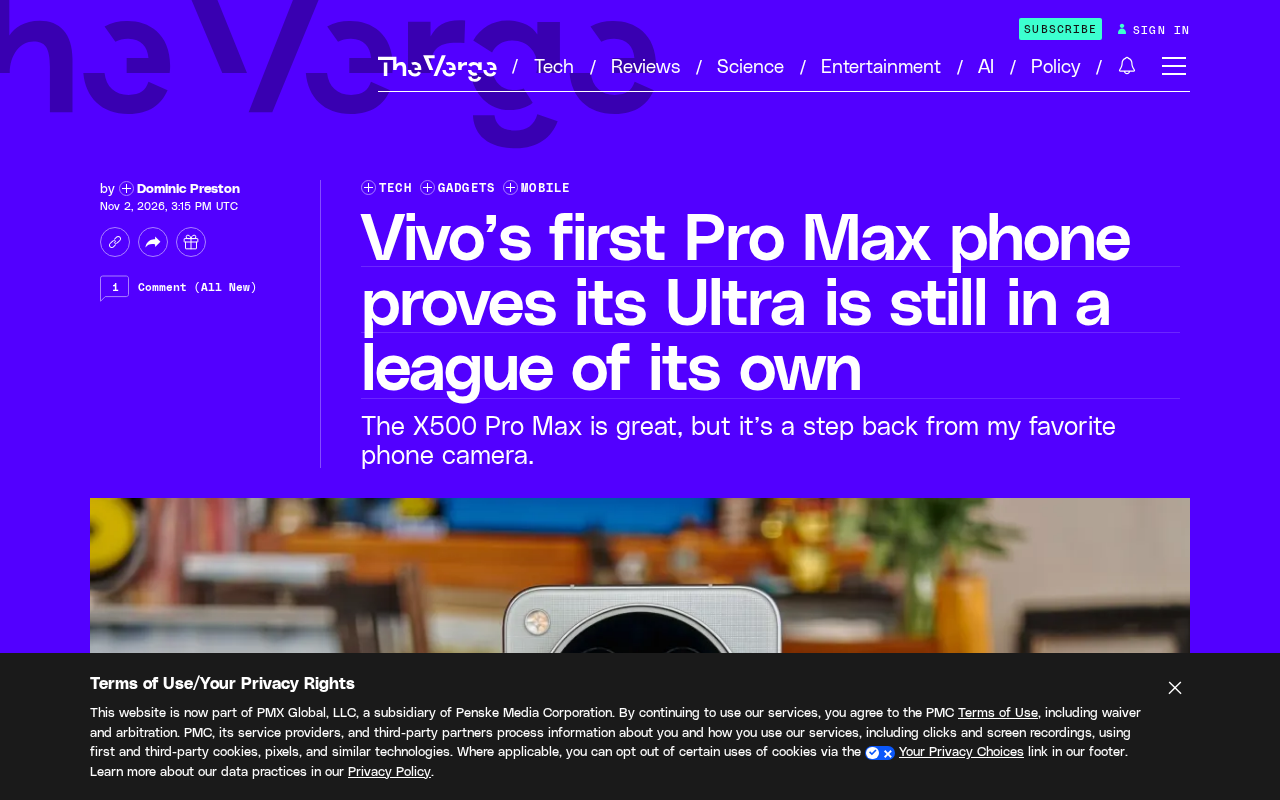
Ultra's Imaging Moat Remains Solid
According to source analysis, the author asserted earlier this year that the Vivo X300 Ultra has the best camera system of any phone, backed by two core factors: a 35mm narrow-field main camera and what remains the most capable ultra-wide lens globally. Neither of these configurations appears on the X500 Pro.
This means Vivo has adopted a deliberate withholding strategy in its imaging flagship product segmentation. As a newly added naming tier, Pro Max hasn't inherited Ultra's imaging DNA, but has been positioned closer to a regular upgrade. For consumers expecting Pro Max to be an Ultra equivalent, this is a reality they need to recognize upfront.
In phone product lines, Ultra typically refers to the most fully equipped, highest-priced top-tier model in a generation, with differentiation often concentrated in imaging modules, materials, and cooling—parts that are hard to trickle down. Pro Max is more of a size and battery enlarged version, with core imaging specs close to Pro. The two aren't simply a "large cup vs. small cup" relationship, but a division of labor between "technology showcase" and "volume driver." Understanding this tier logic explains why the newly named Pro Max won't automatically inherit Ultra's exclusive hardware—manufacturers need to reserve irreplaceable selling points for their most expensive models, otherwise the price gradient loses its support.
35mm Main Camera and Ultra-Wide: Ultra's Two Aces
The 35mm focal length is uncommon among phone main cameras; most manufacturers favor wider angles to cover more scenarios. But 35mm is closer to the human eye's natural perspective, offering inherent compositional advantages in street photography and portraits—one of the key reasons the X300 Ultra was rated the best camera phone.
On the other hand, ultra-wide lenses have long been the weak link in phone imaging, and the X300 Ultra's ultra-wide was described by the source as still the strongest globally. This refusal to compromise on secondary cameras constitutes the key difference that sets Ultra apart from other product lines. The X500 Pro's absence in these two dimensions directly results in its imaging capabilities being incomparable to Ultra.
Phone main camera equivalent focal lengths have long centered on 23mm–26mm—a range that accommodates more environmental information, suitable for landscapes and group shots, but with obvious edge perspective distortion and easily imbalanced subject-to-background ratios. 35mm is a "small wide-angle" with roughly a 63° field of view, between traditional wide-angle and standard lenses: perspective compression is more natural, facial proportions don't distort easily in portraits, and street photography compositions can be achieved without extensive movement. The trade-off is less scene coverage per frame, demanding more from the photographer's positioning. This is why manufacturers bold enough to make 35mm the default main camera focal length typically need extra compensation in sensor size, pixel redundancy, and cropping strategy—which is why this approach remains a minority among flagships.
Ultra-wide lenses on phones typically handle 0.5x–0.6x framing tasks, with equivalent focal lengths around 12mm–14mm. They've long been the weak spot of imaging systems: sensors are generally smaller than the main camera, apertures are smaller, edge quality degradation and chromatic aberration are pronounced, and noise control in low light is difficult. Making it "the best" requires large sensors, freeform lenses, or aspherical lens groups to suppress distortion, combined with multi-frame synthesis and distortion correction algorithms. Ultra-wide quality directly determines the usability of video stabilization cropping, macro mode, and architectural photography—so despite being a secondary camera, it has a leverage effect on the overall imaging experience.
What Pro Max's Positioning Means
From a product line perspective, the addition of Pro Max looks more like Vivo supplementing product density in the high-end price segment rather than replacing Ultra. Through naming tiers, Vivo signals to the market: Ultra remains the ceiling of imaging technology, while Pro Max serves volume and coverage.
For consumers, this segmentation strategy reduces choice difficulty—users pursuing ultimate imaging still have only one path: Ultra, while Pro Max targets those who want a flagship experience but don't need top-tier imaging hardware. The source's conclusion confirms this: the emergence of Pro Max actually proves that Ultra remains in a class of its own.
Editorial View
Phone manufacturers continuously subdividing naming on high-end product lines is essentially using product definition to create price gradients. Vivo's choice to maintain the imaging gap on Pro Max rather than letting the new naming series leapfrog across the board shows its continued confidence in Ultra's brand premium. But this also brings a concern: when Pro Max can't deliver imaging experiences commensurate with Ultra, consumer expectations for the new naming may cool rapidly. Competition among imaging flagships ultimately returns to the hard power of hardware and tuning—naming is just surface.
One-line Summary
Vivo X500 Pro doesn't inherit Ultra's 35mm main camera and ultra-wide, confirming Ultra's imaging stands in a class of its own.
Paragraph Summary
Vivo launched its first Pro Max model, the X500 Pro, but the naming upgrade didn't bring a leap in imaging. The article notes that the X300 Ultra is regarded as the best camera phone thanks to its 35mm narrow-field main camera and the world's strongest ultra-wide lens—both absent on the X500 Pro. So Pro Max isn't an Ultra equivalent, but a product density supplement in the high-end segment, handling volume and coverage. For consumers, segmentation actually reduces choice difficulty: those pursuing ultimate imaging still have only Ultra. The author believes Pro Max's emergence actually proves Ultra remains in a class of its own, while also suggesting that if the new naming lacks commensurate imaging experience, consumer expectations may cool rapidly.
Related articles

Deleted Reddit Post Sparks Debate Over AI Content Moderation
A Reddit post removed with only a 'Removed by Reddit' notice highlights AI content moderation's transparency gaps, misjudgment risks, and appeal challenges for platforms and creators.

DSH + Ollama Local LLM Deployment in Practice: Free Chat with Da Fei Yu
Bilibili creator tests DSH + Ollama local LLM deployment end to end: Ollama install, Xunlei-accelerated downloads, ModelScope GGUF model import, DSH custom API address setup, and a comparison of Qwen 3.5 4B, 8B, Gemma, and other models on 8GB VRAM, with advice on choosing local deployment vs. API calls.

Tested: A $899 Mac Mini vs. a $200/Month AI Subscription
Real-world test of whether an M4 Mac mini can replace a $200 AI subscription: 16GB can't fit large models, and both speed and quality fall short—but privacy, no caps, and near-zero running costs make it an ideal host for an always-on agent. Includes buying advice per configuration and money-saving strategies.