vLLM and XGrammar: How They Optimized Tool Calling for DeepSeek-v4.1

vLLM and XGrammar team up to bring reliable, high-performance tool calling to DeepSeek-v4.1 via constrained decoding.
The vLLM team recently acknowledged XGrammar for their joint work in solving tool-calling reliability and performance challenges when deploying DeepSeek-v4.1 on vLLM. Tool calling requires models to consistently output JSON-schema-compliant structured content — a task that depends on constrained decoding to filter valid tokens during inference. XGrammar specializes in efficient structured generation, minimizing performance overhead while guaranteeing output validity. This integration allows developers to build function-calling agent applications directly on a mature open-source inference stack, lowering the barrier to production deployment and reflecting a broader industry trend toward deep integration between inference frameworks and structured generation engines.
Overview
Recently, the vLLM team publicly acknowledged the XGrammar team for their collaboration in achieving reliable and high-performance tool calling when deploying DeepSeekAd-v4.1 on vLLM. Behind this brief social media post lies a broader trend: the LLM inference serving stack is steadily evolving toward structured output and function-calling capabilities.
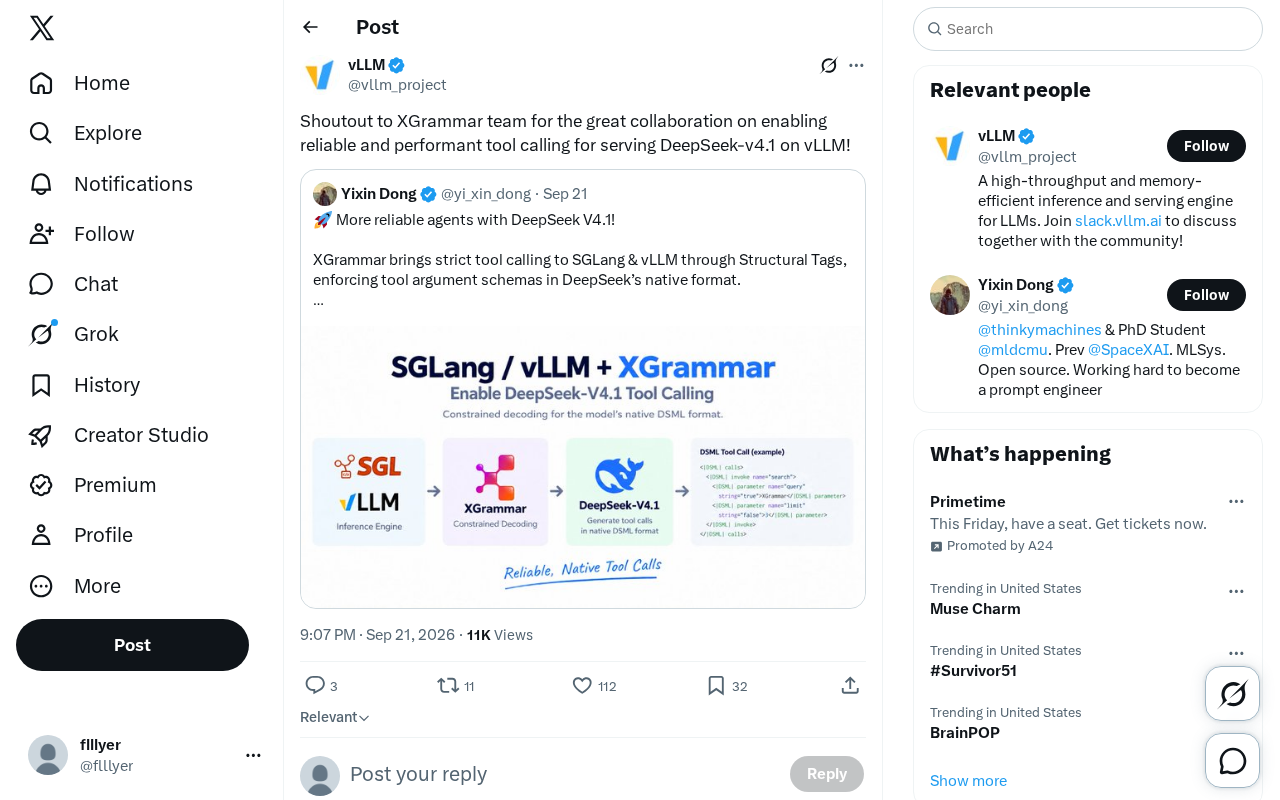
For developers focused on bringing large models into production, this collaboration is worth paying attention to — it signals meaningful improvements in both performance and stability when open-source inference frameworks handle the tool-calling demands of complex AI agent scenarios.
What Is Tool Calling and Structured Generation?
Tool calling (also known as function calling) is a critical capability that enables large language models to move beyond pure text generation and into real-world applications. It allows a model to output structured results — typically JSON — conforming to a specific schema during inference, enabling it to invoke external functions, APIs, or tools to perform tasks like retrieval, computation, and execution.
To ensure models consistently produce valid structured output, constrained decoding is typically required. This is precisely where XGrammar excels — it is a high-efficiency engine dedicated to structured generation that enforces syntactic constraints on output tokens during the decoding phase, guaranteeing that generated results always conform to predefined format specifications and eliminating unparseable invalid outputs.
Constrained decoding is typically implemented using finite state machines (FSMs) or context-free grammars (CFGs). At each decoding step, the engine computes a mask of valid tokens based on the content generated so far and the target schema, allowing the model to sample only from legal candidates. Regardless of the model's probability distribution, the final output is guaranteed to meet format requirements. XGrammar's key innovation is offloading part of the mask computation asynchronously to the CPU and caching common JSON structures — so that when the GPU executes decoding, virtually no additional latency is introduced. This directly addresses the throughput degradation that plagued earlier constrained decoding approaches.
The Value of XGrammar and vLLM's Collaboration
vLLM is one of the most popular open-source LLM inference and serving frameworks, renowned for high-performance features like PagedAttention. Tool calling scenarios place two core demands on the inference engine:
Reliability
Model outputs must strictly conform to the JSON schema required for tool calls — any formatting error will cause downstream parsing to fail. By integrating XGrammar's grammar constraint capabilities, vLLM can guarantee that DeepSeek-v4.1 produces structurally valid output when generating tool calls, significantly reducing error rates.
JSON schema compliance validation is especially critical in tool-calling pipelines. A typical tool call request includes fixed fields such as name (function name) and arguments (a parameter dictionary), where parameter values may also be subject to constraints like enumerations or numeric ranges. If the model generates freely, even a single extra comma or missing quotation mark will cause json.loads() to throw an exception, triggering error handling or even crashing the entire agent workflow. In high-concurrency inference services, these low-probability but real formatting errors are amplified with request volume, becoming a long-tail reliability issue that affects service availability.
Performance
If implemented poorly, constrained decoding introduces additional latency that drags down overall throughput. One of XGrammar's core design goals is to minimize performance overhead while maintaining constraint correctness. The emphasis on "performant" in this collaboration indicates that both teams have made targeted engineering optimizations to constrained decoding speed.
What This Means for DeepSeek-v4.1 Deployments
The DeepSeek model series has significant influence in the open-source community, and reliable tool-calling support for DeepSeek-v4.1 on vLLM means the barrier to building agent applications on top of this model is now lower than ever. Developers can directly leverage a mature open-source stack to deploy services with function-calling capabilities, without needing to handle the complexities of constrained decoding themselves.
This kind of framework-level capability improvement often accelerates real-world adoption more effectively than pure model capability gains, because it directly improves stability and maintainability in production environments.
DeepSeek-v4.1 is a large-scale model based on a Mixture of Experts (MoE) architecture, where the number of activated parameters is far smaller than the total, giving it higher inference efficiency than comparable dense models. However, scheduling MoE models in batch inference frameworks like vLLM already carries some inherent complexity — layering constrained decoding on top raises the bar further for memory management and dynamic batching. The fact that this vLLM–XGrammar integration covers this model suggests the joint solution has a degree of architectural generality, extending beyond just standard dense Transformer tool-calling scenarios.
Summary
Though it was just a brief acknowledgment post, it reflects an important direction in the open-source inference ecosystem: deep integration between inference frameworks and structured generation engines. The collaboration between vLLM and XGrammar delivers tool calling for DeepSeek-v4.1 that is both reliable and performant, providing a more solid infrastructure foundation for building production-grade agent applications.
Note: This article is based on a single social media source. Specific technical details and performance figures await further official disclosure.
Related articles

Gaussian Process Bandit Optimization: Exploration Strategies and Inference Regret Guarantees
Cumulative regret guarantees in Bayesian optimization fail to reflect final recommendation quality. This article examines a new study that provides inference regret guarantees for Gaussian process bandit optimization through exploration query strategies and fill distance analysis, validated on hyperparameter optimization and control tasks.

The Most Detailed Codex Guide on Bilibili: From Installation to Real-World Practice
The most detailed Codex guide on Bilibili: from app store installation to daily work mode configuration, with a real coffee shop project demonstrating file organization, data extraction, dashboard creation, and other practical tasks. Learn to use Plan Mode and desktop pets to leverage Codex efficiently.

Appearance Compensation in Volume Rendering: Why RGB Accuracy Cannot Guarantee Density Correctness
Volume rendering research reveals that volumetric data perfectly reproducing external RGB views may still contain density errors: appearance compensation can double central density and keep external rays unchanged even when L2 error exceeds 14.52%. Density recovery depends on appearance capacity, spatial resolution, and measurement design.