vLLM Conference Wraps Up: The Explosive Energy of the Open-Source Inference Community

The vLLM Conference sold out with lines out the door, showcasing the booming open-source LLM inference ecosystem.
The vLLM Conference wrapped up to massive turnout, with multiple sessions drawing crowds that lined up out the door — and all recordings are now publicly available. vLLM is the leading open-source LLM inference framework, built around PagedAttention, a paged memory management system that dramatically boosts concurrent throughput and cuts inference costs at scale. The conference's overwhelming popularity reflects genuine engineering demand as well as the irreplaceable value of in-person exchange — face-to-face discussions and spontaneous hallway conversations spark connections that online collaboration rarely achieves. For practitioners tracking inference optimization, the publicly released session recordings are an essential first-hand resource.
vLLM Conference: Standing-Room-Only Community Excitement
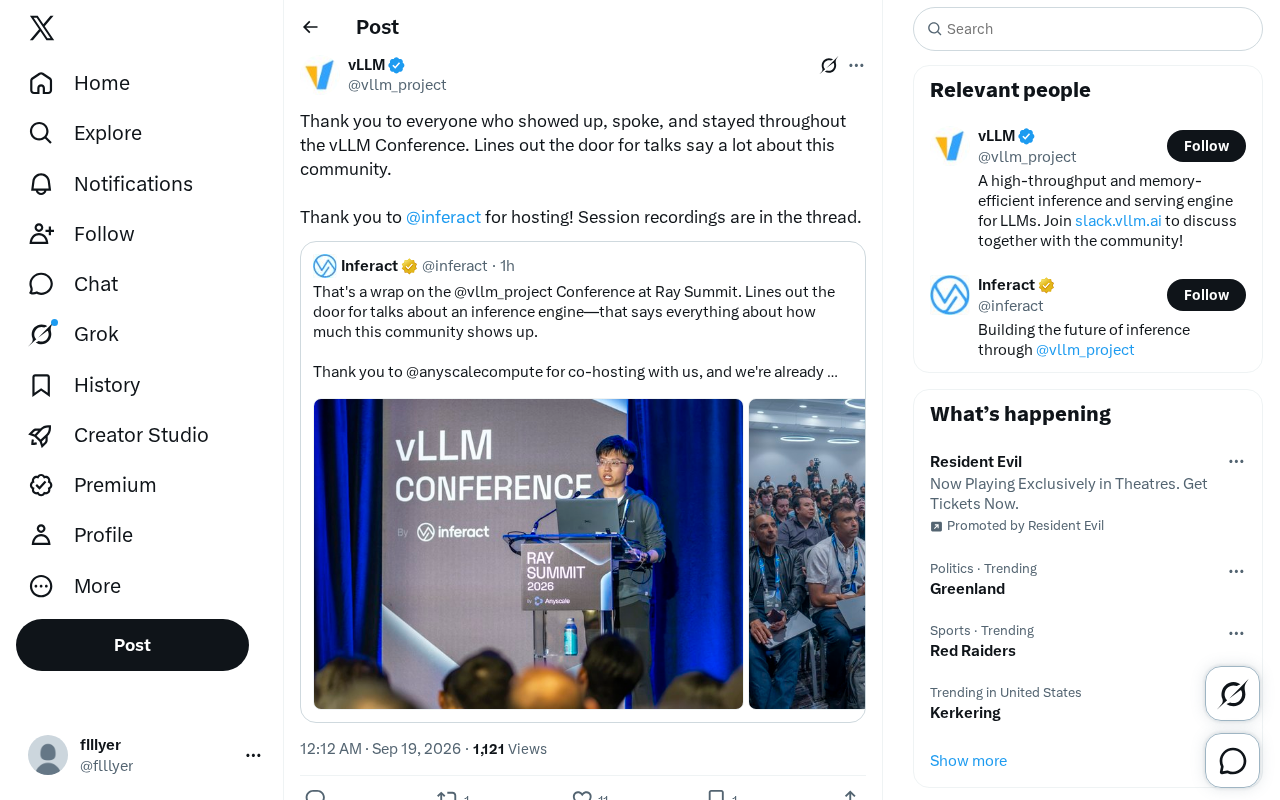
The vLLM Conference has come to a successful close. According to the organizers' post-event message on social media, the event drew massive crowds — multiple sessions had attendees "lining up out the door" — a detail that speaks volumes about the current vitality and influence of the vLLM community.
The organizers extended special thanks to everyone who attended, presented, and participated throughout the event, as well as to the host venue @inferact. Video recordings of all sessions have been made available in the official thread for developers who couldn't attend in person.
For practitioners focused on LLM inference optimization, the fact that an in-person conference dedicated to an open-source inference engine attracted lines out the door reflects just how central efficient inference has become to the AI infrastructure landscape.
Why vLLM Commands Such Enormous Attention
vLLM is one of the most widely adopted open-source frameworks for large language model inference and serving. It is renowned for core innovations like PagedAttention, which delivers dramatically higher throughput and better resource utilization in production environments through more granular GPU memory management and request batching.
As large models move from the lab into large-scale deployment, inference cost, latency, and concurrency have become the critical pain points for enterprise adoption. vLLM directly addresses these needs, making it the default choice for many teams deploying open-source models. A packed technical conference centered on it is simply a reflection of that real-world demand at the community level.
"The lines out the door say a lot" — the organizers' understated remark points to a developer ecosystem that is growing at a rapid pace. When more and more engineers gather to exchange ideas around the same open-source toolchain, the tool's vitality and the correctness of its technical direction are simultaneously validated.
PagedAttention is vLLM's landmark innovation, inspired by the virtual memory and paging mechanisms found in operating systems. Traditional LLM inference frameworks pre-allocate contiguous GPU memory blocks for each request's KV Cache (key-value cache), leading to significant memory fragmentation and waste — especially problematic in high-concurrency, variable-length sequence scenarios. PagedAttention breaks the KV Cache into fixed-size, non-contiguous "pages," allowing different requests to share common prefix cache pages and substantially reducing memory consumption. Benchmarks show that vLLM can deliver several times the inference throughput of naive implementations on the same hardware. This breakthrough at the systems level is the technical foundation that enabled vLLM to rapidly become the go-to tool for production deployments.
The Value of In-Person Open-Source Community Gatherings
Online collaboration is the norm for open-source projects, but in-person conferences serve an irreplaceable role. Face-to-face technical presentations, impromptu hallway conversations, and direct dialogue between contributors and users often spark the kind of deep connections that are difficult to form online.
All session recordings from the conference have been made publicly available, continuing the open-source community's longstanding tradition of knowledge sharing. Even those who couldn't attend in person can still access first-hand technical insights through the recordings. This spirit of "openness" is reflected not only in the code, but also in how conference content is distributed.
For readers looking to dive into vLLM's technical details or understand its future direction, following the session recordings released in the official thread is highly recommended — they offer first-hand information on inference optimization, deployment practices, and community roadmap planning.
Since being open-sourced in 2023 by a team from UC Berkeley, vLLM has attracted hundreds of external contributors and built an active GitHub community and Discord channel. Its ecosystem spans a model compatibility layer (supporting major architectures like LLaMA, Mistral, and Qwen), multiple deployment interfaces (OpenAI-compatible API, async engine, etc.), and hardware backend extensions (NVIDIA GPU, AMD ROCm, and limited TPU support). In-person conferences serve as "offline nodes" for this distributed community, giving core contributors, enterprise users, and researchers rare opportunities for synchronous exchange — helping drive roadmap discussions, align priorities, and accelerate the cycle from conference consensus to merged code.
Wrap-Up
Given the limited source material available, this article is more of an observation on the conference's energy and community significance than a breakdown of specific technical sessions. But starting from the phenomenon of sold-out demand alone, the vigorous appetite for open-source inference engines is already abundantly clear. Readers who want to go deeper can continue following the content through the officially released session recordings.
Related articles

Meta vs. Publishers: The AI Data Battle Over Terms of Service Changes and the Future of the Internet
Meta changed its business account terms to allow AI training on linked website data, sparking backlash from publishers and creators. Industry groups demanded negotiations, forcing Meta to remove 'training' wording and delay the effective date. The dispute reveals the deeper battle over data authorization and the future of the internet in the AI era.

When Outside Xbox Meets Blood on the Clocktower: A Legion Match in Minecraft
Outside Xbox guests Ellen and Mike play Minecraft Blood on the Clocktower in a Legion game. How can three good players fight an evil majority amid information noise? This article breaks down Legion mechanics, information-role mind games, and the endgame reversal.

Kimi K3.1 Hands-On Test: Open-Source Model Nears Opus, Video Generation Steals the Show
Kimi K3.1 completed motion graphics, 3D rendering, mini-games, and video generation in a live test. Analysis of its 2.8T MoE architecture, gap vs Opus/GPT, and hidden video generation.